
A UAE villa is a target. The combination of year-round warmth, proximity to landscaped gardens, shared boundary walls, drainage infrastructure, and a residential environment that includes food, moisture, and shelter makes villas in Dubai, Sharjah, and Ajman ideal habitat for the full range of pest species common to the region. Most villa owners discover they have a pest problem when it is already established. This guide covers how to identify what you are dealing with, what professional treatment actually involves, why some pests come back without the right approach, and how to make sure your villa stays protected throughout the year.
Why UAE villas attract pests year-round — and what makes the problem worse in summer
The UAE climate does not have a pest season in the way that colder countries do. In Europe or North America, winter temperatures kill or drive pests into dormancy. In Dubai, Sharjah, and Ajman, the temperature stays above the threshold for active pest reproduction and feeding every month of the year. There is no natural reset. Cockroaches breed continuously. Ants remain active. Termites continue working through wood and plaster without interruption.
What changes with the seasons in the UAE is the direction pests move. During summer — when outdoor temperatures exceed 45°C — pests that have been living in gardens, drainage infrastructure, and boundary walls move inward. They follow air conditioning, moisture, and food sources. This is when villa owners suddenly discover cockroaches in kitchen cupboards, ants tracking across bathroom tiles, and rodents scratching behind walls. The infestation was not sudden. The pests were present in the surrounding environment throughout the year and moved inside when the outdoor conditions became hostile.
The design of UAE villas compounds this. Shared boundary walls connect directly to neighbouring properties. Gardens and landscaping create green corridors along which ants, cockroaches, and rats move from property to property. Drainage infrastructure — septic tanks, sewage connections, and irrigation lines — creates underground networks that cockroach and rodent populations use as protected highways. A villa with immaculate pest control that shares a boundary wall with a property that is not treated will experience re-infestation regardless of what treatments were applied inside.
This is why one-time pest treatments in UAE villas rarely provide lasting results. Effective villa pest control is a programme — regular, professional treatment at the right intervals, using the right products for each pest species present, addressing both interior and exterior environments.
Total Defence provides comprehensive pest control for villas across Dubai, Sharjah, and Ajman. Our pest control services are tailored to the UAE environment and the specific pest pressures that villa properties face. This guide covers everything you need to know.
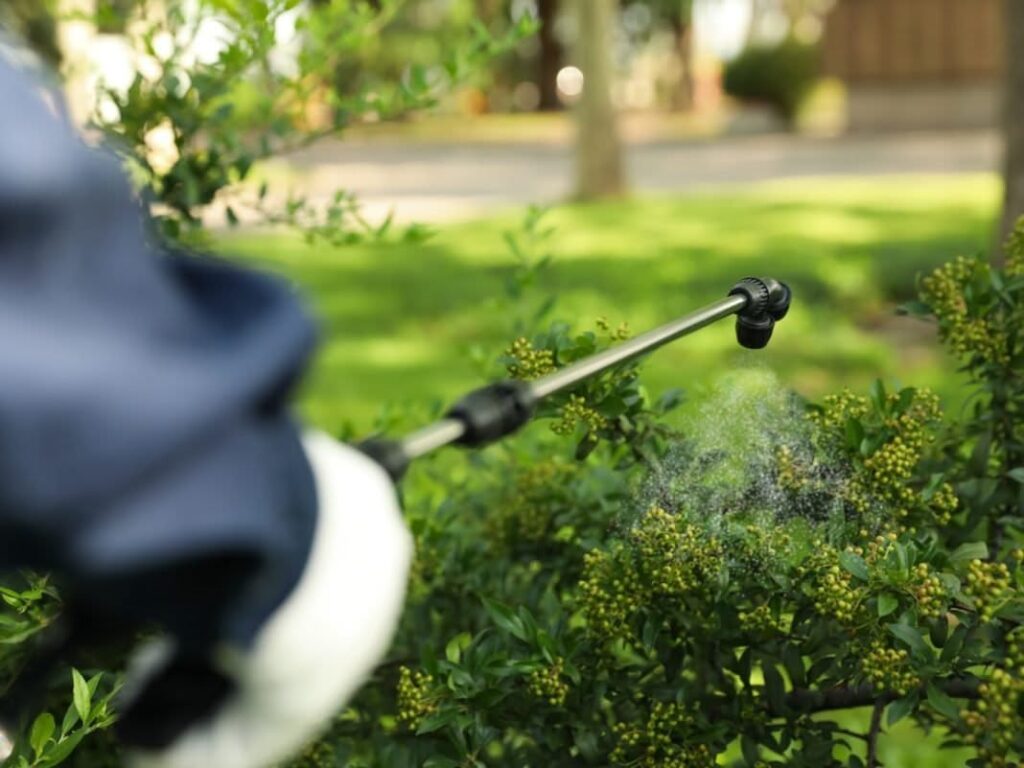
The most common pests found in UAE villas — and what they tell you
Understanding which pest you are dealing with is the starting point for effective control. Different species respond to different treatments, breed in different locations, and indicate different underlying conditions in the property.
Cockroaches are the most frequently encountered pest in UAE villas and the most misunderstood. There are two species that dominate in the region. The German cockroach (Blattella germanica) — small, light brown, with two dark stripes on the pronotum — lives almost exclusively indoors, preferring the warm, humid microclimate of kitchen cabinets, behind appliances, and under sinks. A German cockroach infestation is entirely indoor and spreads rapidly; a single gravid female carries an egg case of up to 40 eggs. The American cockroach (Periplaneta americana) — large, reddish-brown — is the one that enters villas from outside. It lives in drainage systems, gardens, and beneath the property and comes inside in search of food and water. If you see large cockroaches in your kitchen at night, they are almost certainly entering from the drainage or garden and returning outside. If you see small cockroaches, you have an established indoor infestation that needs different treatment.
Bed bugs (Cimex lectularius) are invisible during daylight, which is why most villa owners discover them after weeks or months of unexplained bites. They hide in mattress seams, behind headboards, in gaps in bed frames, behind picture frames, and in upholstered furniture. They do not come from outside — they are introduced into a property via second-hand furniture, luggage, or clothing. Once established, they spread rapidly through a villa. A bed bug problem does not resolve on its own and does not respond to over-the-counter sprays. Professional heat treatment or targeted residual insecticide application is required.
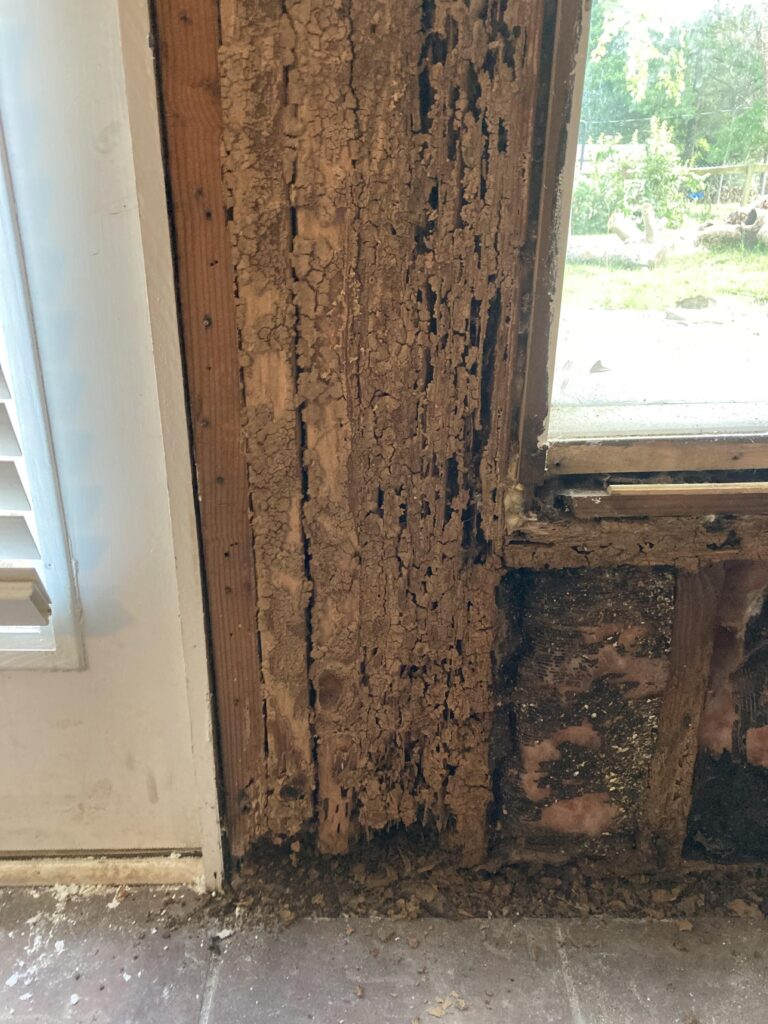
Termites are the pest that causes the most structural financial damage and the least visible activity during active infestation. Subterranean termites — the species most common in UAE soil — build colonies underground and send foraging workers up through the soil and along any contact point between soil and timber. They consume wood from the inside, leaving a paper-thin shell that looks intact from the outside. By the time termite damage is visually obvious in a villa — blistered paint, hollow-sounding timbers, mud tunnels on walls — the colony has typically been active for a year or more. Early detection through a professional inspection is the only way to catch termite activity before significant damage occurs.
Rats and mice in UAE villas are almost always entering from outside — through gaps in exterior walls, drainage connections, AC duct openings, and ground-level vents. Roof rats (Rattus rattus) — slim, agile, good climbers — typically gain access through roof spaces and upper-floor openings. Brown rats (Rattus norvegicus) — larger, ground-burrowing — enter through drainage and ground-level gaps. Both are serious: they damage wiring, contaminate food storage, and carry disease. Rodent activity in a villa is almost never limited to the building itself; the entry points that allow rodents in continue to allow rodents in until they are sealed. Treatment without exclusion is a holding measure, not a solution.
Ants in UAE villas present as indoor trails — across kitchen counters, along bathroom grout lines, around plumbing penetrations. The species most common in UAE villas are the Argentine ant and various Camponotus (carpenter ant) species. Ant colonies are typically located outside the villa in garden soil, beneath paving, or in boundary walls — the ants you see inside are foragers. Surface spraying of ants rarely works; it kills the foragers visible on the surface without reaching the colony. Gel baiting — which the foragers carry back to the colony — is far more effective.
Mosquitoes in UAE villas breed in standing water — plant pot trays, neglected swimming pool corners, garden irrigation puddles, and drainage outlets. The tiger mosquito (Aedes albopictus) is increasingly common in the UAE and bites during daylight as well as at dusk. A persistent mosquito problem in a villa garden almost always has a local breeding source on the property.
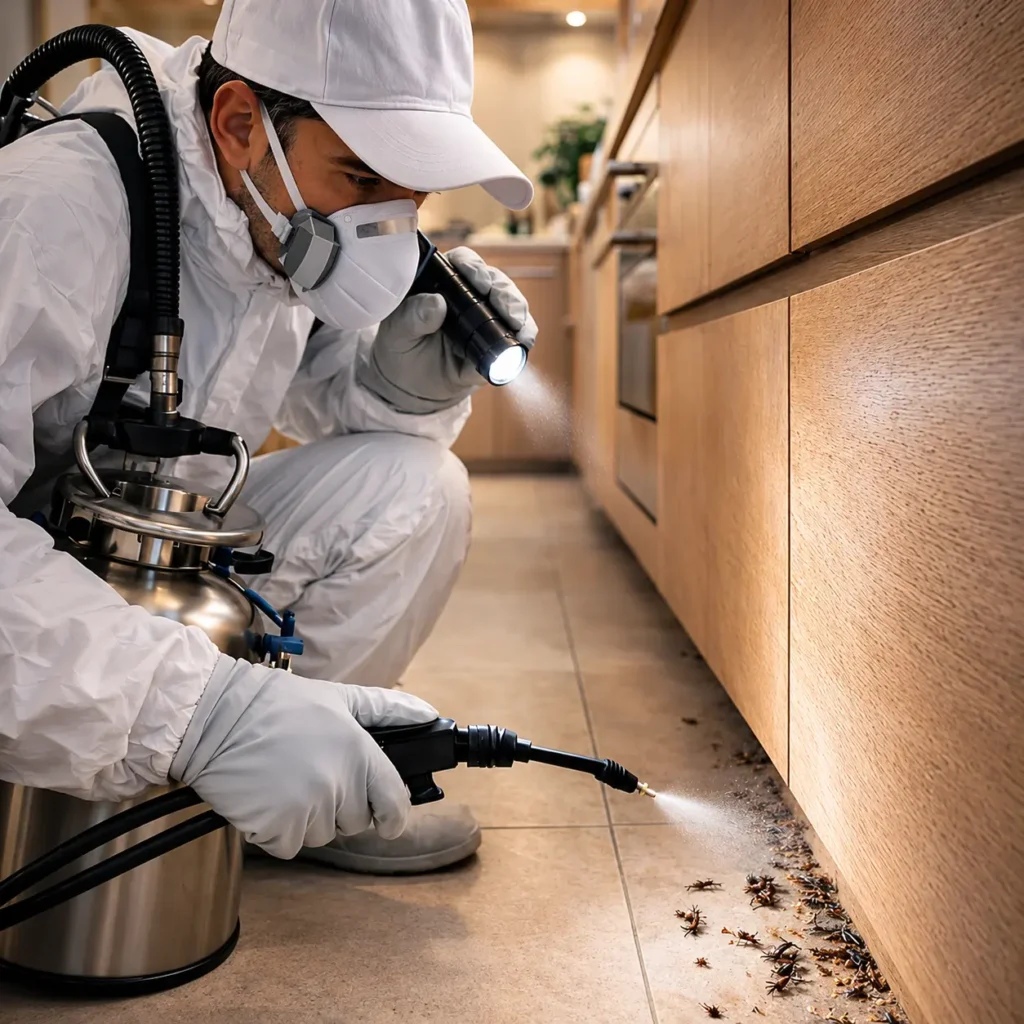
Signs of a pest infestation in your UAE villa — what to look for
By the time a pest infestation is obvious, it is established. Knowing the early indicators allows you to act before the population grows.
For cockroaches, the earliest sign is their droppings — small, dark, cylindrical deposits that accumulate behind appliances, in drawer corners, and in the hinges of cabinet doors. A musty, oily smell in a kitchen or bathroom that has no obvious source is cockroach pheromone — a sign of an established population nearby. Seeing a single cockroach during daylight is significant: cockroaches are nocturnal and the presence of one during the day often means the hidden population is large enough that competition for space is forcing individuals into the open.
For bed bugs, the signs are: unexplained bites appearing after sleeping — typically in lines or clusters on exposed skin; small rust-coloured stains on mattress fabric (crushed bugs or their excrement); pale shed skins at mattress seams; and, in heavy infestations, a sweet, musty odour in the bedroom. Using a torch to inspect mattress seams, the gap between the headboard and wall, and the underside of the bed frame is the most reliable self-inspection method.
For termites, look for: mud tubes — thin, earth-coloured tunnels running up exterior foundation walls, interior skirting boards, or along pipework — which termites build as protected pathways between soil and timber. Wood that sounds hollow when tapped. Blistered or bubbling paint on walls or ceilings with no visible moisture source. Small piles of sawdust-like pellets (frass) near wooden fittings. Wings shed in piles near windows — termite swarmers shed wings after their mating flight.
For rats and mice, look for: droppings — dark, cylindrical rat droppings or smaller mouse droppings near skirting boards, in storage areas, and behind appliances. Gnaw marks on food packaging, wooden fittings, or electrical cable insulation. Grease marks along walls where rats habitually travel (their fur leaves a dark smear at contact points). Scratching or scurrying sounds in walls or ceilings at night.
For ants, the trail itself is the clearest sign — a column of ants moving between an entry point and a food or water source. The entry point is usually a gap in window or door sealing, a plumbing penetration, or a crack in exterior wall rendering.
If you recognise any of these signs, contact Total Defence for a villa pest inspection across Dubai, Sharjah, and Ajman. Early professional inspection consistently results in faster resolution and less disruption to the household.
What happens during a professional villa pest control service
When Total Defence carries out a villa pest control treatment in Dubai, Sharjah, or Ajman, this is the actual process — not a simplified summary.
The service begins with a professional inspection. Before any treatment is applied, a qualified technician walks the entire property — interior and exterior — to identify pest species present, active infestation zones, entry points, harbourage areas, and conditions conducive to infestation (moisture sources, food storage gaps, drainage issues). This inspection determines what treatment is appropriate. A villa with German cockroaches needs a different approach to a villa with an American cockroach entry problem. A bed bug treatment is entirely different from an ant treatment.
For general pest control — the standard quarterly or bi-annual villa treatment — the treatment covers interior and exterior zones. Interior treatment includes application of residual insecticide in harbourage zones (behind appliances, under sinks, in wall void access points, around plumbing penetrations), gel baiting in cockroach harbourage areas, and treatment of drainage points. Exterior treatment covers the perimeter of the building — along the base of exterior walls, around the boundary wall interior, garden drainage outlets, AC unit drainage points, and any visible pest activity areas. Mosquito treatment in garden areas addresses standing water and vegetation.
For bed bug treatment, the approach is more detailed. Heat treatment — raising the temperature in affected rooms to levels lethal to all life stages of bed bugs — is the most effective single-session solution. This requires specialist equipment and a full room clearance and preparation by the household. Chemical treatment using residual insecticide applied to all harbourage zones is an alternative approach that requires multiple visits — typically three at intervals — to break the breeding cycle. Both approaches are effective when carried out correctly; heat treatment resolves the problem faster.
For termite control, the standard professional approach is a soil treatment barrier — applying a termiticide to the soil around the foundation of the building that creates a treated zone termites cannot pass through. For active infestations with established timber damage, localised treatment of affected timber using foam or injection application is carried out alongside the soil barrier. Termite treatment requires access to the exterior foundation perimeter and, in some cases, drilling through interior flooring at contact points. It is a specialist service with a significant treatment scope — not a general pest spray.
For rodent control, the programme involves placement of tamper-resistant bait stations at identified activity points, physical exclusion work (sealing confirmed entry points with appropriate materials), and follow-up visits at intervals to monitor bait uptake and activity. Rodent control without exclusion is a temporary measure — identifying and sealing how rodents are entering the building is the only way to achieve a lasting result.
On completion of each service, Total Defence provides a written service report detailing what was found, what was treated, what products were used, and any recommendations for structural or environmental improvements. This documentation is important for villa owners and property managers maintaining maintenance records.
How often should pest control be carried out in a UAE villa?
The frequency of treatment depends on the pest species, the property’s pest pressure level, and whether the goal is reactive treatment of an existing problem or proactive prevention of infestation.
For general pest control — cockroaches, ants, silverfish, and general crawling insect prevention — the standard recommendation for UAE villas is quarterly treatment (every three months). This interval is based on the residual effectiveness period of professional-grade insecticide formulations in UAE temperature conditions. Heat and UV exposure degrade residual insecticides faster outdoors than in temperate climates. Quarterly treatment maintains an effective residual barrier throughout the year.
For villas in higher-risk environments — near drainage infrastructure, adjacent to undeveloped land, or in areas with known rodent activity — bi-monthly treatment (every two months) is more appropriate.
For bed bug treatment, the schedule depends on the treatment method. Heat treatment is typically a single session with a follow-up inspection at 14 days. Chemical treatment requires three visits — initial, then at 10–14 days, then at 28 days — to break the full breeding cycle.
For termite prevention, annual inspection and renewal of the soil treatment barrier is the standard. In villas where active termite pressure from surrounding soil is confirmed, a bi-annual inspection is appropriate.
For mosquito control in villa gardens, treatment timing should align with the UAE’s main breeding season — April through October — with treatments every four to six weeks during this period.
If you are not sure what your villa needs based on its location and current pest pressure, Total Defence can carry out an initial inspection and recommend a programme specific to your property. Our pest control services cover single-visit treatments and ongoing maintenance programmes across Dubai, Sharjah, and Ajman.
What the municipalities in Dubai, Sharjah & Ajman require around villa pest control
Pest control regulation in the UAE primarily applies to commercial premises — food establishments, hotels, hospitals, schools, and other licensed operations have mandatory pest control compliance requirements as a condition of their operating licences. For residential villas, there is no direct regulatory requirement to maintain a pest control programme, but there are connected requirements that villa owners and landlords should be aware of.
Under Dubai Municipality and Sharjah Municipality guidelines, property owners are responsible for maintaining their property in a condition that does not constitute a public health hazard. A property with a severe and uncontrolled rodent or cockroach infestation that affects neighbouring properties or common areas can be subject to a municipality notice requiring remediation.
For tenants and landlords in UAE residential villas, pest control is a common area of dispute. The standard position under UAE tenancy law is that pre-existing pest infestations are the landlord’s responsibility to remediate; infestations that develop during the tenancy due to tenant hygiene practices may be the tenant’s responsibility. In practice, the allocation depends on the specific lease terms and the circumstances of the infestation. Total Defence provides pest inspection reports that document the nature and extent of an infestation — documentation that is useful in tenancy disputes.
For villa communities managed by homeowner associations or community management companies in Dubai, pest control is often part of the community maintenance framework. Our building cleaning services for managed communities include coordinated pest control programmes across shared areas and individual units.
For any villa owner dealing with a pest control requirement from a municipality inspector or a landlord compliance requirement, Total Defence provides full service documentation — a signed treatment certificate specifying the date, property, pest species treated, products used, and technician details. Contact us for a quotation.
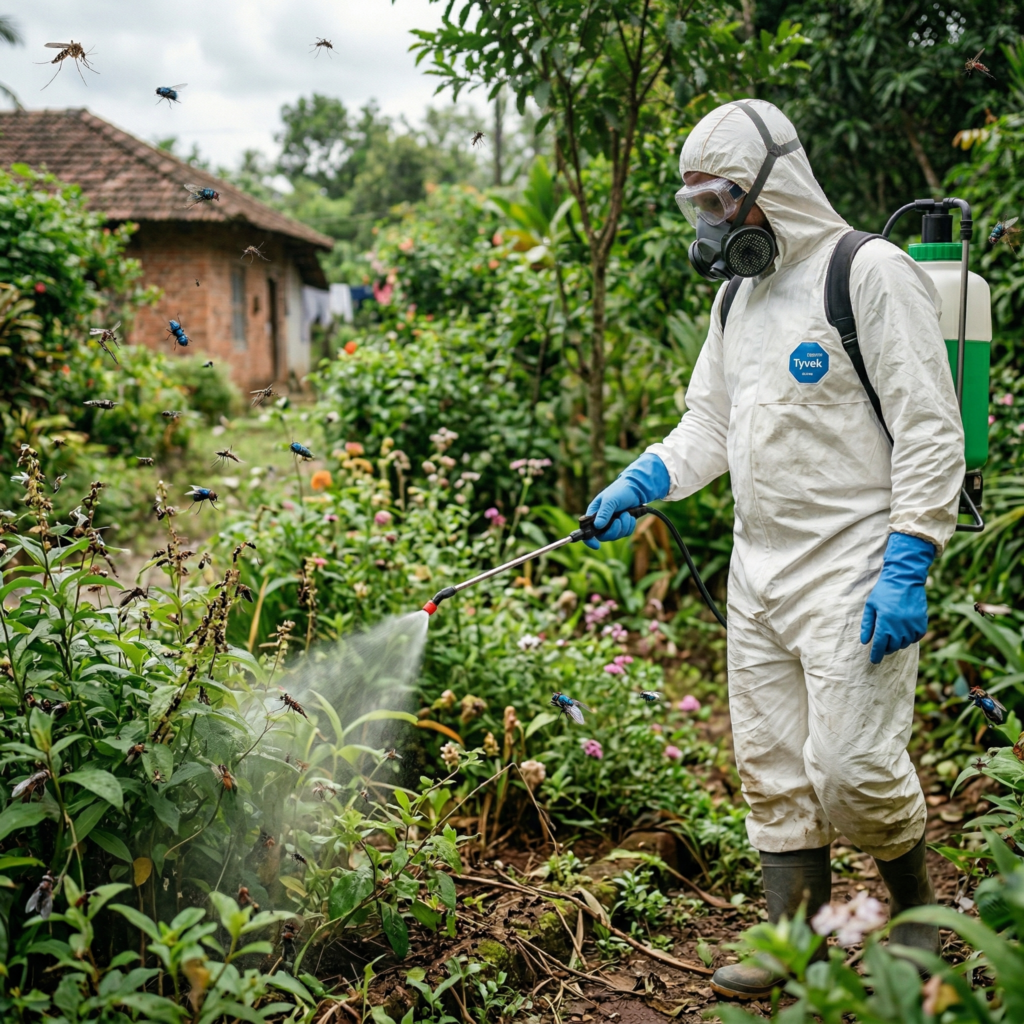
Frequently asked questions
How do I know if my UAE villa has cockroaches? Early signs include small dark droppings behind appliances, in drawer corners, and in cabinet hinges; a musty oily smell in the kitchen or bathroom with no obvious source; and seeing cockroaches during daylight — which indicates a large hidden population. At night, use a torch in your kitchen: if cockroaches scatter when you switch on the light, the infestation is established.
Why do cockroaches keep coming back after treatment in my Dubai villa? The most common reason is that the treatment addressed visible cockroaches but did not treat the entry points or harbourage zones where the population originates. Large cockroaches in UAE villas typically enter from drainage systems and garden infrastructure. If drainage points are not sealed and treated as part of the programme, re-entry continues. German cockroaches require gel bait treatment targeted at their indoor harbourage — surface spraying alone does not reach them.
What is the best pest control method for villas in Dubai? There is no single best method — the right approach depends on which pest is present. General cockroach and crawling insect control requires residual insecticide applied to harbourage zones and entry points, plus gel bait for German cockroaches. Termites require specialist soil barrier treatment. Bed bugs require heat treatment or a structured chemical programme. Rodents require bait stations combined with physical exclusion. A professional inspection before treatment identifies what is actually needed.
Do I need pest control every month for my UAE villa? Monthly treatment is not necessary for most villas. Quarterly (every three months) is the standard recommended interval for general pest prevention in UAE villas. Villas in higher-risk environments or with a history of infestation may benefit from bi-monthly treatment. Some specific pests — bed bugs, termites — require their own dedicated treatment schedule independent of general quarterly visits.
How do I know if I have bed bugs and not mosquito bites? Bed bug bites typically appear in clusters or lines on areas exposed during sleep — shoulders, arms, neck, and ankles. They appear after sleeping, are intensely itchy, and may have a small central puncture mark. Mosquito bites are more random in distribution and appear at any time. To confirm bed bugs, inspect the mattress seams and the gap between the headboard and the wall using a torch — look for rust-coloured stains, shed skins, or small dark insects roughly 4–5mm long.
Can I treat cockroaches in my villa myself? Over-the-counter cockroach sprays and bait stations provide limited, short-term results. They kill visible cockroaches but do not address the harbourage population, the egg cases already laid, or the entry routes that allow re-infestation. Professional treatment uses formulations and application methods that are not available for public purchase and addresses the full infestation cycle. For an established infestation, professional treatment consistently resolves the problem faster and more completely than repeated DIY attempts.
Does Total Defence do pest control in Sharjah villas? Yes. Total Defence provides full villa pest control across Sharjah — all areas including Muwaileh, Al Nahda, and surrounding residential zones — with service documentation provided after every visit. Contact us to book.
Does Total Defence do pest control in Ajman villas? Yes. We cover all major areas of Ajman including Al Rawda, Al Rashidiya, and Al Jurf. Contact us for a quotation for your villa.
Are pest control chemicals safe for children and pets? Professional pest control products used by licensed operators in UAE are applied at concentrations and in locations that are safe once dry or cured. Technicians specify a re-entry time after indoor treatment — typically 2 to 4 hours for the treated areas to ventilate and surfaces to dry. Pets should be removed during treatment and until re-entry is confirmed safe. Total Defence technicians brief homeowners on pre and post-treatment instructions at every visit.
What should I do before a pest control visit to my villa? Clear under-sink areas and remove items from kitchen cupboard bases. Remove pet food and water bowls. Cover fish tanks. For bed bug heat treatment, detailed room preparation instructions are provided in advance. For general treatments, ensure technicians have access to all areas including bathrooms, laundry rooms, and garden areas.
How long does a villa pest control treatment take? A standard general pest control treatment for a 3–4 bedroom villa takes approximately 1.5–2.5 hours, covering interior and exterior. Specialist treatments — bed bug heat treatment, full termite soil barrier application — take longer. A bed bug heat treatment typically runs 6–8 hours for a full bedroom suite.
Can termites damage a villa in the UAE? Yes — termites are present in UAE soil and regularly cause structural damage to UAE villas, particularly in properties with timber-framed interiors, wooden door frames and window surrounds, or roof structures incorporating timber. Subterranean termites work invisibly inside wood, and damage is often extensive before it is discovered. Annual termite inspection is the standard preventive measure.
Why does my villa have rats even though it is clean? Cleanliness reduces food attractants but does not eliminate the structural entry points that rodents use. In UAE villas, rats typically enter through gaps around drainage pipes in exterior walls, unsealed AC duct penetrations, damaged roof soffits, and poorly sealed ground-level utility vents. A clean villa with open structural entry points will still have rodents. Effective rodent control requires sealing entry points in combination with population reduction.
What is the difference between general pest control and termite treatment? General pest control covers cockroaches, ants, mosquitoes, flies, and crawling insects using insecticide spray and baiting. Termite treatment is a specialist service using different chemistry — termiticides applied to the soil as a barrier around the foundation, or to affected timber directly. It requires different equipment, a different application method, and a different service protocol. They are booked separately and should not be confused.
Can cockroaches make my family sick? Yes. Cockroaches are vectors for a range of pathogens — Salmonella, E. coli, Staphylococcus, and others — which they transmit by walking across food preparation surfaces, food packaging, and utensils. Cockroach allergens are also a significant trigger for asthma and respiratory conditions, particularly in children. An established cockroach infestation in a kitchen is a genuine health risk.
Do pest control treatments have a smell? Some insecticide formulations have a mild chemical odour immediately after application that dissipates as the product dries — typically within an hour or two with ventilation. The re-entry time specified by the technician accounts for this. Total Defence uses low-odour formulations where possible and briefs householders on ventilation requirements.
Why are there ants in my bathroom in Dubai? Ants in bathrooms are typically entering from outside through plumbing penetrations, window seals, or wall cracks and are attracted to moisture rather than food. The entry point is the priority — treating ants on the surface without addressing where they enter and where their colony is located provides only temporary results. Professional gel baiting targeted at the forager trail and entry zone is the most effective approach.
What is a pest control service report and why do I need it? A service report is the written record of every pest control treatment — what was found, what was treated, what products were used, and any follow-up recommendations. For tenants, it is evidence that treatment was carried out. For landlords, it is documentation of property maintenance. For any property under homeowner association management, it may be required as part of community compliance records. Total Defence issues a signed report with every service.
How quickly can Total Defence respond for an urgent pest problem in my villa? We provide same-week appointments across Dubai, Sharjah, and Ajman for standard pest control. For urgent situations — visible rodent activity, bed bug confirmation, or severe cockroach infestation — we offer priority scheduling. Contact us to discuss your timeline.
Can one villa’s pest problem affect my villa next door? Yes — this is one of the most common causes of re-infestation in UAE villa communities. Cockroach populations move along shared boundary walls and drainage infrastructure. Rodents move through gardens and gaps between adjacent properties. A coordinated treatment across neighbouring villas or, where possible, a community-wide programme is more effective than treating individual units in isolation. Contact Total Defence to discuss coordinated treatment options.
The bottom line
Pest control in UAE villas is not a one-time event. The climate, the built environment, and the density of UAE residential communities create sustained pest pressure that does not go away between treatments. Cockroaches, termites, rodents, and bed bugs — the four species that cause the most disruption and cost the most to remediate when established — are all present in the UAE villa environment and all require professional treatment at the right interval to control effectively.
The cost of a regular maintenance programme is consistently lower than the cost of dealing with a well-established infestation. Termite damage is expensive. Bed bug remediation in a family home is disruptive. Rodent damage to wiring is a fire risk. A quarterly pest control programme that prevents these situations from developing is one of the most cost-effective decisions a UAE villa owner can make.
Book your villa pest control inspection or treatment with Total Defence today. We serve Dubai, Sharjah, and Ajman with qualified technicians, professional-grade products, and full service documentation after every visit.
Total Defence provides pest control, tank cleaning, and disinfection services across Dubai, Sharjah, and Ajman. Contact: | (+971) 52 161 2380