
You’ve already tried the obvious things. You killed the one you saw. You wiped down the web. Maybe you sprayed something from the supermarket around the corners. And yet — a week later, there’s another web. Sometimes in the same spot. Sometimes somewhere new.
That’s the pattern most people experience with spiders, and it’s frustrating because it feels like the problem never fully goes away. The reason? Killing individual spiders and removing visible webs doesn’t address anything that’s actually driving the infestation. The population continues. The entry points stay open. The food source stays in place. And within days or weeks, you’re right back where you started.
This guide is built differently. Instead of just explaining what spiders are common in the UAE, we walk through the actual problem-by-problem approach to eliminating spiders from your property — from identifying the infestation correctly, to treating the right areas, to preventing recurrence. Every section tackles a specific part of the problem with a specific solution.
If you want a thorough, lasting resolution to a spider problem in Dubai or Sharjah — this is how it actually works.
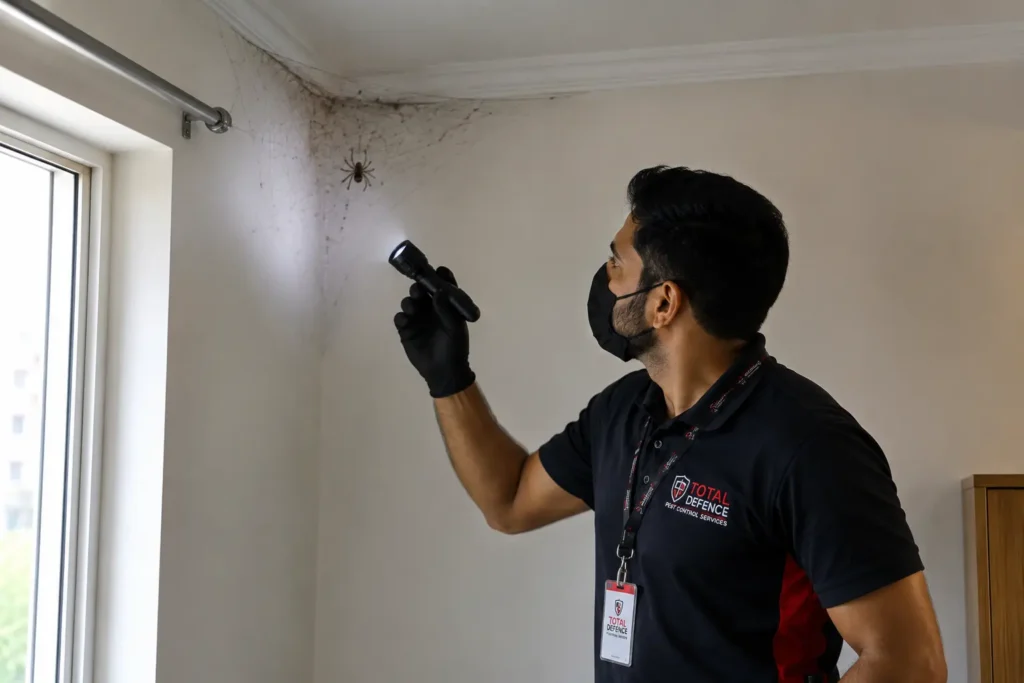
Problem: You Don’t Know What You’re Dealing With — Solution: Identify the Species First
This might seem like an unnecessary first step. A spider is a spider, right? Get rid of it.
Wrong — and this is where most DIY attempts immediately go off track. The species determines the risk level, the right treatment approach, and how urgently you need professional support. Misidentifying a false black widow as a harmless wall spider, or writing off a yellow sac spider as insignificant, leads to the wrong response at the wrong time.
Here’s a practical guide to the main species you’ll encounter in Dubai and the wider UAE:
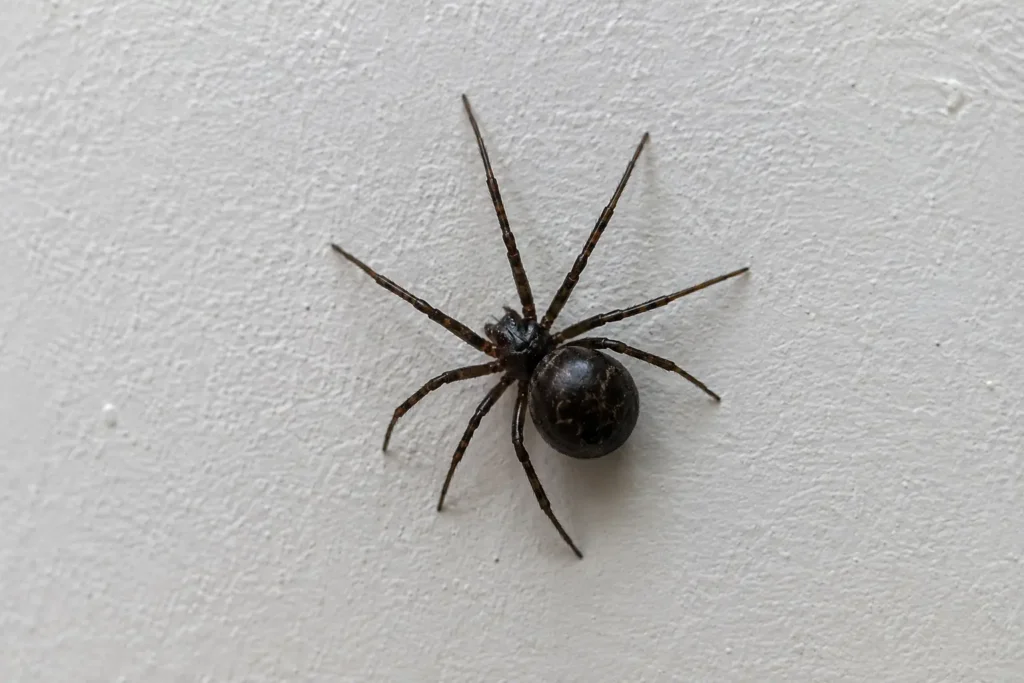
False Black Widow (Steatoda grossa)
Dark, glossy, rounded abdomen. Medium size. Usually found in web at corners of rooms, behind furniture, inside storage. Not as dangerous as a true black widow, but capable of causing painful bites — particularly in children. Extremely common in UAE homes.
How to distinguish from black widow: The false black widow lacks the characteristic red hourglass marking on the underside. Body colour tends toward dark brown rather than pure black.
Black Widow (Latrodectus sp.)
Jet black body, small (1–1.5 cm body length), with a distinctive red or orange hourglass shape on the underside of the abdomen. Builds a chaotic, irregular, tangled web — not the neat round orb shape. Found in storage areas, garages, under outdoor furniture, and in undisturbed corners.
This is the one species where DIY is not appropriate. If you suspect a black widow, do not attempt to remove or kill it yourself. Call for professional assessment immediately.
Yellow Sac Spider (Cheiracanthium spp.)
Small, pale yellow or beige — easy to miss. Doesn’t build a typical web; instead creates small silk tubes or “sacs” in corners, folds of curtains, or under objects. Hunts at night. Responsible for a significant number of bites in the UAE — often mistaken for unexplained skin irritation or rash.
Desert Tarantula (Pseudoctenus arabicus)
Large — up to 15 cm leg span. Brown, hairy. Found in properties near open desert land, particularly in the outer zones of Sharjah. Intimidating but not aggressive; bites are painful but not life-threatening. Their presence indicates other pest activity in the area providing a food source.
Huntsman / Wall Spider
Large, flat, fast-moving. Brown or grey. Often found behind pictures, behind furniture, or running across walls and ceilings. Generally harmless but will bite if cornered. Common in apartments and villas across Dubai.
Practical solution: If you can’t confidently identify the species, photograph it and contact a pest professional before proceeding. An incorrect identification leads to an incorrect response.
Problem: You Don’t Know Where They’re Coming From — Solution: Map the Entry Points and Nesting Zones
Killing spiders you can see does nothing about the ones you can’t see — and it does nothing about how they’re getting in. Entry point identification is the step that makes the difference between a temporary fix and an actual solution.
Where Spiders Enter UAE Properties
Gaps around pipes and conduits: Every point where a pipe, cable, or conduit enters your wall is a potential entry point. These gaps are often left partially sealed during construction, and they widen over time as buildings settle. Spiders and their prey use these regularly.
Unsealed vents and AC units: Air conditioning systems — which are everywhere in the UAE — create consistent airflow through your walls. Without proper mesh screening on exterior vents, spiders can travel along these channels directly into your living or working spaces.
Window and door frame gaps: In older buildings, and even in newer ones where finishing work wasn’t carefully done, there are often small but significant gaps between window frames and walls, or around door frames. These are primary entry routes for crawling insects of all types.
Under doors: The gap under an exterior door needs only to be 3–4 mm to allow most spider species to enter. Standard door seals, particularly in older properties, often aren’t tight enough.
Through landscaping that touches the building: Shrubs, climbing plants, or trees that physically touch your external walls act as direct bridges for spiders and other insects. Ground-floor units in villa compounds with heavy garden planting are particularly exposed.
How to Map Nesting Zones Inside
Walk your entire property — including spaces you don’t use daily — and note the following:
- Web presence in corners (ceiling-to-wall junctions, cabinet interiors)
- Silk sac presence (look for small cream or white pouches in fabric folds, behind objects, in drawer corners)
- Live spider sightings and the time of day they occur (active at night = hunting species; active during day = web-builders)
- Egg sacs (flat, round, silky pouches — often found near established web locations)
Map these on a rough floor plan. What you’re looking for is a pattern — are sightings clustered near a specific wall? Near a window? Near a storage area? That clustering tells you where the nesting zones are and often points toward the most likely entry routes.
Problem: You Have Active Webs and Egg Sacs — Solution: Remove and Destroy Correctly
Most people sweep webs down with a broom and consider the job done. It isn’t — particularly if an egg sac is present.
How to Remove Webs Properly
Use a vacuum cleaner with a hose attachment rather than a broom or cloth. A broom can scatter egg sacs and dislodge spiders without capturing them. Vacuuming draws web material, egg sacs, and spiders directly into the collection chamber.
After vacuuming, dispose of the bag or empty the canister outside immediately — not into an indoor bin.
For ceiling corners and high wall areas, a vacuum extension hose works far better than a duster, which typically just moves material around without removing it.
Dealing With Egg Sacs
Never crush an egg sac with your hand or a cloth. Depending on the species, a single sac can contain anywhere from 20 to over 400 eggs. Crushing it releases them rather than destroying them.
The correct approach: vacuum the sac directly into the vacuum hose, then immediately seal and dispose of the bag outside. For sacs in areas the vacuum can’t reach, use a sealed plastic bag to remove the sac intact, then dispose of it in an outside bin — not inside the property.
If you find more than two egg sacs on your property, that’s a signal that the infestation has been established for long enough that female spiders have completed multiple breeding cycles. At this point, the scope of the problem is likely larger than what’s visible, and professional treatment is the right next step.
Problem: DIY Sprays Keep Failing — Solution: Understand Why and Switch Approach
The supermarket spider sprays aren’t useless — but they’re not designed to solve the underlying problem, and understanding why helps you make a better decision.
Why Over-the-Counter Sprays Give Short-Term Results Only
Contact kill only. Most retail spider sprays kill on contact — meaning the spider has to walk through or be directly sprayed with the product. They don’t create a long-lasting residual barrier. Once the visible spray film dries, its protective effect is limited.
Wrong formulation for the species. Not all pesticide formulations work equally against all spider species. Some retail products are effective against certain crawling insects but have limited effect on specific spider types. Without knowing what species you’re dealing with, you may be applying the wrong product entirely.
They don’t reach nesting zones. Spraying corners and visible web areas doesn’t treat inside wall cavities, behind skirting boards, within ceiling voids, or deep inside storage — which is where established populations actually live.
They don’t address secondary pest activity. If cockroaches, ants, or flies inside your property are providing a food source for spiders, killing spiders with spray while that food source continues does nothing to reduce the long-term attraction of your property.
When to Escalate Beyond DIY
Here’s a practical threshold: if you’ve done a thorough web and egg sac removal, sealed visible entry points, and applied retail treatment — and spiders have returned within two to three weeks — the infestation is established beyond what consumer products can resolve.
At that point, our pest control services in Dubai and Sharjah include professional-grade residual treatment products that create significantly longer-lasting barriers, applied to the specific locations where spiders nest and travel — not just the surfaces you can see.
Problem: Spiders Keep Coming Back — Solution: Eliminate What’s Attracting Them
This is the piece most people miss. Spiders don’t randomly choose your property — they go where conditions support them. Fix the conditions, and the spider problem becomes far more manageable.
Remove the Food Supply
Spiders eat insects. If your property has a consistent population of cockroaches, ants, flies, or moths, that’s the food supply sustaining your spider population. Address those pest types and you simultaneously reduce the spider population’s ability to maintain itself.
This is one of the main reasons we recommend comprehensive pest management rather than single-pest treatment. A full assessment that addresses all active pest types in your property — not just the one you’re most bothered by — gives you a fundamentally better outcome.
For residential properties, our home pest control service covers the full spectrum of common household pests as part of a structured treatment plan, rather than treating each pest type in isolation.
For commercial properties — particularly food service, warehousing, and hospitality — this matters even more. A restaurant kitchen with a spider problem almost always has a flying insect problem contributing to it. Our commercial pest control programme addresses properties at the systemic level, not symptom by symptom.
Fix Lighting That Attracts Insects
Flying insects are drawn to white light at night. Where flying insects gather — near windows, entrance lights, and outdoor fixtures — spiders follow. This is why exterior walls and window frames often have more spider activity than interior spaces.
The solution: switch exterior lights and lights near windows or glass doors to yellow sodium-vapour bulbs or warm LED equivalents. These are significantly less attractive to flying insects and create a noticeably lower concentration of insect activity around your building’s entry points.
Reduce Humidity in Problem Areas
Moisture-loving spider species — and many of their prey insects — thrive in consistently damp areas. Bathrooms with poor ventilation, under-sink cabinets, utility rooms without adequate airflow, and any space with a slow leak or water ingress are all high-risk zones.
Practical fixes:
- Run bathroom extractor fans during and for 10–15 minutes after showering
- Check under-sink areas for drips and repair immediately
- Keep utility room doors open when the space isn’t in use to improve air circulation
- Check for and address any slow wall damp or flooring moisture — particularly in ground-floor units
Clear Clutter From Storage Areas
Boxes, stacked materials, old furniture, rarely moved equipment — these are prime spider habitat. They offer exactly what spiders need: darkness, stability, warmth, and protection from disturbance.
This doesn’t mean you need to throw things away. It means reorganising so that storage areas have some airflow, items are moved periodically, and nothing stays completely undisturbed for months at a time. Even shifting boxes a few centimetres from walls makes a difference — spiders prefer to nest where surfaces are in close contact.
Problem: Entry Points Are Still Open After Treatment — Solution: Seal Systematically
Treatment eliminates existing spiders. Sealing keeps new ones from establishing. You need both — treatment without sealing is a temporary fix; sealing without treatment leaves an active population intact.
A Systematic Sealing Process
Step 1 — Pipe and conduit penetrations: Use silicone sealant (not foam — foam degrades and compresses over time) around every pipe or cable entry point. Pay particular attention to kitchen and bathroom wall penetrations. Check that existing sealant hasn’t cracked or shrunk.
Step 2 — Window and door frames: Inspect the joint between frame and wall on all windows and exterior doors. Apply sealant to any visible gap. Check that window screens are intact and fitted flush — a torn corner of a screen is sufficient entry space for most spiders.
Step 3 — Door base gaps: Fit door sweeps or brush seals to the base of all exterior doors, including utility room doors and any door accessing a garage or external storage space. These seals are inexpensive, widely available in UAE hardware stores, and make a significant difference.
Step 4 — Vent and AC grille mesh: Check that all exterior ventilation grilles have intact insect mesh screens. Replace missing or torn mesh. This applies to kitchen extractor vents, bathroom exhaust vents, and any fresh air intakes associated with your AC system.
Step 5 — Roof and ceiling voids: For properties with accessible ceiling voids or roof spaces, check the access points for gaps. In Dubai’s older villa stock particularly, ceiling void access points are sometimes not properly sealed, and these voids can harbour significant spider and insect populations that gradually migrate into living spaces.
Problem: Spiders in a Commercial Property Are a Compliance Risk — Solution: Structured Professional Programme
For residential properties, spiders are a nuisance and occasionally a health concern. For commercial properties, they’re something more serious.
In food service environments — restaurants, hotel kitchens, catering operations — any visible pest activity is a potential regulatory violation under Dubai Municipality’s food safety regulations. A spider sighting by a customer or a municipal inspector carries real consequences.
In healthcare and childcare facilities, the standard is zero tolerance. Vulnerable populations mean that even low-risk spider species require immediate professional attention.
In offices and retail spaces, spider sightings affect staff wellbeing and client confidence. The reputational cost of a visible pest problem is often underestimated.
For any commercial setting, the right solution is a structured pest management programme — not reactive treatment when something is spotted. This means scheduled inspections, documented treatment records, proactive identification of emerging issues, and rapid response for urgent situations.
After any significant pest treatment in a food service or healthcare environment, pairing the pest control with a professional disinfection and sterilisation service is recommended — both for hygiene assurance and for compliance documentation purposes.
Problem: You’re Not Sure If the Treatment Worked — Solution: Know What to Expect Post-Treatment
After professional spider control, many people get alarmed when they see what appears to be increased spider activity in the first 48–72 hours. This is completely normal — and actually a sign the treatment is working.
What Happens in the First 72 Hours
Residual treatments don’t kill spiders instantly on contact the way direct spray does. Instead, they work as spiders walk across treated surfaces and absorb the pesticide through their legs and body. This means spiders that were in untreated hiding areas during application will eventually move across treated zones and be exposed.
For the first few days, you may see more spiders moving erratically, appearing in unusual locations, or dying in visible areas. This is the treatment taking effect — not a sign of failure.
What to Watch for During the Warranty Period
After the initial 72-hour period, spider activity should reduce significantly. By week two, you should be seeing very minimal or no spider activity in previously affected areas.
If significant spider activity — not occasional isolated sightings — resumes after three to four weeks, contact your pest control provider to report it. Under our 3-month warranty, this triggers a free re-treatment.
Keep a note of where and when you see spiders during the warranty period. This information helps the technician on a follow-up visit identify whether there’s a specific nesting zone that wasn’t fully reached during initial treatment, or a new entry point that’s been opened up.
Maintaining the Residual Barrier
Avoid mopping or washing treated wall bases and skirting boards with heavy detergent for at least two to three weeks after treatment. Aggressive cleaning of treated surfaces reduces the residual pesticide’s effectiveness and shortens the protection period.
Light sweeping is fine. Targeted surface cleaning is fine. Full floor mopping with detergent directly along skirting boards will degrade the barrier more quickly.
Problem: You’ve Fixed It Once But It Keeps Coming Back Seasonally — Solution: Scheduled Preventive Treatment
If you’re experiencing spider problems that resolve after treatment but return every few months, you’re not failing at pest control — you’re experiencing the reality of year-round pest pressure in the UAE.
Unlike colder climates where spiders have a genuine dormant period in winter, the UAE’s consistently warm temperatures mean spider and insect populations are active year-round. There’s no natural seasonal die-off that resets the clock for you.
The practical solution is a scheduled treatment programme. Here’s what works:
Quarterly treatment: Scheduled every three months, this is the most effective preventive approach for properties with a history of recurring problems, properties near green areas or open land, ground-floor units, and commercial properties with continuous pest pressure.
Bi-annual treatment: Every six months — appropriate for properties with moderate risk profiles where previous treatment has been effective, and where good hygiene and sealing practices are consistently maintained.
Annual treatment: The minimum worthwhile commitment for any property in the UAE. Even well-maintained properties with good sealing and hygiene practices benefit from an annual inspection and treatment to catch any emerging populations before they establish.
The cost of scheduled preventive treatment is consistently lower than the cost of reactive treatment after a significant infestation has built up — and it eliminates the stress of dealing with the problem repeatedly.
The Complete Solution Checklist for Spider Control in Dubai
Use this as your action plan — sequential order matters:
Step 1: Identify the spider species present. If you can’t, photograph and call for assessment before doing anything else.
Step 2: Map the extent of the problem — webs, egg sacs, live sightings, areas of concentration.
Step 3: Remove all visible webs and egg sacs using a vacuum. Dispose of vacuum contents outside immediately.
Step 4: Identify and seal entry points — pipes, vents, door gaps, window frames.
Step 5: Address secondary pest activity (cockroaches, ants, flies) that’s providing a food source.
Step 6: Adjust lighting near exterior entry points to warm-spectrum bulbs.
Step 7: Reduce humidity and clutter in storage and utility areas.
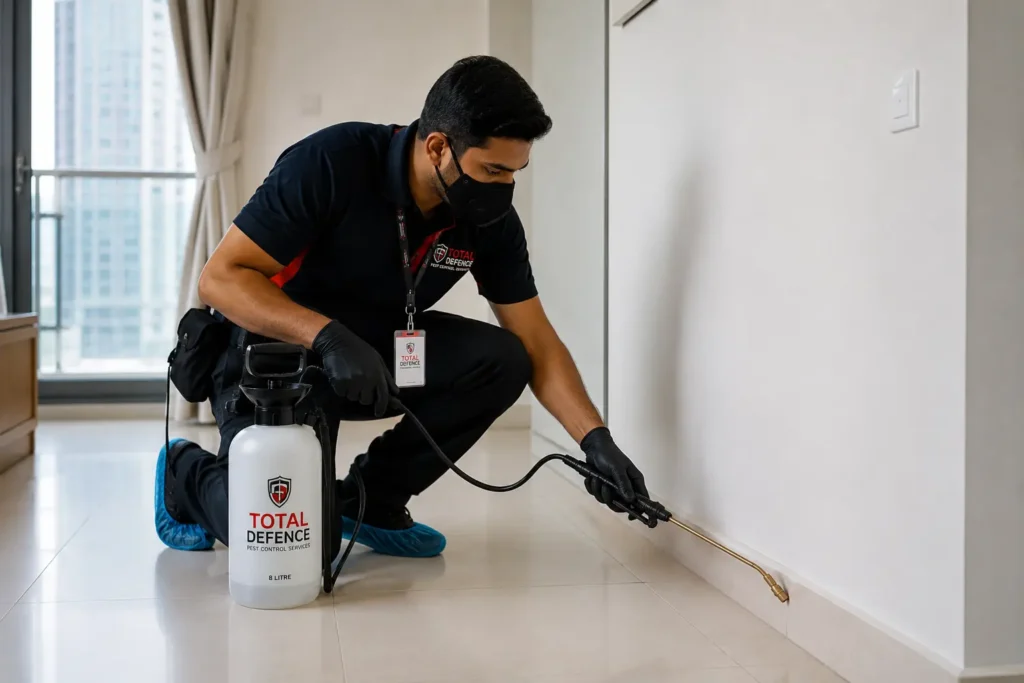
Step 8: Apply professional-grade residual treatment to nesting zones, entry points, and perimeter areas.
Step 9: Follow post-treatment guidance — avoid washing treated surfaces, monitor activity, note and report any recurrence within the warranty period.
Step 10: Establish a scheduled treatment programme appropriate to your property’s risk profile.
Steps 1–7 are things you can begin immediately. Steps 8–10 require professional involvement for reliable, lasting results.
Frequently Asked Questions
I’ve sprayed the corners and wiped the webs three times already. Why do spiders keep coming back?
Because surface-level treatment addresses individual spiders, not the population or the conditions supporting it. If you haven’t identified and sealed entry points, addressed secondary pest activity that’s feeding the spiders, and treated actual nesting zones rather than just visible areas — the population will continue to re-establish regardless of how many times you clean the surface webs. Professional treatment combined with the environmental steps above breaks this cycle.
Is it safe to use DIY sprays in a home with young children?
Many retail pesticide sprays carry clear warnings about use around children. Read the label carefully. Some products require children and pets to be kept out of treated areas for several hours. For households with infants or toddlers, professional treatment using Dubai Municipality-approved products with specific residential safety profiles is a significantly safer approach than buying whatever’s available at the supermarket.
How do I know if a spider I’ve found is a black widow?
The black widow is small — about the size of a grape — jet black, with a red or orange hourglass marking on the underside of its abdomen. Its web is irregular and chaotic, not neat and symmetrical. It’s typically found in dark, undisturbed locations: storage areas, under furniture, in garages, behind rarely moved equipment. If there’s any uncertainty at all — don’t handle it. Photograph it and contact a professional. There’s no upside to getting this wrong.
Do spiders in Dubai come in through the AC system?
Yes — it’s more common than most people realise. Without properly meshed exterior vent grilles, spiders and their prey insects can travel along ducting into your property. This is particularly relevant in villas and older apartment buildings where duct integrity and vent mesh may not have been maintained. Checking and replacing vent mesh is a worthwhile preventive step, especially in ground-floor units.
How long should I wait after treatment before cleaning my floors?
Avoid cleaning treated surfaces — particularly wall bases, skirting boards, and floor edges — with detergent for at least two to three weeks after treatment. Light sweeping is fine. Heavy mopping along treated surfaces degrades the residual barrier and reduces the treatment’s effectiveness and duration.
Can spider control be done the same day I notice a problem?
We aim for same-week appointments across Dubai and Sharjah for standard residential and commercial call-outs. For urgent situations — confirmed dangerous species, high-risk environments like childcare facilities or commercial kitchens — contact us directly by phone for the fastest response.
Will the treatment smell? Is it disruptive?
Professional-grade residual treatments have minimal odour and dry quickly. For most residential treatments, the property is ready for re-entry within 1–2 hours. There’s no need to arrange alternative accommodation for standard spider control. We’ll confirm the specific re-entry time and any precautions when we book the appointment based on your property type and treatment plan.
What if I find a spider after the treatment warranty period has expired?
Occasional single spider sightings after a warranty period are normal — particularly if a property has multiple entry routes that take time to fully seal. One spider doesn’t indicate infestation recurrence. If you’re seeing consistent activity again, webs in multiple locations, or egg sacs — contact us for a follow-up inspection and renewal of treatment. Many clients move to a scheduled programme at this point, which is more cost-effective than reactive treatment.
Ready to Solve Your Spider Problem Properly?
Spot treatments and surface sprays give you temporary results. Systematic identification, targeted treatment, entry point sealing, and environmental adjustment give you lasting results.
Total Defence provides licensed spider control across Dubai and Sharjah — for homes, apartments, villas, offices, restaurants, warehouses, and every commercial property type in between. Every service starts with a proper inspection, every treatment comes with a 3-month warranty, and every team member uses Dubai Municipality-approved products applied to professional standards.
Contact Total Defence today for a free site inspection and a transparent quote. We respond quickly, and we get it done right.
Total Defence provides certified pest control and disinfection services across the UAE. All treatments use Dubai Municipality-approved products delivered by licensed technicians. 3-month warranty on all pest control services.