Your sewage system works every single day and asks for nothing — until the day it does. When a septic or sewage tank fails in a UAE villa or building, the consequences are immediate, serious, and impossible to ignore. This guide covers everything: how to know your tank is overdue for cleaning before it becomes a crisis, what the cleaning process actually involves, how often service is required across different property types, and what the municipality requires from you legally.
Why sewage tank problems in UAE villas are more common than you think
Not every property in Dubai, Sharjah, and Ajman is connected to the municipal mains sewage network. This surprises many people who assume that being within an urban emirate means automatic connection to central infrastructure.
The reality is that a significant number of villas, older residential buildings, and properties in developing areas of Sharjah and Ajman still rely on individual septic tanks or sewage holding tanks. These work perfectly well when maintained. When they are not, the problems escalate from inconvenient to serious very quickly.
In the UAE climate, the timeline from “tank is getting full” to “tank is overflowing” is compressed by heat. Higher temperatures accelerate bacterial activity inside the tank, producing more gas pressure, more rapid liquefaction of solids, and faster accumulation of the scum layer that eventually blocks the outlet. What might take a year to become critical in a European climate can take six months in a Dubai summer.
The issue is compounded by household size. Many UAE villas house extended families or include live-in domestic staff. A septic tank sized for a family of four is serving a household of eight or ten. The tank fills at double the design rate and requires twice the cleaning frequency — a fact that nobody mentions when you sign the tenancy agreement or complete the property purchase.
Total Defence handles sewage and septic tank cleaning across Dubai, Sharjah, and Ajman. Our tank cleaning services cover everything from standard residential pump-outs to large commercial and industrial systems. This guide tells you everything you need to know before you call.
What is the difference between a septic tank and a sewage holding tank?
Before anything else, it helps to know which system your property actually has — because the maintenance requirements are different.
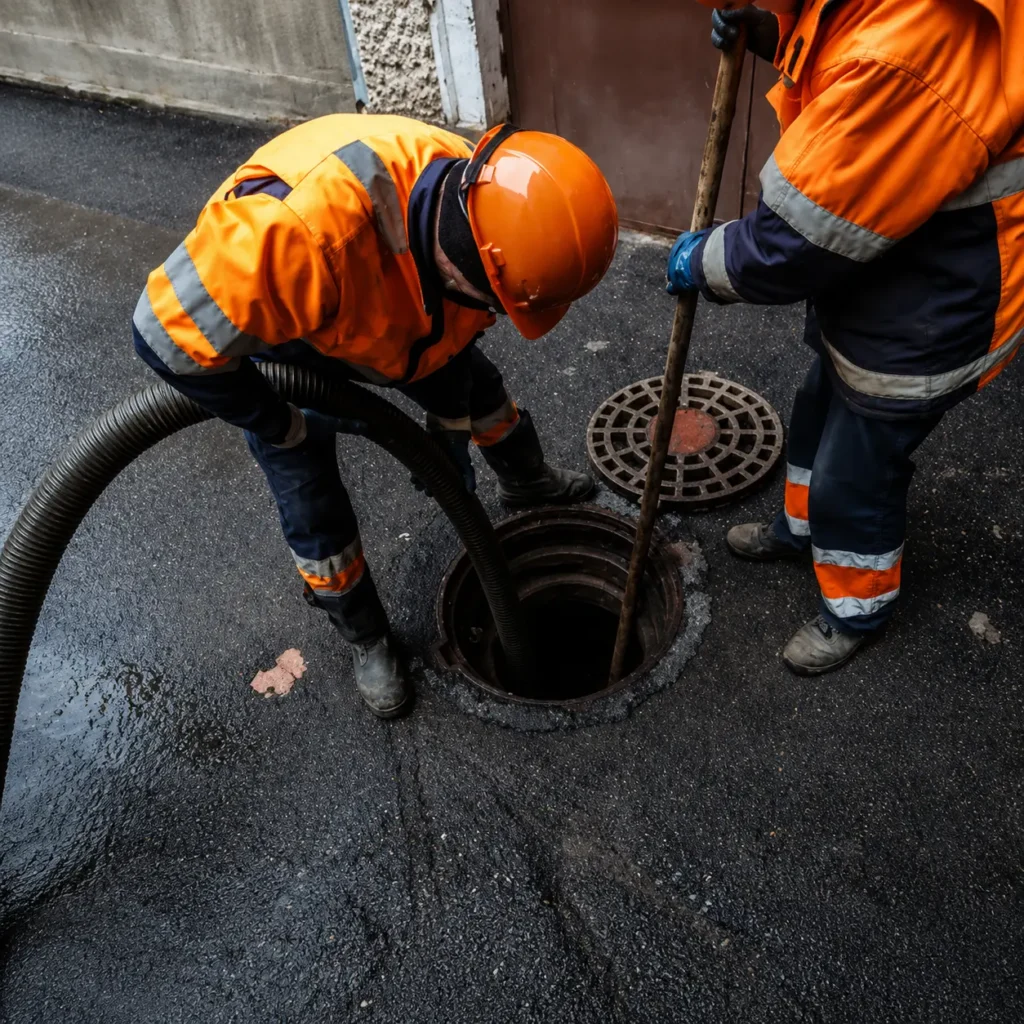
A septic tank is a two-chamber underground structure where wastewater from your toilets, sinks, and showers collects. Inside the tank, solids settle to the bottom as sludge and fats float to the top as scum. The liquid in the middle — relatively clarified effluent — flows out through an outlet pipe into a soakaway or drainage field in the surrounding soil, where it is absorbed and naturally filtered. The solid sludge and scum layers stay in the tank and must be pumped out before they build up to the point where they block the outlet or overflow.
A sewage holding tank (sometimes called a cesspit) does not allow any liquid to drain away. It simply holds everything — liquid and solid — until the entire contents are pumped out by a tanker. There is no soakaway. This means holding tanks fill up much faster than septic tanks and require more frequent cleaning — typically every one to three months for a family-sized villa, depending on usage.
A third category is mains-connected drainage, where your property is linked to the municipal sewer network. These properties do not have on-site tanks, but they still require periodic maintenance of the internal drainage pipes — high-pressure jetting to remove grease, scale, and blockages that build up in connecting pipework over time.
If you are unsure which system your property uses, your original property documents or tenancy agreement should include drainage details. If not, a technician can identify the system during an inspection.
I have a bad smell outside my villa — is my sewage tank full?
A persistent foul smell in the garden or near the exterior of your villa is one of the clearest early warning signs of a sewage tank problem — and one of the most commonly ignored ones.
Here is what that smell is: hydrogen sulphide gas, produced by anaerobic bacteria decomposing organic matter inside the tank. As the tank fills and less air space remains, gas pressure builds and finds any way out — through inspection covers, through the soil if the tank lid seal is deteriorating, and back up through the drainage pipes into your building.
At low concentrations, it smells exactly like rotten eggs. This is the “it’s probably just the drains” smell that people ignore for months. At higher concentrations — which occur when a tank is significantly overfull — the smell becomes a constant presence indoors, not just outside.
The smell alone should be enough to schedule a tank inspection. But there are other signs that typically appear alongside it:
Slow drainage throughout the property is almost always connected. When a tank is approaching full, effluent has nowhere to go quickly, and the backpressure slows every drain in the building. If you notice that your kitchen sink drains slowly, your shower takes longer to clear, and your toilet flushes sluggishly — and these things are happening throughout the building rather than in one isolated fixture — a full tank is the first thing to check.
Unusually lush, green patches of grass directly above where the tank is buried indicates that liquid effluent is rising to the surface level. The grass is being fertilised by sewage that should be draining deeper. This is a warning that the soakaway has failed or the tank is overfull.
Gurgling sounds from drain pipes — particularly when multiple fixtures are used simultaneously — indicate that air is being displaced back up the system rather than liquid flowing away freely.
If you are experiencing any of these signs, contact Total Defence for a sewage tank inspection across Dubai, Sharjah, and Ajman. Do not wait for visible overflow.
What happens if I never clean my sewage tank in the UAE?
This is worth spelling out clearly, because many property owners genuinely do not know how serious the consequences are.
The first stage is what is described above — slow drains, bad smells, wet patches in the garden. Unpleasant, but the damage at this point is still limited to inconvenience.
The second stage is sewage backflow. When the tank is completely full and the outlet is blocked, wastewater has nowhere to go but backwards — up through floor drains, up through toilet bowls, up through shower trays. This is sewage — not just grey water — entering your living space. The health hazard at this point is serious: E. coli, Salmonella, Hepatitis A, and other pathogens are present in sewage and can cause severe illness.
The third stage is structural damage. Saturated ground around an overfull tank loses its bearing capacity. In extreme cases, particularly in older properties or in the sandy soil common in parts of Ajman and Sharjah, prolonged saturation can affect the stability of the surrounding ground and, in worst cases, foundation integrity.
The fourth consequence is pests. Sewage overflow is one of the most powerful cockroach and rodent attractants in any environment. The combination of moisture, warmth, and organic matter creates ideal conditions for rapid infestation. Total Defence frequently responds to pest callouts in villas where the underlying cause is sewage maintenance that has been neglected for too long. Our pest control services and tank cleaning team work together when both problems are present.
The fifth consequence is legal. Dubai Municipality, Sharjah Municipality, and Ajman Municipality all regulate sewage management. For commercial properties, failure to maintain sewage systems is a trade licence compliance issue. Illegal discharge of sewage — allowing it to overflow into public areas or neighbouring properties — can result in substantial fines.
What does professional sewage tank cleaning actually involve?
When Total Defence carries out a sewage or septic tank clean in Dubai, Sharjah, or Ajman, this is exactly what happens — not a simplified version, the actual process.
The first step is always inspection. The technician locates the tank access point, removes the inspection cover carefully (venting accumulated gas before approaching the opening closely), and assesses the fill level using a measuring probe. The depth of the scum layer at the top and the sludge layer at the bottom are recorded. This tells us the actual condition of the tank and what the service will involve.
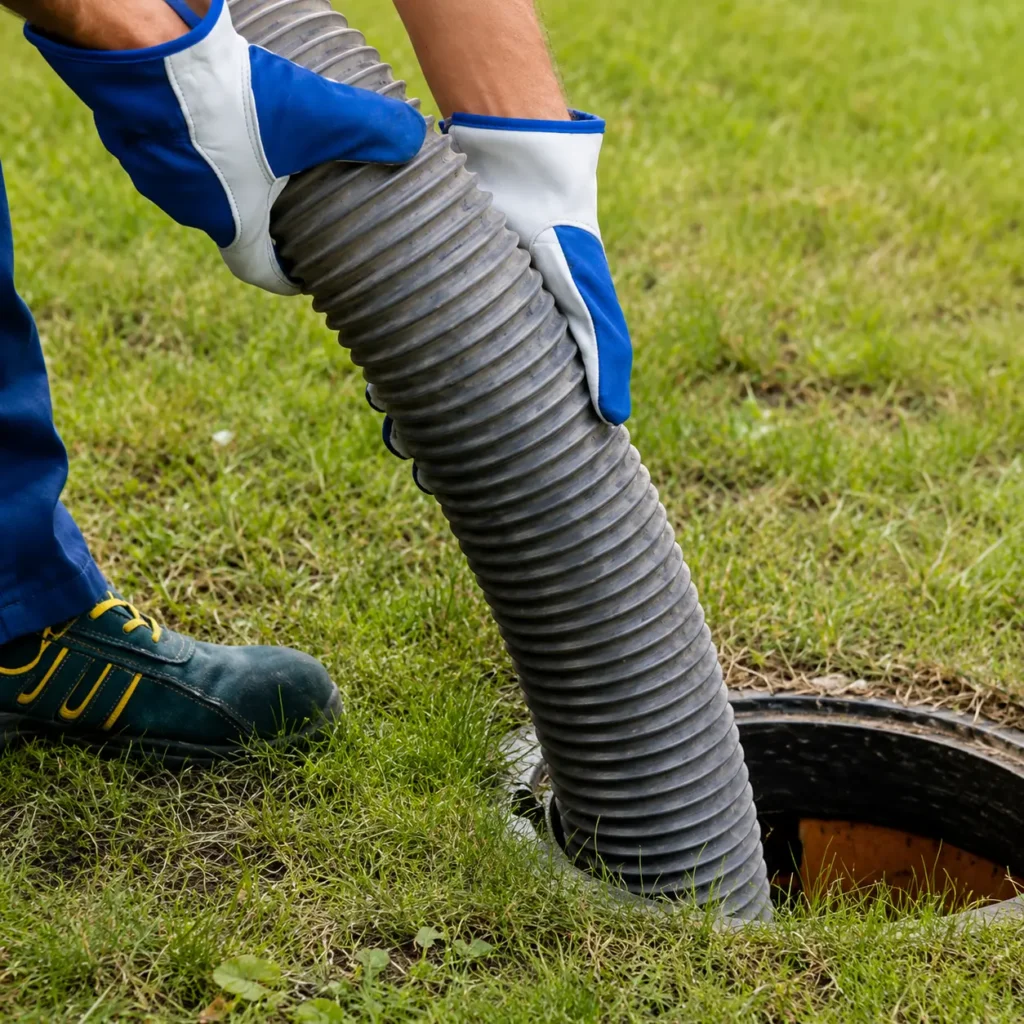
The second step is pump-out. A vacuum tanker — a specialist truck with a high-capacity industrial vacuum system — pumps all liquid and semi-solid waste from the tank. This is the step most people think of when they picture a sewage clean. The waste is contained entirely within the tanker and transported to a licensed disposal facility. It is never discharged into drains, gardens, or any non-approved location. Total Defence uses only licensed tanker operators compliant with UAE environmental regulations, and we provide documentation of compliant disposal as part of every service.
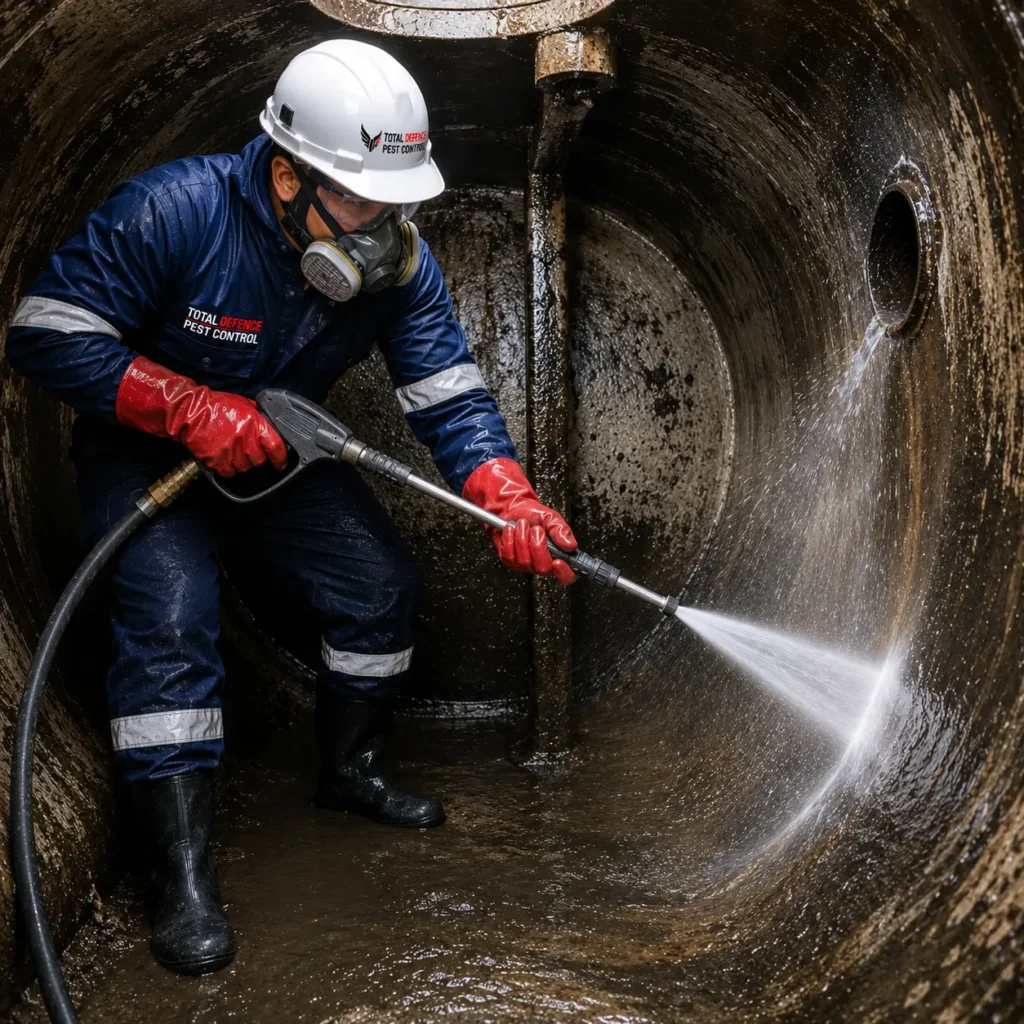
The third step — and the one that separates a thorough clean from a basic pump-out — is interior jetting. After the tank is emptied, high-pressure water is used to blast the layer of hardened sludge and biofilm from the tank walls, base, and baffles. This matters because simply pumping out the liquid leaves a thick coating of compressed waste on every internal surface. This residue breaks down quickly in the UAE heat and dramatically accelerates the rate at which the tank refills. Proper interior jetting after pump-out extends the interval to your next service by months.
The fourth step is inspection of the tank structure. With the tank empty and clean, we can actually see the condition of the inlet and outlet baffles, the tank walls, the base, and the inspection cover seal. Cracked baffles, root intrusion through tank walls, and deteriorating seals are all common findings in older UAE properties and all affect how well the system performs.
The fifth step, where it applies, is pipe jetting — clearing the connecting pipes from the building to the tank using high-pressure water. A clean tank connected to partially blocked pipes will experience backflow and slow drainage almost immediately.
On completion, Total Defence provides a written service report and certificate confirming the service date, volumes removed, tank condition, and disposal compliance. This is your documentation for municipality compliance or property management records.
How often should you clean a sewage tank in Dubai, Sharjah & Ajman?
The answer depends on tank size, the number of people using the property, and what type of system you have. Here is a practical guide based on real-world UAE usage patterns.
For a standard 3–4 bedroom villa in Dubai, Sharjah, or Ajman with a typical family of four, annual cleaning is the minimum for a septic tank with a functioning soakaway. If the household is larger — six or more people, or live-in domestic staff — cleaning every six months is more appropriate.
For a holding tank (no soakaway), the calculation is different. A holding tank serving a family of four will typically require emptying every two to four months. There is no drainage to give you extra time.
For commercial properties — restaurants, offices, retail buildings — frequency depends entirely on usage and tank size. Restaurants produce very high wastewater volumes. A restaurant sewage tank may need cleaning monthly. Offices with lower water usage may manage with quarterly service.
The practical rule to apply regardless of property type: when the combined depth of the sludge layer at the bottom and the scum layer at the top reaches one third of the total tank depth, it is time to clean. At that point, the functioning liquid volume of the tank has been reduced by a third, the outlet is at risk of contamination, and the soakaway (if present) is already under stress.
If you are not sure when your tank was last cleaned or how full it currently is, Total Defence can carry out a level inspection before committing to a cleaning schedule.
What do the municipalities in Dubai, Sharjah & Ajman actually require?
Across all three emirates, the legal requirements around sewage management follow similar principles, enforced by different authorities.
Dubai Municipality requires that sewage waste removed from on-site tanks be transported by licensed tankers and disposed of at designated reception facilities — specifically the Jebel Ali Sewage Treatment Plant and designated network connection points. Simply pumping waste out and disposing of it elsewhere is an environmental offence. Dubai Municipality also enforces maintenance standards on commercial properties through trade licence inspection requirements.
Sharjah Municipality requires compliant disposal through approved operators and maintains oversight of commercial premises through routine inspections. Businesses renewing trade licences in Sharjah may be required to demonstrate sewage system maintenance records.
Ajman Municipality enforces similar requirements. For commercial properties in Ajman, particularly in industrial and food-service areas, sewage system maintenance is part of the operational compliance framework.
For any property owner or facility manager, the key practical requirement is documentation. When Total Defence completes a sewage tank clean, we issue a service certificate showing the date, property details, volume removed, and confirmation of compliant disposal. This is the documentation that satisfies a municipality inspector. Without it, you have no proof that the work was carried out by a licensed provider. Keep these certificates — inspectors have requested records going back twelve months or more.
Our building cleaning services for commercial properties include sewage maintenance as part of a complete facilities management package.
FAQ
How do I know if my septic tank is full in Dubai? The main signs are slow drains throughout the property, foul sewage or rotten egg smell in the garden or indoors, gurgling drain sounds, unusually green grass patches above the tank area, and sewage backing up into floor drains or toilets. If you notice any of these, book an inspection immediately.
How often should I clean my septic tank in the UAE? Minimum annually for a standard family villa. Every six months if your household has six or more people. Holding tanks typically need emptying every two to four months. Commercial properties may need monthly service.
Is sewage tank cleaning required by law in Dubai? Yes for commercial properties — it is a municipality compliance and trade licence requirement. For residential properties, compliant disposal of sewage waste is required when any maintenance is carried out. Illegal discharge of sewage is an environmental offence.
Can I clean my own septic tank? No. Sewage tank cleaning requires a vacuum tanker truck, specialist pumping equipment, and licensed disposal at an approved facility. It cannot be done by a homeowner or with standard tools or equipment.
Why does my villa smell like sewage even after a tank clean? If the smell persists after cleaning, the cause may be a cracked or missing inspection cover seal allowing gas to escape, a failed outlet baffle allowing gas to return up the drainage pipes, or a problem with the connecting pipework between the building and the tank. Request a follow-up inspection.
What happens if a septic tank is never cleaned? Progressive stages: slow drains and bad smells, then sewage backflow into the building, then saturated ground and potential structural impact, then pest infestation — cockroaches and rats follow sewage rapidly. Beyond that, municipality fines and forced remediation for commercial properties.
Does sewage tank cleaning include pipe jetting? Not always. Standard pump-out pricing typically covers the tank only. Interior tank jetting and connecting pipe jetting are additional services. Confirm what is included when you book. Total Defence offers combined packages. Contact us here.
Can sewage problems cause cockroaches in my villa? Yes — this is one of the most common connections we see. Cockroaches, especially the American cockroach, breed in drainage systems and follow sewage. A full or leaking tank dramatically increases cockroach pressure in the connected property. Our pest control and tank cleaning teams address both together.
What is the difference between a sewage tank and a septic tank? A septic tank partially treats the liquid and allows clarified effluent to drain into the surrounding soil through a soakaway. A sewage holding tank stores everything until pumped — there is no drainage. Holding tanks need more frequent emptying.
How long does a sewage tank clean take? A standard residential pump-out typically takes 1–2 hours. A full service including interior jetting and inspection runs 2–3 hours. Larger commercial tanks take longer depending on volume.
Do I need to be present during the sewage tank clean? Access to the tank location is required. A property representative should be present to grant access, confirm the tank location, and receive the service report on completion.
What do I do with the sewage waste after cleaning? Nothing — this is the service provider’s responsibility. Total Defence transports all waste in a licensed tanker to approved disposal facilities and provides a certificate confirming compliant disposal.
What is high-pressure jetting in a sewage tank clean? After pump-out, a high-pressure water lance blasts hardened sludge and biofilm from the tank walls and baffles. Without this step, you are only removing the liquid — the solid residue left behind breaks down rapidly and causes the tank to refill much faster than it should.
Does Total Defence cover sewage cleaning in Sharjah? Yes. We provide full sewage and septic tank cleaning across Sharjah with Sharjah Municipality-compliant documentation. Book here.
Does Total Defence cover sewage cleaning in Ajman? Yes. We cover all major areas of Ajman including Al Jurf and Al Rashidiya. Contact us for a quotation.
Can tree roots damage my septic tank? Yes. Root intrusion through tank walls and drainage field pipes is a common cause of septic system failure in villa gardens. We recommend keeping large trees and shrubs away from the tank footprint and drainage field area.
Why does my toilet gurgle when someone uses a tap elsewhere in the villa? This is typically a sign of a drainage system under pressure — either a full tank, a blocked pipe, or a failed baffle. The gurgling is air being displaced back up the system rather than the liquid flowing away freely. It needs investigation, not ignoring.
How do I get documentation for municipality compliance after sewage cleaning? Book your service with Total Defence. We issue a signed service certificate on completion of every job, confirming the date, property, volumes removed, and compliant disposal. This is the document a municipality inspector will ask for. Book your service here.
Does sewage cleaning smell? Will it affect my neighbours? Professionals manage this with proper equipment and procedure. The vacuum tanker is a sealed system. The inspection cover is opened briefly and carefully with gas dissipation managed before work begins. A professional clean is considerably less disruptive to neighbours than an overflowing tank.
What is a sewage tank inspection and should I get one before cleaning? An inspection involves a technician measuring the fill level of your tank — the depth of the sludge layer at the bottom and the scum layer at the top — using a measuring probe. It tells you exactly how full your tank is and whether cleaning is immediately required or can be scheduled. If you do not know when your tank was last cleaned, an inspection is the right starting point. Contact Total Defence to arrange one.
The bottom line
Sewage and septic tank maintenance is invisible when it is working and catastrophic when it is not. In the UAE climate, the gap between “overdue for a clean” and “overflow” is shorter than most property owners realise. The cost of a routine pump-out is a fraction of the cost of dealing with sewage backflow, pest infestation, structural assessment, and the emergency service call that follows a complete system failure.
Do not wait for a smell that fills your house or drains that stop working entirely. A scheduled maintenance programme keeps your system working, keeps your property compliant, and keeps the health risks at zero.
Book your sewage tank inspection or cleaning with Total Defence today. We serve Dubai, Sharjah, and Ajman with same-week appointments, licensed disposal, and full municipality compliance documentation.
Total Defence provides tank cleaning, pest control, and disinfection services across Dubai, Sharjah, and Ajman. Contact: admin@totaldefence.ae | (+971) 52 161 2380