
Rats and mice are active in Dubai and Sharjah year-round — and an untreated infestation doubles in size every 21 days. Total Defence is a Dubai Municipality-approved rodent control company serving Dubai, Sharjah, and Ajman.
Book your free inspection today.
Most people in Dubai and Sharjah do not realise they have a rodent problem until it has already become serious.
By the time you see a rat or mouse in daylight — in your kitchen, your store room, your restaurant — the infestation behind that single sighting is typically far larger than the one individual suggests. Rodents are nocturnal, cautious, and expert at staying hidden. A rat seen during the day is usually a sign of significant population pressure: the colony is large enough that competition for food and space is forcing animals out into the open at unusual times.
This guide covers every real question that residents, villa owners, restaurant operators, and business managers in Dubai and Sharjah search for about rodent control — from the health and legal risks that most people underestimate, to the practical steps for eliminating an infestation and keeping it gone.
1. What types of rodents are common in Dubai and Sharjah?
Three species account for the vast majority of rodent infestations across the UAE:
- Roof rat (Rattus rattus) — the most common rodent in Dubai and Sharjah. Slender, agile, and excellent climbers, roof rats live in attics, ceilings, roof voids, and wall cavities. They enter buildings via trees, drainage pipes, and any gap above ground level. In densely built residential and commercial areas of Sharjah and Al Nahda, roof rat infestations are extremely common.
- Norway rat (Rattus norvegicus) — larger and heavier than the roof rat, Norway rats prefer ground-level burrows near foundations, drainage systems, and basement areas. They are commonly found in warehouses, construction sites, and around food-handling premises in industrial areas of Dubai and Sharjah.
- House mouse (Mus musculus) — smaller than both rat species, house mice can enter through gaps as narrow as 6 mm — roughly the diameter of a pencil. They are prolific breeders, reaching reproductive maturity in as little as five weeks, and are a particular problem in apartment kitchens, pantries, and food storage areas.
Each species requires a slightly different control approach. Correct identification is the first step — and one of the key reasons professional treatment produces better outcomes than DIY methods.
2. How do I know if I have a rodent infestation in my home or business?
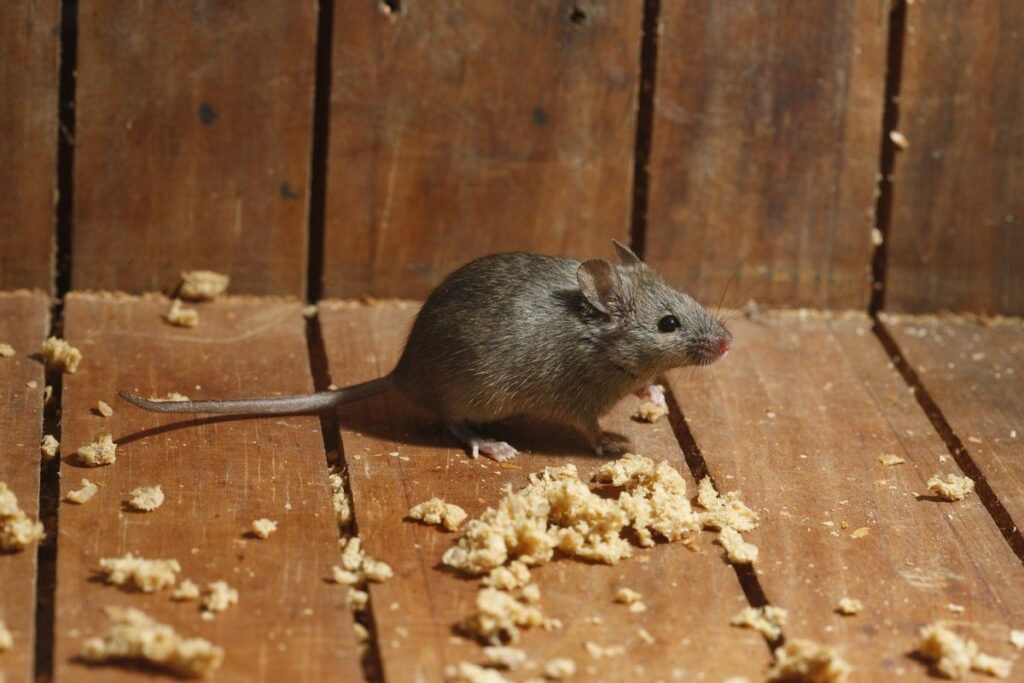
Rodents are secretive. You will typically notice the evidence long before you see an animal directly. Here are the warning signs every Dubai and Sharjah resident should recognise:
- Droppings — small, dark, pellet-shaped droppings near food storage, inside cupboards, along skirting boards, or behind appliances. Fresh droppings are soft and dark; older ones dry out and become grey.
- Gnaw marks — rats and mice gnaw constantly to keep their ever-growing incisor teeth at a functional length. Gnaw marks on food packaging, wooden furniture, cables, and structural materials are a clear sign of active infestation.
- Scratching and scurrying sounds — particularly at night, inside walls, ceilings, or beneath floors. Roof rats are especially associated with sounds from above.
- Greasy rub marks — rodents follow established routes and their fur leaves greasy marks along walls, pipes, and beams.
- Nesting material — shredded paper, fabric, insulation, and plant material gathered into a nest, typically in warm, dark, undisturbed areas.
- Food damage — gnawed food packaging, partially eaten produce, and small holes in bags or boxes in kitchen or storage areas.
- Urine odour — a strong ammonia-like smell, particularly in enclosed areas such as cupboards and store rooms.
If you have identified two or more of these signs, do not delay.
Contact Total Defence for a free inspection
3. How dangerous are rodents to my family’s health in Dubai?
Rodents are among the most significant public health threats in any urban environment. In the UAE specifically, the combination of warm climate, year-round food availability, and dense residential and commercial construction creates conditions where rodent populations can grow rapidly — and with them, the health risks they carry.
- Direct disease transmission — through bites, through contact with rodent droppings, urine, or saliva, and through handling dead rodents.
- Airborne contamination — dried rodent droppings and urine become airborne particles when disturbed during cleaning or normal activity.
- Food and water contamination — rodents contaminate food, food preparation surfaces, and water with faeces, urine, and fur. A single rat produces approximately 40 droppings and contaminates 10 times more food than it actually eats each night.
- Secondary pest introduction — rodents carry fleas, ticks, and mites into your property.
The link between rodent contamination and water system hygiene is important. If your building has a water tank issue alongside a rodent problem, our tank cleaning service and our rodent control can be combined in a single visit.
Learn more: Tank Cleaning Service
4. What diseases can rodents spread in the UAE?
- Leptospirosis — spread through contact with water or surfaces contaminated with rodent urine. Symptoms range from flu-like illness to severe liver and kidney failure (Weil’s disease).
- Salmonellosis — food poisoning from Salmonella bacteria spread when rodents contaminate food or food preparation areas. Particularly dangerous for children, elderly people, and pregnant women.
- Rat-bite fever — caused by Streptobacillus or Spirillum bacteria. Transmitted through rodent bites, scratches, or contact with rodent droppings.
- Hantavirus — inhaled from dried rodent droppings and urine. Causes severe respiratory illness with significant fatality rates.
- Murine typhus — transmitted by fleas carried by rats. Documented in the Gulf region and associated with rat-flea populations.
A rodent infestation is not merely a nuisance — it is a health emergency that warrants the same urgency as any other household safety issue.
5. How fast do rodents breed? Why you cannot wait
A female house mouse reaches sexual maturity in as little as five weeks. Her average gestation period is 19 to 21 days. She produces an average of six to eight pups per litter and can have five to ten litters per year. In ideal conditions, mouse populations can increase tenfold in under three months.
A female Norway rat reaches maturity at 5 to 6 weeks, produces 8 to 12 pups per litter, and can produce 6 to 8 litters per year. A single breeding pair and their offspring can produce over 1,000 individuals in a year under good conditions.
Every week you wait adds to the population you will need to eliminate. A problem that could be resolved with two visits today may require a more intensive, multi-week programme in a month’s time — at significantly greater cost and disruption.
Contact us today for a free inspection.
6. Can rats chewing electrical cables cause a fire in my Dubai property?
Yes — and this is one of the most serious and least discussed consequences of a rodent infestation. Fires caused by rodent damage to electrical wiring are documented across Dubai and Sharjah.
- Insulation stripping — rats and mice remove the plastic insulation from cables, leaving live conductors exposed.
- Short circuits — when two stripped cables make contact, the resulting short circuit generates heat and can cause fires inside wall cavities.
- Partial damage — partially chewed cables often remain functional, making it impossible to identify the damage through normal testing.
- Hard-to-access locations — roof spaces and wall cavities where roof rats prefer to live are also where major cable runs pass through buildings.
If you have confirmed or suspected roof rat activity in your attic or ceiling, have a qualified electrician inspect accessible cable runs as part of your pest treatment programme.
7. Can rodents contaminate my food and water supply?
Every food safety professional in Dubai and Sharjah will give you the same answer: yes, completely — and this is one of the primary reasons rodent infestations in food-handling businesses are treated as grounds for immediate shutdown by Dubai Municipality.
A single rat moving through a food storage area contaminates far more food than it consumes. Rodent saliva contains bacteria that contaminate everything it touches, and the contamination is invisible.
Store all dry goods, cereals, fruits, and vegetables in sealed hard containers. If you have found droppings in a food storage area, the affected food should be discarded and the area disinfected.
Book professional treatment immediately.
Rats actively access drainage systems and can travel through pipe networks between floors and buildings. Any building with a combined rodent and water tank issue should address both simultaneously.
Learn more: Tank Cleaning Service
8. How do rodents get into apartments and villas in Dubai and Sharjah?
A mouse can enter through a gap of just 6 mm — about the diameter of a standard pen. A rat can squeeze through a gap of 12–25 mm. Common rodent entry routes include:
- Gaps around pipes and utilities — every water pipe, gas pipe, electrical conduit, and communication cable that enters a building passes through a hole that is rarely completely sealed.
- Drainage systems — rats are excellent swimmers and can travel through drainage and sewage pipes. Unprotected drain covers are a direct entry route.
- Roof and attic access — roof rats climb walls, trees, and drain pipes to access rooflines and ventilation gaps.
- Under doors — the gap under an external door without a brush seal is wide enough for a mouse in most cases.
- Damaged building fabric — cracks in exterior walls, damaged brickwork, and gaps around window frames.
- Shared building infrastructure — in apartment buildings, shared electrical ducts and pipe chases connect all floors.
Physical exclusion — professionally sealing all identified entry points — is an essential component of any complete rodent treatment.
Our residential pest control service includes an entry-point assessment.
9. What is the difference between a rat problem and a mouse problem in terms of treatment?
- Bait station placement — rats are neophobic and will avoid newly placed stations for days to weeks. Mice are more exploratory and investigate new objects within hours.
- Travel range — rats range 50–100 metres from their nest; mice typically stay within 3–9 metres. Rat bait stations need wider coverage.
- Entry point size — mice can access gaps far smaller than rats. Complete exclusion programmes account for both species.
- Treatment timelines — due to rat neophobia, a rat eradication programme typically requires 3–4 weeks for full effect. Mouse problems can often be resolved faster.
Correct identification of the species before treatment begins is essential. Our technicians identify the species — and in many cases both are present simultaneously — before designing the treatment programme.
10. How much property damage can a rodent infestation cause?
- Structural damage — rats burrow through insulation, plasterboard, and wooden structural components.
- Water pipe damage — gnawed plastic water supply pipes cause slow leaks inside walls.
- HVAC system damage — ducting, insulation, and wiring within air conditioning systems are attractive gnawing and nesting materials.
- Furniture and fixtures — sofas, mattresses, and stored clothing are used for nesting material.
- Stock and inventory loss — for businesses, contaminated stock must be discarded.
- Reputation damage — for hospitality and food businesses, a rodent sighting by a customer or an inspection failure can be commercially devastating.
The cost of professional rodent control — a fraction of any of the above consequences — makes preventive treatment an obvious economic priority.
11. Should I try DIY rodent control from a supermarket or hardware store first?
For the very earliest stage of a mouse problem — one or two mice with a clearly identified and already-sealed entry point — a properly placed snap trap can be effective. This is a limited scenario.
For the majority of infestations in Dubai and Sharjah properties, supermarket products have consistent, well-documented limitations:
- Rodents learn from traps — after one member of a population is caught or injured, others rapidly learn to avoid it.
- Supermarket baits lack professional-grade actives — rodenticide concentrations available to consumers are significantly lower than those used by professional operators.
- Placement matters more than product — professional bait station placement is based on knowledge of rodent behaviour and runway identification.
- DIY approaches do not address the source — supermarket products kill individual rodents; they do not seal entry points or eliminate nesting sites.
- Secondary poisoning risk — consumer rodenticide products, when used incorrectly, create risk for pets, birds of prey, and non-target wildlife.
Our professional pest control service is the right approach from the outset.
12. Is rodent control in Dubai legally regulated?
Yes — and this is a point that is particularly important for commercial property owners and business operators. Under Dubai Municipality’s Public Health and Safety regulations, pest control services must be carried out by licensed operators holding a valid Dubai Municipality pest control permit.
For businesses operating in food-handling, hospitality, healthcare, and education sectors, the requirements are more specific:
- Regular pest monitoring records must be maintained and available for inspection on request
- Treatment must be carried out by licensed operators using registered products
- Pest control service reports must document the date of treatment, products used, areas covered, and findings
- Businesses subject to Dubai Municipality food establishment inspections are evaluated on their pest control records as a mandatory compliance item
Total Defence holds a valid Dubai Municipality pest control licence covering all services across Dubai, Sharjah, and Ajman. Every treatment produces a signed service report with our DM licence number.
See our commercial pest control page for compliance documentation.
13. Does Dubai Municipality require businesses to have pest control records for inspections?
Absolutely — and the consequences of failing a Dubai Municipality pest inspection are serious enough to make this a priority for every business operator. Inspectors look for:
- Evidence of current, valid pest control contract with a licensed operator
- Pest monitoring logs with dated entries showing regular inspection
- No evidence of active rodent activity (droppings, gnaw marks, live or dead rodents)
- Correctly installed and maintained bait stations where applicable
- Staff awareness of pest monitoring responsibilities
Violations related to pest control are among the most common causes of food establishment closure orders in Dubai. A single confirmed rodent sighting during an inspection can trigger an immediate closure notice.
Contact us via our commercial pest control page.
14. How does professional rodent control actually work? What does a treatment involve?
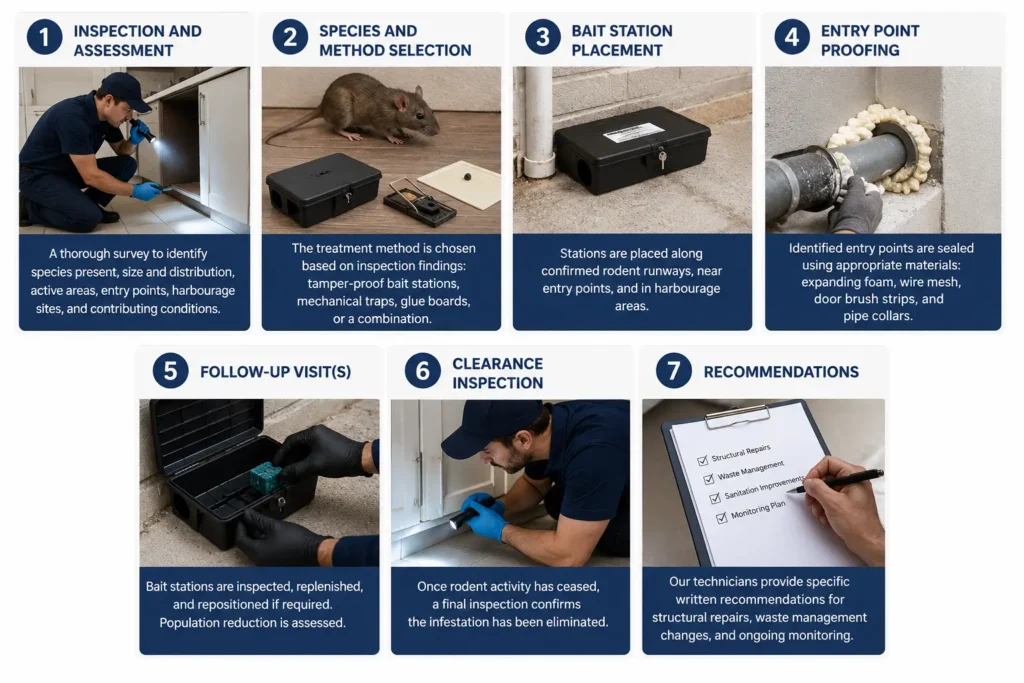
A complete Total Defence rodent control programme involves the following steps:
- Step 1 — Inspection and assessment — a thorough survey to identify species present, size and distribution, active areas, entry points, harbourage sites, and contributing conditions.
- Step 2 — Species and method selection — the treatment method is chosen based on inspection findings: tamper-proof bait stations, mechanical traps, glue boards, or a combination.
- Step 3 — Bait station placement — stations are placed along confirmed rodent runways, near entry points, and in harbourage areas.
- Step 4 — Entry point proofing — identified entry points are sealed using appropriate materials: expanding foam, wire mesh, door brush strips, and pipe collars.
- Step 5 — Follow-up visit(s) — bait stations are inspected, replenished, and repositioned if required. Population reduction is assessed.
- Step 6 — Clearance inspection — once rodent activity has ceased, a final inspection confirms the infestation has been eliminated.
- Step 7 — Recommendations — our technicians provide specific written recommendations for structural repairs, waste management changes, and ongoing monitoring.
15. How many visits are needed to get rid of a rodent problem completely?
- Minor infestation, contained area — one to two visits over 10 to 14 days is typically sufficient.
- Moderate infestation, single property — two to three visits over three to four weeks. This is the most common scenario for residential properties.
- Severe infestation or large property — a structured programme of three to four visits over four to six weeks.
Rat populations, because of their neophobia, require more time than mice for bait acceptance. Rushing this process typically leads to incomplete treatment and quicker recurrence.
Our residential pest control service covers all residential property types.
16. Is professional rodent control treatment safe for my family, children, and pets?
Safety is the first question we address at every inspection — and the answer, for a professionally conducted treatment by a licensed operator using approved products, is yes.
- Tamper-proof bait stations — all rodenticide bait is placed inside locked, tamper-proof stations that cannot be opened by children or pets.
- UAE-approved products only — all rodenticides used are registered with the UAE Ministry of Environment and approved by Dubai Municipality.
- Transparent product information — you will be told exactly which products are being used and their relevant safety data before any treatment begins.
- Re-entry guidance — for standard rodenticide treatments, no evacuation is required.
- Post-treatment clean-up guidance — we advise on safe handling of any dead rodents found after treatment.
If you have specific concerns — a very young infant at home, a pet bird, or a medically vulnerable family member — raise these at the time of booking.
17. How long does a rodent control treatment take?
- First inspection and treatment visit — 60 to 90 minutes for a standard apartment; 90 minutes to 2.5 hours for a villa; 2 to 4 hours for a commercial property.
- Follow-up visits — typically 30 to 45 minutes for a residential property.
- Large commercial properties — a multi-floor warehouse, food processing facility, or hotel requires a longer initial survey and ongoing monitoring visits.
We work around your schedule. For businesses, we offer out-of-hours treatments before opening or after closing to minimise operational disruption.
18. Do I need to leave my home or business during rodent treatment?
For the vast majority of residential and commercial rodent treatments, you do not need to vacate the property. Rodenticide bait station treatments do not involve spraying or applying any chemical to open surfaces. The bait is inside sealed, locked stations. There is no aerosol, no residue on surfaces, and no re-entry period required.
However, if your treatment programme also includes a disinfection service — which we recommend whenever there has been significant rodent activity — a short ventilation period will be required.
Our disinfection and sterilisation service can be combined with rodent treatment in a single visit.
19. What should I do to prepare before the Total Defence team arrives?
- Store all food items in sealed, hard-sided containers or move them to a room that does not require treatment
- Clear access to under sinks, behind large appliances, and inside built-in cupboards where practical
- Ensure loft hatch or attic access is clear if a roof space inspection is part of the visit
- If you have a basement, plant room, or utility area, ensure our technician can access it
- Keep pets out of areas being treated for the duration of the visit
- Let our technician know about any areas that are particularly sensitive
No deep cleaning is required before we arrive — in fact, avoid thorough cleaning of rodent-active areas immediately before treatment, as this can disturb trails and make assessment of activity levels harder.
20. How do you get rid of rats in a restaurant, hotel, or warehouse in Dubai?
Commercial rodent control in Dubai and Sharjah has additional requirements that go beyond a standard residential treatment:
- HACCP-compliant bait station positioning — in food-handling environments, bait station placement must comply with hazard analysis protocols.
- Product documentation — every product used in a food establishment must be documented with its safety data sheet, concentration, and application method.
- Treatment outside operational hours — for restaurants and food businesses, treatment should be conducted outside food service hours.
- Staff briefing — effective ongoing rodent monitoring requires trained staff who know what signs to look for and how to report them.
- Comprehensive service reports — our commercial service reports are specifically structured to satisfy Dubai Municipality inspection requirements.
Learn more: Commercial Pest Control
21. What preventive measures can I take to stop rodents coming back?
Physical exclusion
- Seal all gaps around pipe penetrations, cable entries, and utility access points with appropriate materials
- Install door brush strips on all external-facing doors
- Fit drain covers and gully guards to all drainage access points around the property
- Check and repair any cracks in exterior walls, particularly around the base of the building
- Remove or trim trees and vegetation that provides roof access to your building
Sanitation
- Store all dry food, cereals, and stored goods in sealed hard containers — never in the original packaging after opening
- Keep rubbish bins covered and empty them daily — do not allow food waste to accumulate overnight
- Remove clutter from storage rooms, utility spaces, and roof areas — rodents nest in undisturbed clutter
- Maintain clean drains and ensure no standing water accumulates around the property
Monitoring
- Conduct a quick monthly check of known rodent entry risk areas: under sinks, behind appliances, in storage rooms
- Look for droppings, gnaw marks, and grease trails during routine cleaning
- Book an annual preventive inspection — earlier identification always means simpler treatment
Our annual preventive maintenance contract includes a scheduled inspection every six months, priority call-out response if activity is detected, and discounted rates on any treatment required.
22. What is the best time of year to treat for rodents in Dubai and Sharjah?
The honest answer is: whenever you detect a problem — that is always the best time. However, understanding the seasonal patterns helps with preventive planning:
- Summer peak (June to September) — extreme outdoor temperatures drive rodents indoors in large numbers. A preventive inspection in May, before peak summer, is excellent timing.
- Post-Ramadan period — the increase in food preparation and entertaining during Ramadan and Eid periods can attract rodents to properties not previously affected.
- Winter activity — cooler temperatures from November through February reduce outdoor food sources, pushing rodents further into buildings.
- Construction nearby — if there is significant construction activity within 200 metres of your property, the probability of rodent migration increases substantially.
23. How much does rodent control cost in Dubai and Sharjah?
We are transparent about pricing — and an accurate quote requires a free inspection, because cost varies with infestation severity and property type.
Every quote comes after a free inspection. You will always know the full cost before any work begins — no surprises, no hidden fees.
For clients who combine rodent control with our building cleaning, disinfection, or tank cleaning services in a single visit, package pricing applies — often producing significant savings against booking each service separately.
See our Building Cleaning Service
Book a free inspection for your quote.
24. What guarantee does Total Defence offer for rodent control?
We stand behind our work with a 3-month warranty on all completed rodent control programmes. If rodent activity returns within three months of a completed treatment, we return and re-treat at no additional charge.
The warranty applies when:
- The treatment programme has been completed as agreed (all recommended visits completed)
- The client has followed our post-treatment recommendations regarding sealing and sanitation
- No new infestation route has been opened (e.g. structural work that creates new entry points after treatment)
For commercial clients on ongoing annual contracts, the warranty period is extended for the duration of the contract, with unlimited call-outs included.
25. How do I book rodent control in Dubai or Sharjah? Do you offer same-day appointments?
Booking is straightforward — call, WhatsApp, or use the contact form on our website:
- Phone/WhatsApp: (+971) 52 161 2380
- Email: admin@totaldefence.ae
Online: totaldefence.ae/contact
We offer same-day and next-day appointments across Dubai and Sharjah. Areas covered include all of Dubai (Deira, Bur Dubai, Al Barsha, Jumeirah, JBR, Al Quoz, Mirdif, Arabian Ranches, and all surrounding areas) and all of Sharjah (Al Nahda, Muwaileh, Al Khan, Al Majaz, and all surrounding areas). We also cover Ajman.
Final word: a rodent infestation does not get better by itself
Every rodent control professional in the UAE will tell you the same thing: the single most expensive thing you can do with a rodent problem is wait. The population grows, the damage accumulates, the risk increases — and the treatment required becomes more intensive and more costly with every week that passes.
Total Defence is a Dubai Municipality-approved pest control company. Our rodent control services cover Dubai, Sharjah, and Ajman — for homes, villas, apartments, restaurants, hotels, warehouses, offices, and all other property types. We offer:
- Free inspection and no-obligation quote
- Same-day and next-day appointments
- Dubai Municipality-compliant treatment and documentation
- 3-month warranty on all completed programmes
- Annual maintenance contracts for businesses and residential clients
- Combined packages with disinfection, tank cleaning, and building cleaning
Also read: Residential Pest Control Service
Also read: Commercial Pest Control
Ready to book? Contact Total Defence today or call (+971) 52 161 2380 for your free inspection.
Frequently Asked Questions
Q: How quickly can Total Defence respond to a rodent emergency in Dubai or Sharjah?
A: We offer same-day and next-day appointments across Dubai, Sharjah, and Ajman. Call or WhatsApp (+971) 52 161 2380 for urgent bookings.
Q: Does Total Defence provide documentation for Dubai Municipality compliance?
A: Yes. Every completed treatment produces a signed service report with our DM licence number, technician details, products used, and areas covered — suitable for Dubai Municipality inspection compliance records.
Q: Can Total Defence treat both rats and mice in the same visit?
A: Yes. Our inspection identifies all species present and the treatment programme is designed to address all of them simultaneously.
Q: Can I combine rodent control with building cleaning or disinfection?
A: Absolutely — and we recommend it for any property with significant rodent activity. Combined packages are available.
Q: Are your technicians licensed?
A: Yes. All Total Defence pest control technicians hold valid operator certifications issued by the relevant UAE authorities, and our company holds a valid Dubai Municipality pest control licence. Licence details are available on request and appear on all service documentation.
Q: What if rodents return after treatment?
A: Our 3-month warranty covers re-treatment at no additional cost if rodent activity returns within three months of a completed programme. For annual contract clients, cover extends for the full contract period with unlimited call-outs.
Q: Do you offer rodent control in Ajman as well as Dubai and Sharjah?
A: Yes. Total Defence operates across Dubai, Sharjah, and Ajman. Call us to confirm scheduling for your specific location.