
Mosquitoes in Dubai, Sharjah, and Ajman are not just a nuisance — they are active disease vectors, and a single neglected breeding site near your home or business can sustain a biting population for weeks. Total Defence is a Dubai Municipality-approved mosquito control company serving Dubai, Sharjah, and Ajman.
Book your free inspection today.
Most residents in Dubai, Sharjah, and Ajman treat mosquitoes as an unavoidable seasonal inconvenience. They buy plug-in repellents, burn coils, and accept that evenings outdoors are unpleasant for a few months of the year. That approach misses what is actually happening: every biting mosquito around your home or business is emerging from a breeding site somewhere nearby — and without eliminating that breeding site, repellents only push the problem temporarily out of sight.
This guide covers every real question that residents, villa owners, hotel operators, and business managers in Dubai, Sharjah, and Ajman ask about mosquito control — from the diseases that make this more than a comfort issue, to the professional treatment methods that deliver lasting results.
1. What types of mosquitoes are common in Dubai, Sharjah, and Ajman?
Two species are responsible for the majority of mosquito problems across the UAE:
- Aedes aegypti (Yellow fever mosquito) — the most medically significant mosquito in the UAE. Aedes aegypti is a small, dark mosquito with white markings on its legs and body. Unlike most mosquito species, it bites primarily during the day — particularly in the early morning and late afternoon — making standard evening repellent routines ineffective against it. It breeds in small, still water containers: flower pot saucers, water storage tanks without lids, blocked gutters, discarded tyres, and any small vessel that collects rainwater or irrigation runoff. Aedes aegypti is the primary vector for dengue fever, chikungunya, and Zika virus.
- Culex quinquefasciatus (Southern house mosquito) — the species most commonly encountered indoors at night across Dubai, Sharjah, and Ajman. Culex mosquitoes bite predominantly after dark and are responsible for the overnight biting that disrupts sleep. They breed in larger bodies of stagnant, organically enriched water: drainage channels, sewage overflow areas, irrigation pools, and neglected water features. Culex mosquitoes are the primary vector for West Nile virus and are associated with filariasis transmission in the broader Gulf region.
Correct species identification matters because Aedes and Culex require different treatment approaches — different breeding site targets, different application timing, and different residual treatments. A professional inspection identifies which species is responsible for the problem before treatment begins.
2. Why are mosquitoes such a significant problem in Dubai, Sharjah, and Ajman?
The UAE climate creates near-ideal conditions for mosquito breeding and activity across a large part of the year. Understanding why helps explain why off-the-shelf solutions consistently underperform.
- Warm temperatures year-round — mosquito larvae develop faster at higher temperatures. In the UAE, larval development from egg to adult can occur in as little as seven days during summer months, meaning breeding sites produce new adults continuously rather than in seasonal pulses.
- Irrigation and landscaping water — the landscaping of residential communities, hotel grounds, parks, and commercial properties in Dubai, Sharjah, and Ajman creates abundant standing water in irrigation systems, plant saucers, ornamental features, and low-lying areas. This water is often overlooked as a mosquito breeding source.
- Construction and infrastructure — active construction projects across Dubai, Sharjah, and Ajman create temporary water accumulations in excavations, drainage channels, and unused equipment. Construction sites are among the most productive mosquito breeding environments in the region.
- Water storage practices — water storage tanks, water cooler units, and rooftop cisterns are common across UAE properties. Where lids are missing, damaged, or improperly sealed, these become significant breeding sites — particularly for Aedes aegypti.
- Proximity to drainage channels — Sharjah and Ajman in particular have extensive open drainage and irrigation infrastructure that provides permanent Culex breeding habitat in close proximity to residential areas.
These conditions mean that effective mosquito control in Dubai, Sharjah, and Ajman requires a professional programme that addresses breeding sites, not just adult mosquitoes. Fogging or spraying without source reduction produces temporary results at best.
3. What diseases do mosquitoes spread in the UAE?
The following diseases are all associated with mosquito species present in the UAE and have been documented in the UAE and the wider Gulf region:
- Dengue fever — transmitted by Aedes aegypti. Dengue cases have been documented in the UAE, primarily among residents who have travelled to endemic regions but also through local transmission. Symptoms include severe fever, intense headache, muscle and joint pain, and rash. Severe dengue can cause internal bleeding and organ failure and is potentially fatal without medical care.
- Chikungunya — also transmitted by Aedes aegypti. Causes fever, severe joint pain, muscle pain, and rash. Joint pain from chikungunya can persist for months or years after the acute infection resolves, causing significant long-term disability.
- Zika virus — transmitted by Aedes aegypti. While Zika causes mild illness in most adults, infection during pregnancy is associated with serious foetal abnormalities including microcephaly. Zika has particular implications for pregnant women or those planning pregnancy in the UAE.
- West Nile virus — transmitted by Culex mosquitoes. Most infections are mild or asymptomatic, but West Nile encephalitis — inflammation of the brain — occurs in a small proportion of cases and can be fatal, particularly in older adults or immunocompromised individuals.
- Malaria — while not locally transmitted in the UAE, cases among returning travellers are documented. Culex and Anopheles mosquitoes present in the UAE can theoretically transmit malaria if they bite an infected individual, making local mosquito control a component of broader public health management.
A mosquito problem around your home or business is not merely an inconvenience. Where children, elderly family members, pregnant women, or immunocompromised individuals are present, professional mosquito control is a direct health protection measure.
4. How do I know if I have a mosquito problem that needs professional treatment?
Not every mosquito encounter requires professional intervention — but several signs indicate that a breeding population is established near your property and that consumer products will not resolve it:
- Biting indoors at night — if mosquitoes are biting you or your family indoors after dark despite closed windows, there is a Culex breeding site very close to the property — likely within 200 metres. Consumer plug-in repellents may reduce biting but do not eliminate the source.
- Biting outdoors during the day — daytime biting in a garden, courtyard, or outdoor seating area indicates Aedes aegypti activity and almost certainly a breeding site within the immediate property or adjacent area.
- Large numbers of mosquitoes at dawn or dusk — significant mosquito density at these peak activity times suggests a productive breeding site nearby that is generating large adult populations.
- Mosquitoes in rooms despite screens — if mosquitoes are present inside rooms with intact window and door screens, they are likely breeding inside the building — in a water storage area, a planter, a drain, or another internal water source.
- Recurring problem despite repeated consumer product use — if you have used sprays, coils, plug-ins, or other consumer products repeatedly without lasting effect, the breeding source has not been eliminated and professional source identification is required.
If any of these apply to your property in Dubai, Sharjah, or Ajman, contact Total Defence for a free inspection. Our technicians identify both the species responsible and the breeding sites sustaining the population before recommending treatment.
5. Where do mosquitoes breed around homes and businesses in Dubai, Sharjah, and Ajman?
Eliminating breeding sites is the single most important step in any effective mosquito control programme. The following are the most common breeding locations identified during Total Defence inspections across Dubai, Sharjah, and Ajman:
Inside the property
- Flower pot saucers and plant trays holding standing water
- Water storage tanks or containers without secure, intact lids
- Air conditioning drip trays and condensate drain lines
- Unused water features, birdbaths, or ornamental bowls
- Floor drains in utility rooms, bathrooms, or kitchens that hold residual water
Outside the property
- Blocked or slow-draining gutters holding organic debris and water
- Low-lying areas of garden or courtyard where irrigation water pools
- Water accumulated in discarded containers, tyres, buckets, or garden equipment
- Neglected swimming pools or pool covers collecting rainwater
- Irrigation system valve boxes that collect and retain water
- Gaps in boundary walls or paving where water collects after rain or irrigation
Building infrastructure
- Flat roof areas with inadequate drainage retaining shallow water
- Roof gutters and downpipes with blockages
- Underground drainage sumps or inspection chambers with standing water
- Water features in building entrances or communal areas
A professional inspection covers all of these locations systematically. Many breeding sites — particularly internal ones like AC drip trays and water tank gaps — are entirely invisible until a trained technician looks for them specifically.
6. What professional mosquito control methods does Total Defence use?
Effective mosquito control in Dubai, Sharjah, and Ajman uses a combination of methods matched to the species present, the breeding sites identified, and the type of property. Total Defence uses the following professional approaches:
- Larviciding — the application of larvicide products directly to identified breeding sites. Larvicides kill mosquito larvae before they develop into biting adults. This is the most targeted and environmentally responsible treatment method, as it eliminates the population at its source rather than after dispersal. Products used include Bacillus thuringiensis israelensis (Bti) — a naturally occurring bacterium toxic to mosquito larvae but harmless to other animals and humans — and growth regulators that prevent larvae from completing development.
- Residual spraying — the application of residual insecticide to resting surfaces: vegetation, walls, fences, under eaves, and shaded outdoor areas where adult mosquitoes rest during the day. Residual treatments remain active for 4 to 8 weeks depending on the product and surface. This is a key component of the treatment for Aedes aegypti, which rests on vegetation and shaded surfaces close to the ground.
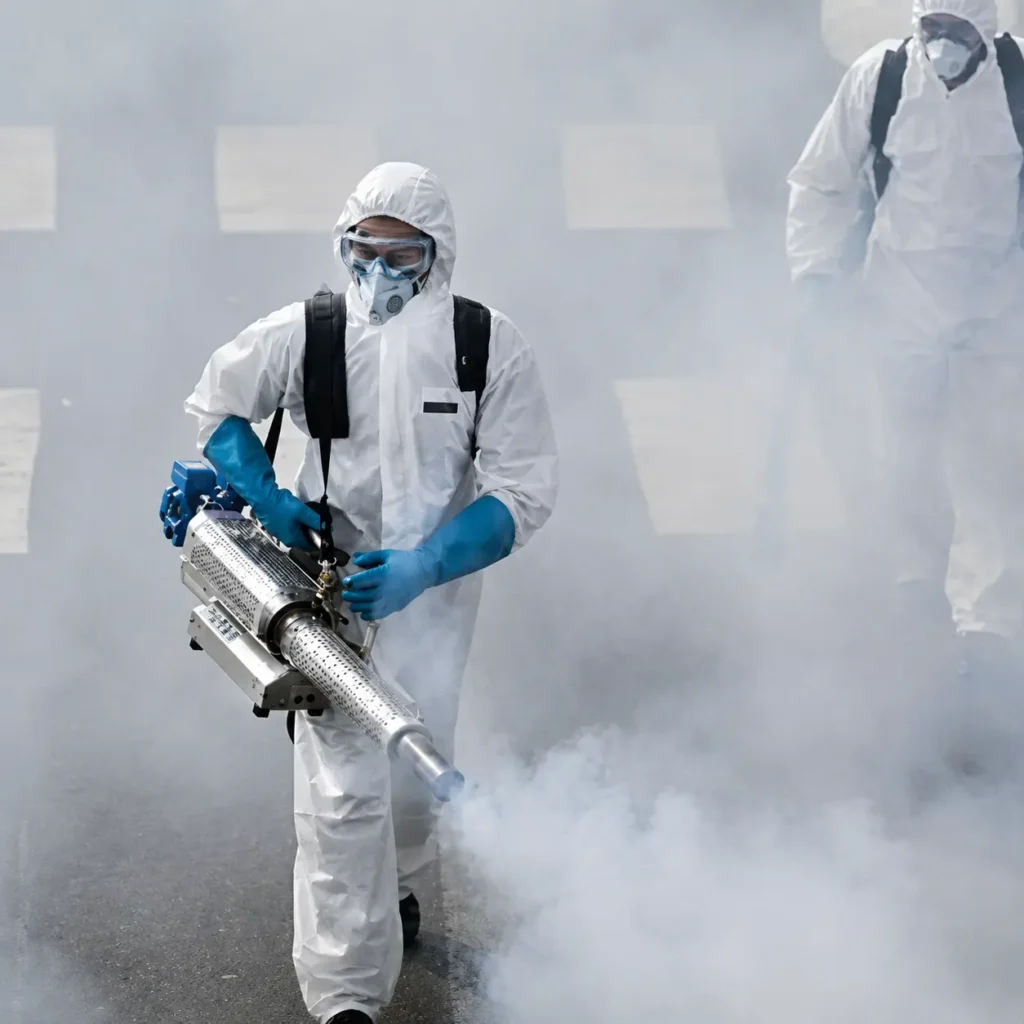
- ULV fogging (thermal or cold fog) — the generation of a fine insecticide mist that penetrates vegetation, hedges, and outdoor spaces to knock down adult mosquito populations rapidly. Fogging provides fast results and is particularly effective for large outdoor areas, hotel grounds, and construction sites. It is not a standalone solution — without larviciding and source reduction, adult populations recover within days as new adults emerge from untreated breeding sites.
- Breeding site elimination and treatment — physical removal or treatment of all identified breeding sites. This includes clearing blocked gutters, advising on drainage improvements, treating water features with mosquito dunks, and recommending physical modifications (lids for tanks, screens for drains) to prevent future breeding.
- Indoor residual treatment — for properties with confirmed indoor mosquito activity, targeted treatment of entry points, resting surfaces, and indoor breeding sites.
Every Total Defence mosquito programme combines source reduction with adult control. Fogging-only programmes that do not address breeding sites are a temporary measure that requires constant repeat applications — and we do not offer them as a complete solution.
7. Is mosquito fogging safe for my family, children, and pets in Dubai?
This is the first question we address at every residential inspection — and the answer, for professionally conducted treatment using UAE-approved products, is yes.
- UAE Ministry of Environment approved products only — all insecticides used by Total Defence are registered with the UAE Ministry of Environment and Climate Change and approved by Dubai Municipality for use in occupied residential and commercial areas.
- Correct application rates — professional operators apply insecticides at rates calibrated to be effective against mosquitoes while remaining safe for humans and non-target animals. Consumer products, used without calibration, are often applied at rates far above what is necessary.
- Re-entry periods — for outdoor ULV fogging, a short re-entry period (typically 30 to 60 minutes) allows the mist to disperse before residents return to treated areas. Our technician will give you specific guidance for your property.
- Pet safety — fish ponds and aquariums should be covered during and for a short period after outdoor fogging, as some insecticides are toxic to fish at very low concentrations. Our technician will advise on this specifically. Dogs, cats, and birds can typically return to treated areas after the re-entry period.
- Bti larvicide safety — Bti-based larvicides applied to water features, drains, and storage areas are non-toxic to humans, pets, birds, and beneficial insects. They are approved for use in drinking water storage.
If you have specific concerns — a household member with respiratory conditions, a fish pond, a very young infant, or particular sensitivity to chemical products — raise these at the time of booking and we will design the treatment approach accordingly.
8. How many visits does a mosquito treatment programme require?
The number of visits required depends on the severity of the infestation, the number and type of breeding sites identified, and the property size.
- Single-source, contained problem — where a specific breeding site has been identified and eliminated, and the property has no other standing water sources, a single treatment visit followed by one follow-up after 2 to 3 weeks may be sufficient.
- Standard residential programme — for a villa or apartment with multiple potential breeding sites in Dubai, Sharjah, or Ajman, a programme of two to three visits over four to six weeks is typical. The first visit addresses breeding sites and applies residual treatment; follow-up visits assess rebound activity and treat any newly identified sources.
- Ongoing seasonal programme — for properties that experience recurring mosquito problems due to their location (near drainage channels, irrigation areas, or construction), a monthly maintenance programme during the high-risk season (April to October) provides the most reliable protection.
- Commercial and large properties — hotels, residential communities, restaurant gardens, and large villas require a structured programme with multiple application zones and regular monitoring visits. These are quoted after a site survey.
For our residential mosquito control programmes across Dubai, Sharjah, and Ajman, contact us to discuss the right programme for your property.
Residential Pest Control Service
9. Do I need to prepare my home before a mosquito treatment visit?
A small amount of preparation makes the treatment more effective and faster to complete:
- Remove or cover children’s toys, outdoor furniture cushions, and any items that you do not want exposed to residual spray in garden or terrace areas
- Cover or temporarily remove fish ponds or outdoor aquariums, or inform our technician of their location so they can be avoided or specifically protected
- Ensure our technician has access to all outdoor areas including back gardens, side passages, roof terraces, and any utility areas
- If the treatment includes indoor areas, clear access to floor drains, under-sink areas, and AC units
- Keep children and pets indoors or away from treatment areas during the visit and for the re-entry period advised by our technician
- Empty and invert any outdoor containers that collect water — buckets, plant saucers, storage trays — before the visit if possible
No major cleaning or preparation is required. Our technician will conduct a thorough inspection before treatment begins and will guide you on any property-specific preparation needed.
10. What is the best time of year for mosquito control treatment in Dubai, Sharjah, and Ajman?
Mosquito activity in the UAE follows a clear seasonal pattern, and understanding it helps with both treatment timing and preventive planning:
- Peak season: April to October — rising temperatures from April onwards accelerate larval development and adult activity. By May and June, mosquito populations in Dubai, Sharjah, and Ajman reach their highest levels of the year. The combination of heat, irrigation activity, and construction water creates near-ideal breeding conditions throughout this period.
- Preventive treatment: March to April — treating before peak season begins — larviciding known breeding sites and applying residual treatments — significantly reduces the adult population that establishes itself in summer. A pre-season inspection in March or April is the most cost-effective investment for properties that experience recurring problems.
- Post-rain activity — rainfall events in the UAE, though infrequent, create widespread temporary breeding sites across flat surfaces, low-lying ground, and blocked drainage systems. The 2 to 3 weeks following significant rainfall typically produce a sharp increase in adult mosquito numbers. A targeted treatment visit after rain events prevents this surge.
- Winter activity — from November through February, cooler temperatures suppress mosquito activity but do not eliminate it. Culex mosquitoes in particular continue to breed in drainage systems and can remain active during warm winter spells. Properties near drainage channels or with indoor breeding sites may experience year-round problems.
We recommend a pre-season inspection in March or April for any property in Dubai, Sharjah, or Ajman that has experienced mosquito problems in previous years. Contact us to book.
11. How do mosquitoes get into apartments and buildings in Dubai and Sharjah?
Understanding entry routes helps with both treatment design and long-term prevention:
- Window and door gaps — the most common entry route for indoor mosquitoes. Damaged screens, gaps around door frames, and windows left open without screens allow direct entry. Aedes aegypti, being a daytime biter, is frequently introduced this way during morning or afternoon hours.
- AC systems and ventilation — split AC units, ducted systems, and ventilation grilles that are not properly screened can allow mosquito entry, particularly from outdoor units installed on balconies or in utility areas adjacent to vegetation.
- Internal breeding sites — mosquitoes found inside a building that has intact screens are almost certainly breeding inside. Common internal sources include AC condensate trays, water features in building lobbies, planter drainage systems, and storage water with uncovered access points.
- Shared building infrastructure — in apartment buildings, open drainage systems, service ducts, and communal areas can allow mosquitoes to move between floors and units. A building-level mosquito problem often cannot be resolved by treating individual apartments in isolation.
- Deliveries and plants — Aedes aegypti eggs are highly desiccation-resistant and can survive dry conditions for months. They are frequently introduced into properties on purchased plants, cut flowers, and water containers. Eggs hatch when water is added, establishing a new breeding population inside the property.
For apartment buildings and residential communities in Dubai, Sharjah, and Ajman, we offer building-level and community-level programmes that address the problem at source — not just individual unit treatments that leave shared infrastructure untreated.
See our Commercial Pest Control page.
12. Can mosquitoes breed in my building’s water tank?
Yes — and this is one of the most important and most overlooked mosquito breeding sources in UAE residential and commercial buildings.
Water storage tanks — whether rooftop tanks, underground cisterns, or intermediate buffer tanks — are productive Aedes aegypti breeding sites wherever access points are unsealed or lids are missing, damaged, or improperly fitted. A single water tank providing access to mosquitoes can sustain a significant population within the building entirely independently of any outdoor source.
Signs that your water tank may be contributing to a mosquito problem include: mosquitoes found indoors consistently despite no obvious outdoor source; Aedes aegypti activity (daytime biting) inside the building; and larvae visible in water drawn from storage tanks.
Total Defence offers a combined water tank inspection, cleaning, and mosquito treatment service. If your building has a water tank issue alongside a mosquito problem, both can be addressed in a single programme visit.
Learn more: Water Tank Cleaning Service
13. Is mosquito control in Dubai legally regulated for businesses?
Yes — and the requirements are particularly relevant for businesses in hospitality, food service, healthcare, and property management.
Under Dubai Municipality regulations, pest control — including mosquito control — in commercial premises must be conducted by licensed operators holding a valid Dubai Municipality pest control permit. Treatment records must be available for inspection and must document the date of treatment, products used, and areas covered.
For outdoor hospitality venues, hotel grounds, restaurant terraces, and residential community management in Dubai, Sharjah, and Ajman, mosquito control is not optional — it is a direct requirement of food establishment and hospitality licensing. Dubai Municipality inspections of outdoor food service areas evaluate pest control records, including mosquito control, as a compliance item.
Total Defence holds a valid Dubai Municipality pest control licence covering all services including mosquito control across Dubai, Sharjah, and Ajman. Every treatment produces a signed service report with our DM licence number — suitable for Dubai Municipality inspection records.
See our Commercial Pest Control page for compliance documentation.
14. How does a Total Defence mosquito control programme work? What does a visit involve?
A complete Total Defence mosquito control programme involves the following steps:
- Step 1 — Inspection and species identification — a thorough survey of the property to identify the mosquito species present, all active and potential breeding sites, resting areas, and entry points. The treatment programme is designed based on these findings, not applied generically.
- Step 2 — Breeding site elimination — physical removal or treatment of all identified breeding sites. Where physical elimination is not possible (drainage channels, permanent water features), larvicide is applied to prevent larval development.
- Step 3 — Larviciding of residual water sources — all water bodies that cannot be drained are treated with Bti-based or growth-regulator larvicide. Treatment is applied to drainage sumps, irrigation valve boxes, roof drainage, and any other water source identified during inspection.
- Step 4 — Residual spray application — residual insecticide is applied to all adult resting surfaces: vegetation, walls, fencing, under eaves, shaded ground-level surfaces, and any other confirmed or likely resting habitat. This provides ongoing adult knockdown as new adults emerge from any untreated or missed breeding sites.
- Step 5 — ULV fogging (where appropriate) — for properties with significant adult populations or large outdoor areas, ULV cold fog or thermal fog is applied to achieve rapid adult knockdown. Fogging is always combined with larviciding, not used as a standalone treatment.
- Step 6 — Follow-up visit — two to three weeks after initial treatment, a follow-up visit assesses the reduction in activity, identifies any new breeding sites, and applies additional larvicide or residual spray as required.
- Step 7 — Written recommendations — our technicians provide specific recommendations for structural modifications, drainage improvements, and ongoing prevention to reduce the risk of recurrence.
15. What preventive measures can I take to reduce mosquitoes around my home?
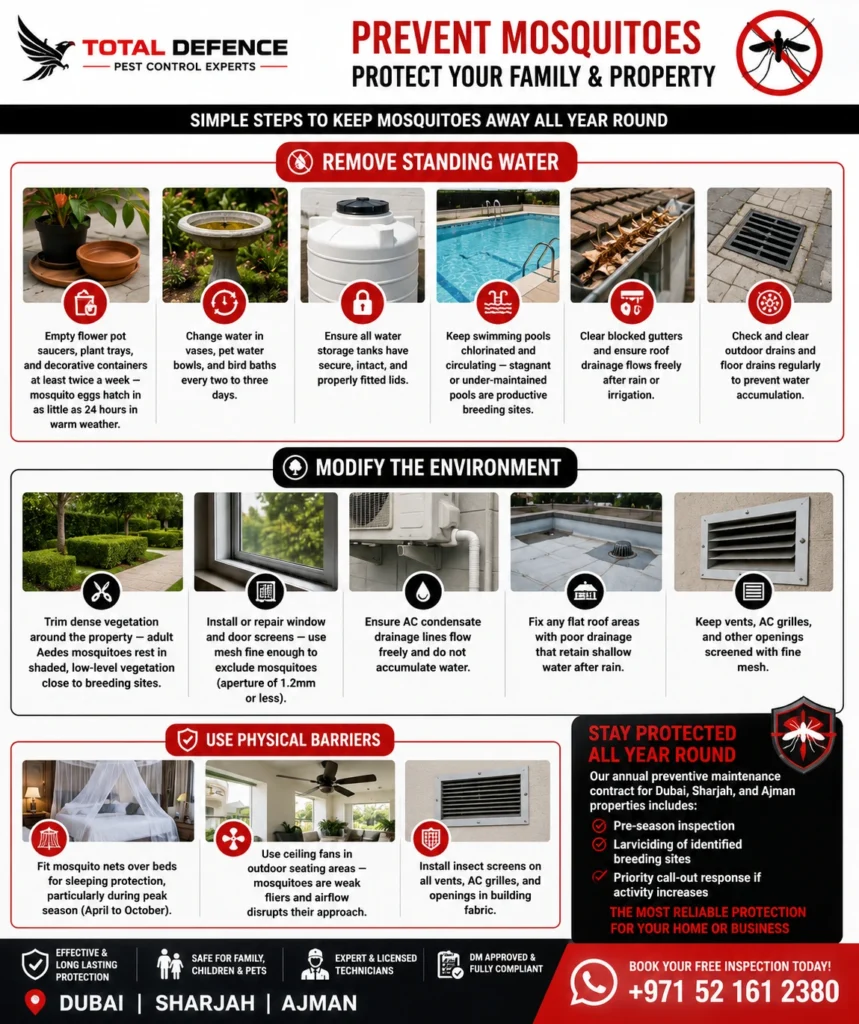
Long-term mosquito prevention in Dubai, Sharjah, and Ajman is built on source reduction — eliminating every standing water source that can support larval development. Practical steps:
Remove standing water
- Empty flower pot saucers, plant trays, and decorative containers at least twice a week — mosquito eggs hatch in as little as 24 hours in warm weather
- Change water in vases, pet water bowls, and bird baths every two to three days
- Ensure all water storage tanks have secure, intact, and properly fitted lids
- Keep swimming pools chlorinated and circulating — stagnant or under-maintained pools are productive breeding sites
- Clear blocked gutters and ensure roof drainage flows freely after rain or irrigation
Modify the environment
- Trim dense vegetation around the property — adult Aedes mosquitoes rest in shaded, low-level vegetation close to breeding sites
- Install or repair window and door screens — use mesh fine enough to exclude mosquitoes (aperture of 1.2mm or less)
- Ensure AC condensate drainage lines flow freely and do not accumulate water
- Fix any flat roof areas with poor drainage that retain shallow water after rain
Use physical barriers
- Fit mosquito nets over beds for sleeping protection, particularly during peak season (April to October)
- Use ceiling fans in outdoor seating areas — mosquitoes are weak fliers and airflow disrupts their approach
- Install insect screens on all vents, AC grilles, and openings in building fabric
Our annual preventive maintenance contract for Dubai, Sharjah, and Ajman properties includes a pre-season inspection, larviciding of identified breeding sites, and priority call-out response if activity increases — providing the most reliable year-round protection.
16. How do you control mosquitoes in a hotel, restaurant, or residential community in Dubai?
Commercial mosquito control in Dubai, Sharjah, and Ajman has specific requirements that go beyond a standard residential treatment:
- Outdoor hospitality areas — restaurant terraces, hotel pool areas, and garden dining spaces require regular residual spray and fogging programmes timed around operational schedules. Treatment is conducted before opening hours to ensure guest comfort and product safety.
- HACCP compliance — for outdoor food service areas, all products used must be documented and compatible with food handling environments. Our commercial service reports include full product documentation suitable for food safety audits.
- Residential community management — large communities in Dubai, Sharjah, and Ajman with communal landscaping, irrigation systems, and drainage infrastructure require a building-level programme covering all common areas, not just individual units. We offer community-level contracts covering all shared outdoor and infrastructure areas.
- Construction site mosquito control — active construction projects are among the most productive mosquito breeding environments in the region. Our construction site programmes include drainage management, larviciding of accumulated water, and regular fogging to protect workers and neighbouring properties.
- Compliance documentation — every commercial mosquito treatment produces a signed service report with our DM licence number, products used, areas treated, and findings — structured to meet Dubai Municipality inspection requirements.
Learn more: Commercial Pest Control
17. What guarantee does Total Defence offer for mosquito control?
We stand behind our work with a 3-month warranty on all completed mosquito control programmes. If mosquito activity returns to treated areas within three months of a completed programme, we return and re-treat at no additional charge.
The warranty applies when:
- The full treatment programme has been completed as agreed (all recommended visits)
- The client has followed our post-treatment recommendations regarding standing water elimination and ongoing prevention
- No new breeding sources have been introduced to the property (e.g. new planters, water features, or structural changes that create new water accumulation)
For commercial clients and residential communities on ongoing annual contracts across Dubai, Sharjah, and Ajman, the warranty extends for the full contract period with unlimited call-outs included — providing continuous, compliance-ready protection.
18. How much does mosquito control cost in Dubai, Sharjah, and Ajman?
We are transparent about pricing — and an accurate quote requires a free inspection, because the cost varies significantly with property size, number of breeding sites, and the treatment programme required.
Every quote comes after a free inspection. You will always know the full cost before any work begins — no surprises, no hidden fees.
For clients who combine mosquito control with our disinfection, tank cleaning, or general pest control services in a single visit, package pricing applies — often producing significant savings against booking each service separately.
See our Disinfection and Sterilisation Service
See our Water Tank Cleaning Service
Book your free inspection and quote.
19. How do I book mosquito control in Dubai, Sharjah, or Ajman? Do you offer same-day appointments?
Booking is straightforward — call, WhatsApp, or use the contact form on our website:
- Phone/WhatsApp: (+971) 52 161 2380
- Email: admin@totaldefence.ae
Online: totaldefence.ae/contact
We offer same-day and next-day appointments across Dubai, Sharjah, and Ajman. For urgent situations — a dengue concern, an outdoor event within 24 hours, or a hospitality inspection scheduled immediately — same-day response is available in most areas.
Areas covered include all of Dubai (Deira, Bur Dubai, Al Barsha, Jumeirah, JBR, Al Quoz, Mirdif, Arabian Ranches, and all surrounding areas), all of Sharjah (Al Nahda, Muwaileh, Al Khan, Al Majaz, and all surrounding areas), and Ajman.
Final word: the breeding site is the problem — not the mosquito you can see
Consumer repellents, coils, and plug-in devices address the symptom. They do not eliminate the breeding population producing new adults every seven to ten days. The only way to achieve a lasting reduction in mosquito activity around your Dubai, Sharjah, or Ajman home or business is to identify and eliminate or treat the breeding sources — and that requires a professional inspection.
Total Defence is a Dubai Municipality-approved pest control company serving Dubai, Sharjah, and Ajman. Our mosquito control services cover all property types — residential villas, apartments, hotels, restaurant terraces, residential communities, warehouses, construction sites, and offices. We offer:
- Free inspection and no-obligation quote
- Same-day and next-day appointments across Dubai, Sharjah, and Ajman
- Dubai Municipality-compliant treatment and full compliance documentation
- 3-month warranty on all completed programmes
- Annual maintenance contracts for businesses and residential clients
- Combined packages with disinfection, tank cleaning, and general pest control
Also read: Residential Pest Control Service
Also read: Commercial Pest Control
Also read: Water Tank Cleaning Service
Ready to book? Contact Total Defence today or call (+971) 52 161 2380 for your free inspection.
Frequently Asked Questions
Q: How quickly can Total Defence respond to a mosquito problem in Dubai, Sharjah, or Ajman?
A: We offer same-day and next-day appointments across all three emirates. Call or WhatsApp (+971) 52 161 2380 for urgent bookings.
Q: Is mosquito fogging safe for children and babies?
A: Yes, when conducted by a licensed professional using UAE-approved products at correct application rates. For very young infants or household members with respiratory conditions, our technician will advise on specific precautions for your property.
Q: Can you treat the mosquito problem in just the garden without treating indoors?
A: Yes — outdoor-only programmes are available and are appropriate where the mosquito problem is confined to garden or terrace areas. However, if indoor biting is occurring, an indoor inspection is required to identify and treat any internal breeding sources.
Q: How long does mosquito fogging take?
A: For a standard villa garden in Dubai, Sharjah, or Ajman, a combined inspection, larviciding, and residual spray visit typically takes 45 to 90 minutes. Larger properties and commercial sites take longer and are quoted individually.
Q: Does Total Defence provide documentation for Dubai Municipality compliance?
A: Yes. Every completed treatment produces a signed service report with our DM licence number, technician details, products used, and areas covered — suitable for Dubai Municipality inspection compliance records.
Q: Can I combine mosquito control with a tank cleaning service?
A: Absolutely — and we recommend combining both for any property where a water tank may be contributing to the mosquito problem. Combined packages produce cost savings and ensure the root cause is fully addressed.
Q: Do you offer mosquito control in Ajman as well as Dubai and Sharjah?
A: Yes. Total Defence operates across Dubai, Sharjah, and Ajman. Call us to confirm scheduling and coverage for your specific location in Ajman.
Q: What is the difference between fogging and residual spray for mosquito control?
A: Fogging (ULV or thermal) provides rapid knockdown of adult mosquitoes currently present — results are visible within hours but last only days as new adults emerge from untreated breeding sites. Residual spray is applied to resting surfaces and remains active for 4 to 8 weeks, killing mosquitoes that land on treated surfaces. An effective programme uses both in combination with larviciding — fogging alone without source reduction is a temporary measure only.