
The Problem, The Fix, and When to Call the Professionals
A no-nonsense expert guide from Dubai’s trusted bird control and pest management specialists
Why Pigeons and Birds Are a Serious Problem in Dubai — Not Just a Nuisance
Let’s be direct. If pigeons have found your balcony, rooftop, or A/C ledge in Dubai, they are not going to leave on their own. Not next week. Not next season. Once a bird establishes a roost or a nest on your property, it marks the site with pheromones in its droppings, signals to other birds, and the colony grows. A pair of pigeons becomes ten. Ten becomes forty. And the damage — structural, hygienic, financial — compounds with every passing month.
This guide is written for Dubai property owners, facilities managers, and business operators who want straight answers: what is the bird problem, why does it happen specifically in Dubai, how do you fix it properly using bird spikes or bird netting, and when does it become a job for a licensed professional? We’ll also answer the most common questions our clients ask before, during, and after installation.
Total Defence has been protecting Dubai homes and businesses from pest and hygiene threats across the emirate. Bird control — specifically humane, permanent, climate-tested spike and netting installation — is one of our most requested services. Everything in this guide reflects real field experience from Dubai’s rooftops, warehouses, villas, and commercial towers.
Section 1: What Is the Bird Problem in Dubai?
The Species You’re Actually Dealing With
Not all birds are the same problem. The approach, product, and mesh size you need depends entirely on which species has colonised your property. Total Defence technicians identify the species first — before recommending anything. Here is what we encounter most frequently across Dubai:
- The dominant urban pest bird in Dubai. They nest on any horizontal surface above two metres — parapet walls, A/C frames, balcony railings, window ledges, rooftop HVAC units. A single breeding pair produces up to 6 clutches per year under Dubai’s warm conditions, meaning numbers escalate rapidly. Their droppings are the most damaging, most common, and most health-relevant issue our clients face.Feral Pigeons (Columba livia):
- Small, social, and nesting in ventilation gaps, solar panel undersections, signage cavities, and ceiling spaces. Their nests are fire hazards when located near electrical components. Sparrow problems require 19mm mesh netting — larger mesh is useless against them.House Sparrows:
- Highly intelligent and territorial. They displace other wildlife, damage facades, and are notoriously difficult to deter with amateur-grade products. UAE population has grown significantly with urban expansion.Common Mynas:
- Found in high concentrations around Dubai Marina, JBR, Palm Jumeirah, and the coastal strip. They are aggressive during nesting season and will divebomb humans protecting their territory. Seagull colonies on restaurant terraces are a serious commercial and safety issue.Seagulls:
- Migratory. They build mud nests on external walls and inside warehouse openings. Some swallow species carry UAE wildlife protection considerations — which means prevention before nesting is legally critical.Swallows:
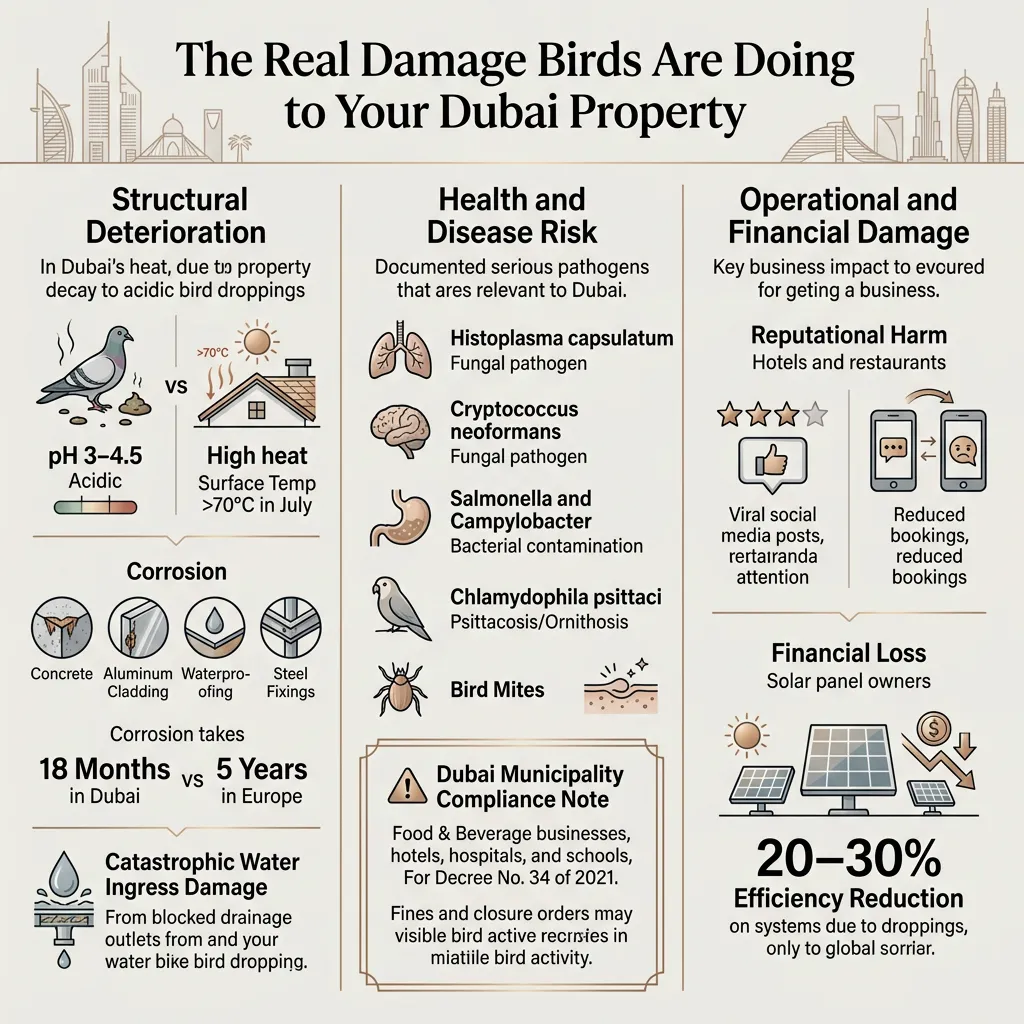
The Real Damage Birds Are Doing to Your Dubai Property
1. Structural Deterioration — Faster Than You Think
Bird droppings have a pH of 3 to 4.5 — highly acidic. On a Dubai rooftop in July, where surface temperatures exceed 70°C, that acidity reacts with concrete, painted surfaces, aluminium cladding, waterproofing membranes, and steel fixings at an accelerated rate compared to cooler climates. Corrosion that would take five years in Europe can occur within 18 months on a Dubai rooftop covered in pigeon droppings. We have inspected properties where drainage outlets have been completely blocked by nesting debris — resulting in catastrophic water ingress damage that cost tens of thousands of dirhams to rectify. All of it avoidable with a few hundred dirhams of professionally installed bird spikes.
2. Health and Disease Risk — Documented, Serious, Dubai-Relevant
Bird droppings are not merely unpleasant. They are documented vectors for serious human disease. The pathogens most relevant to Dubai’s property owners and facility managers include:
- A fungal pathogen found in pigeon and starling droppings. Causes Histoplasmosis, a respiratory illness that mimics pneumonia. In immunocompromised individuals, it is life-threatening.Histoplasma capsulatum —
- Found in pigeon droppings. Causes Cryptococcosis, which can progress to meningitis.Cryptococcus neoformans —
- Bacterial contamination from bird droppings near food preparation or storage areas. For Dubai’s food and beverage businesses, this is a direct regulatory and liability exposure.Salmonella and Campylobacter —
- Causes Psittacosis (parrot fever / ornithosis), a serious flu-like illness. Transmitted by inhaling dried bird droppings.Chlamydophila psittaci —
- When birds nest on or in a property, bird mites follow. They migrate from nesting sites into internal spaces and bite humans. We regularly receive calls from Dubai tenants experiencing unexplained biting and skin irritation — only to discover a pigeon nest in an A/C unit or ceiling void above them.Bird Mites —
| ⚠️ Dubai Municipality Compliance NoteFood and beverage businesses, hotels, hospitals, schools, and food processing facilities operating in Dubai are subject to Dubai Municipality’s Food Safety Regulations under Decree No. 34 of 2021 and the associated HSE framework. Visible bird activity, bird droppings near food handling areas, or evidence of bird nesting in hygiene-critical zones are notifiable deficiencies that can result in inspection failures, fines, and business closure orders. Bird control is not optional for licensed food businesses in Dubai — it is a regulatory requirement. |
3. Operational and Financial Damage
Consider a Dubai hotel with an outdoor rooftop bar or terrace dining — one of the most competitive segments of the city’s hospitality industry. Visible pigeon activity, droppings on furniture, or birds landing near guests causes immediate reputational harm. A single viral social media post or a Google review mentioning ‘pigeons on the terrace’ can reduce bookings measurably. For solar panel owners — increasingly common on Dubai villas and commercial buildings — research consistently shows that bird droppings on panels reduce output efficiency by 20–30%. On a 20-panel system, that is a significant financial loss compounding daily.
Section 2: Why Does the Bird Problem Happen in Dubai?
Dubai Is Accidentally the Perfect Bird Habitat
This is the part most bird control guides skip, and it’s the most important thing to understand if you want a solution that actually works long-term. Birds don’t randomly choose your property. They choose it because it meets specific criteria — shelter, food access, water, safety from predators, and lack of deterrents. Dubai’s urban environment satisfies all of these criteria extremely well.
Climate: Year-Round Breeding Conditions
In Europe or North America, bird populations are regulated by cold winters that reduce food supply and create breeding-season limits. Dubai has no such regulation. Year-round warm temperatures mean pigeons and mynas can breed continuously — up to 6 breeding cycles per year compared to 2–3 in cooler climates. This is why Dubai bird problems escalate faster than property owners expect.
Construction Boom: An Endless Supply of Nesting Sites
Dubai’s extraordinary construction pace creates new rooftops, new ledges, new equipment platforms, and new scaffolding every month. Every new building that goes up without anti-bird measures pre-installed is another nesting site added to the urban ecosystem. By the time residents move in, birds have often already scouted the site. We strongly advise all Dubai developers and property managers to include bird proofing in their pre-handover specification — it is always cheaper than retrospective installation after a colony is established.
Food Availability: Restaurants, Dumpsters, and Outdoor Dining
Dubai’s density of restaurants, open-air food courts, hotel terraces, construction workers’ meal areas, and accessible waste infrastructure means food is available within metres of almost any urban location. A single outdoor dining establishment without a disciplined waste management protocol can sustain a pigeon colony of 50+ birds indefinitely. Our bird control installations for commercial food businesses are often accompanied by advice on food waste hygiene — addressing the root cause alongside the symptom.
Lack of Natural Predators
Falcons are Dubai’s traditional bird deterrent — and the city has a rich falconry heritage. But urban falcons cannot cover every building, every ledge, every day. Urban bird populations in Dubai have no meaningful natural predator pressure in most residential and commercial zones. Human-installed deterrents — spikes, netting, wire systems — fill the gap that nature no longer provides.
The Infestation Escalation Cycle
Here is a pattern we see repeatedly: a property owner notices a few pigeons on their balcony. They shoo them away. The birds return. Nesting begins. Droppings accumulate. More birds arrive — attracted by the pheromone markers in the droppings. Within 3-6 months, a balcony that had 2 birds now has 20. The cleaning cost grows, the smell becomes unbearable, and the first bird mites appear inside the apartment. At that point, the installation cost is higher, the cleaning cost is higher, and the droppings have already caused measurable surface damage. Early intervention is always the correct economic decision.
For a broader view of the pest pressures Dubai properties face — and how bird control integrates with comprehensive pest management — visit Total Defence’s Pest Control overview page.
Section 3: How to Fix the Bird Problem — Bird Spikes and Bird Netting Explained
The Two Proven Physical Deterrents
There are many products marketed as bird control solutions in Dubai: ultrasonic devices, chemical repellents, visual scare items, gel applications, and more. Our honest assessment, based on years of field work across Dubai’s climate conditions, is this: physical exclusion systems — bird spikes and bird netting — are the only solutions that reliably work long-term in Dubai’s environment. Here is why each one works, what it does, and where it belongs.
SOLUTION A: Bird Spikes Dubai — Precision Surface Deterrence
What Exactly Are Bird Spikes?
Bird spikes are purpose-designed deterrent strips: a UV-stabilised polycarbonate or marine-grade stainless steel base strip fitted with multiple thin, angled rods. When installed on a ledge, rail, or surface, they create an irregular, unstable landing area that birds physically cannot perch on. The rods do not injure birds — they simply make the surface unusable as a landing or roosting point. Birds immediately recognise the incompatibility and seek alternative locations.
It is the equivalent of covering a parking space with traffic cones. The cones don’t harm anyone — they just make the space unavailable. Birds are not stupid; they move on within a few visits.
The Types of Bird Spikes Total Defence Installs in Dubai
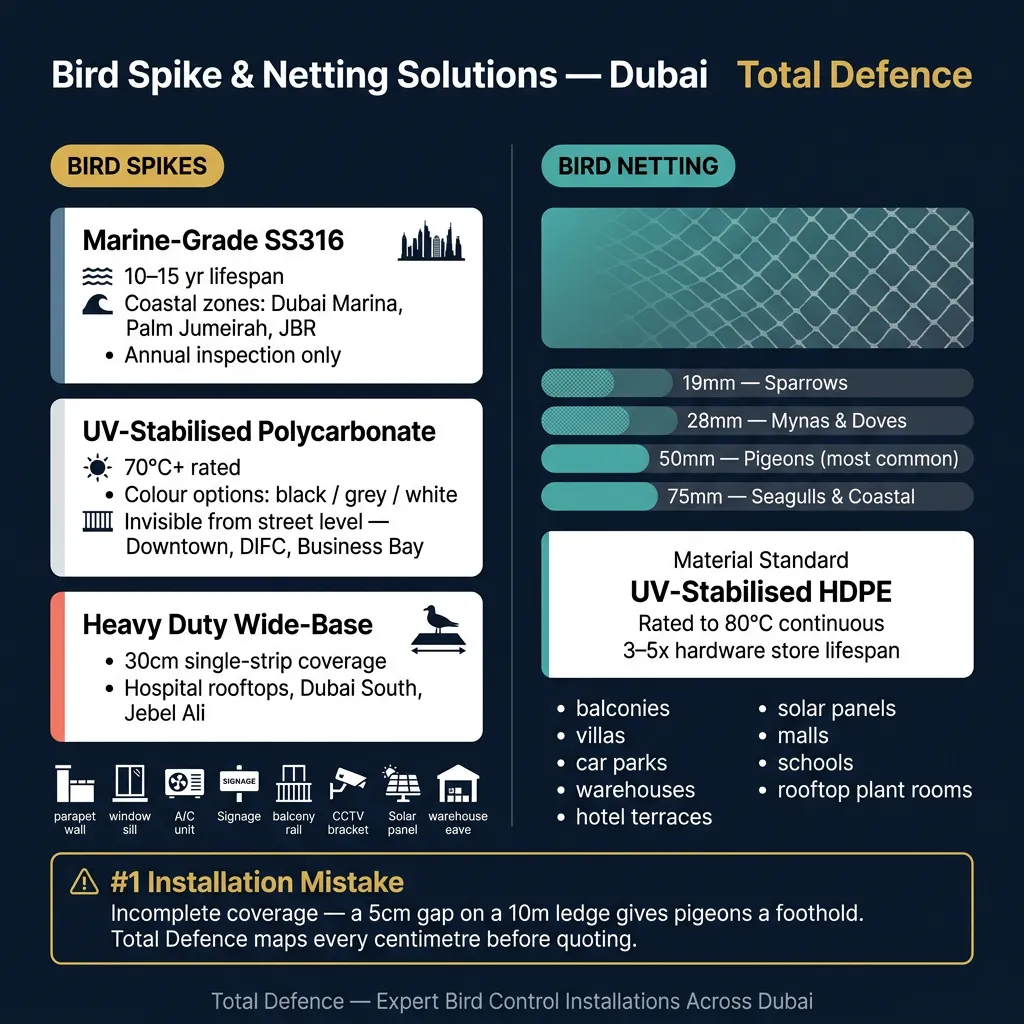
Marine-Grade Stainless Steel (SS316)
This is our recommendation for all coastal and high-exposure Dubai locations: Dubai Marina, Palm Jumeirah, JBR, Jumeirah Beach, and any property within 2km of the Gulf coastline where salt-laden air dramatically accelerates corrosion of lesser metals. SS316 spikes have a proven operational lifespan of 10–15 years in Dubai conditions and require nothing more than an annual inspection. For commercial properties and high-rises, stainless steel is the only grade we recommend.
UV-Stabilised Polycarbonate
For residential properties where aesthetics are a priority — particularly on balconies in premium buildings in Downtown Dubai, DIFC, Business Bay, and Emirates Hills — UV-grade polycarbonate spikes in black, grey, or white can be colour-matched to the substrate. From street level or from neighbouring buildings, they are essentially invisible. The critical detail: standard polycarbonate spike strips (commonly found in hardware stores) are NOT UV-stabilised to Dubai standards. They yellow, become brittle, and fail within 12–18 months. Total Defence only sources commercial-grade UV-stabilised product rated for sustained 70°C+ surface temperatures.
Heavy Duty Wide-Base Spikes
Standard spike arrays have a coverage width of approximately 12–15cm. For wide ledges, parapet copings, and surfaces where seagulls or larger pigeon species are the target, wide-base heavy-duty systems provide coverage up to 30cm in a single strip. These are specified for coastal commercial properties, hospital rooftops, and industrial facilities in Dubai South and Jebel Ali where larger bird species are the primary concern.
Where Bird Spikes Are Used Across Dubai Properties
- Parapet walls and rooftop copings on Dubai villas, apartments, and commercial buildings
- Window sill ledges — particularly south-facing ledges that receive full sun and maximum pigeon traffic
- Air conditioning unit frames and chiller plant room edges
- Building signage, illuminated sign boxes, and billboard frames
- Balcony top rails and glass balustrade caps
- CCTV mounting arms, antenna brackets, and rooftop telecom equipment
- Solar panel perimeter frames (spike array along outer edge; netting for undersection)
- Warehouse eaves and roof overhangs in Al Quoz, JAFZA, Dubai South, and Dubai Industrial City
| ✅ Expert Insight: The #1 Bird Spike Installation Mistake in DubaiThe most common reason a bird spike installation fails is incomplete coverage. Birds don’t give up — they probe the treated surface for any gap. A 5cm gap in spike coverage on a 10-metre ledge is enough for pigeons to establish a new foothold, rendering the entire installation ineffective. Total Defence technicians conduct a systematic perimeter survey before quoting, mapping every centimetre of surface that requires treatment. ‘Good enough’ coverage is not coverage at all. |
SOLUTION B: Bird Netting Dubai — Complete Area Exclusion
What Is Bird Netting and Why Is It Different?
Bird netting is a different philosophy from bird spikes. Spikes deter birds from landing on a specific surface. Netting excludes birds from entering a defined space entirely. It is a physical barrier — a tensioned net suspended on a stainless steel wire cable framework — that closes off an open area and makes it permanently inaccessible to birds of the targeted species.
Netting is the right solution when the problem is not just ‘birds landing on ledges’ but ‘birds living in my balcony’, ‘birds inside my warehouse’, ‘birds nesting under my solar panels’, or ‘birds roosting inside my car park’. It provides zero-access protection — not deterrence, but exclusion.
Mesh Size: The Technical Detail That Makes or Breaks the Installation
This is non-negotiable expertise. Mesh size must match the species. Installing the wrong mesh size means spending money on a product that does not solve the problem:
- House sparrows and small species. Required for any property where sparrows are the primary nuisance bird.19mm mesh —
- Indian mynas, doves, and medium-sized species.28mm mesh —
- Standard pigeon exclusion. The most common specification for Dubai residential and commercial properties.50mm mesh —
- Seagulls and large species. Required for coastal properties in Dubai Marina, JBR, and Palm Jumeirah zones.75mm mesh —
Net Material: UV-Stabilised HDPE Is Non-Negotiable in Dubai
Standard polyethylene netting used in cooler climates degrades rapidly under Dubai’s UV exposure and surface temperatures. Within 12–18 months, it becomes brittle, weakens at stress points, and begins to tear — creating gaps that birds immediately exploit. Total Defence specifies commercial-grade UV-stabilised HDPE or knotted nylon for all Dubai installations, rated for continuous UV exposure and surface temperatures up to 80°C. This is the same material specification used on industrial facilities and international airports. It costs more than hardware store product — and it lasts 3–5 times longer.
Where Bird Netting Is Used Across Dubai
- Residential balconies in high-rise apartments — Dubai Marina, JLT, Business Bay, Downtown, Discovery Gardens, International City
- Villa garden areas, pergolas, and covered terraces in Jumeirah, Arabian Ranches, and The Villa
- Rooftop plant rooms, HVAC equipment bays, and water tank enclosures
- Multi-storey car park internal faces and open bays
- Warehouse openings, loading dock entrances, and roller shutter bays in Al Quoz and JAFZA
- Hotel outdoor dining terraces, pool deck structures, and rooftop bar areas
- Solar panel undersections — preventing nesting beneath the panel array
- Shopping mall atriums, food court skylights, and open-sided canopy areas
- School and university courtyard areas and covered walkways
For properties requiring comprehensive exterior cleaning alongside bird control — including facade cleaning, balcony deep-clean, and post-installation sanitisation — Total Defence’s Building Cleaning Service covers all Dubai property types.
Bird Spikes vs Bird Netting: Which One Does Your Dubai Property Need?
Use this table to identify the right starting point — then call us for a free survey to confirm:
| FACTOR | BIRD SPIKES | BIRD NETTING |
| Best Use Case | Ledges, railings, parapet walls, A/C unit frames, signage | Open balconies, warehouses, car parks, solar panels, rooftops |
| Protection Type | Point & line deterrence — birds cannot land | Full area exclusion — birds cannot enter |
| Coverage Pattern | Linear (per metre) | Square metre (area-wide) |
| Visibility | Low profile — nearly invisible from 5m+ | Virtually invisible from street level when black mesh used |
| Effectiveness | Excellent for target surfaces | Complete — zero access for birds |
| Dubai Climate Grade | Marine SS316 required for coastal zones | UV-stabilised HDPE required for 70°C+ rooftop surfaces |
| Typical Lifespan | 10–15 years (stainless steel) | 5–10 years (UV-grade poly) |
| Installation Time | Half to full day (standard property) | Full day to 3 days (large commercial) |
| Maintenance | Annual inspection + spike check | Annual inspection + net tension + access panel check |
| Cost Relative | Lower upfront | Higher upfront — greater long-term ROI for large areas |
In practice, many Dubai properties benefit from a combined approach: netting over the primary open areas (balcony, rooftop) with spike strips on secondary ledges, parapet copings, and equipment frames that the netting perimeter does not enclose. Total Defence surveyors design each system as an integrated solution, not as individual products bolted together. The goal is zero residual bird access — and that requires thinking about the whole property, not just the most visible problem.
Section 4: The Total Defence Installation Process in Dubai
What Happens from Your First Call to a Protected Property
Step 1 — Free Site Survey (No Obligation, No Sales Pitch)
Every engagement starts here. A Total Defence certified bird control technician visits your property at a time convenient to you — 7 days a week across all Dubai districts. The survey covers: species identification, mapping of all active nesting and roosting sites, surface substrate assessment (critical for fixing method selection), access requirements for installation, existing contamination level and cleaning requirement, any regulatory or Master Developer aesthetic constraints applicable to your building.
The output is a written survey report with product specifications, coverage plan, and a fixed quotation. No surprises on the invoice.
Step 2 — Professional Droppings Removal and Surface Sanitisation
This step is skipped by many contractors and is the source of most failed installations in Dubai. Installing bird spikes or netting over existing droppings and nesting material is wrong for three reasons: first, the adhesive bond of spike base strips is severely compromised when applied over contaminated, unclean surfaces in Dubai’s heat. Second, trapped nesting material beneath a newly installed net harbours bird mites, beetles, and bacteria — creating an enclosed pest habitat rather than solving the problem. Third, dried droppings continue to pose a respiratory health risk to building occupants until removed and sanitised.
Total Defence cleaning teams use commercial-grade biocidal disinfectants approved for UAE use. All waste is bagged, sealed, and disposed of in compliance with Dubai Municipality waste regulations.
Step 3 — Professional Installation to Dubai Climate Standards
Total Defence technicians use only UAE-market-tested installation materials: adhesives rated for 80°C+ surface temperatures, marine-grade SS316 fixings for coastal zones, UV-stable polycarbonate clips and base strips, and corrosion-inhibited wire rope for net framework tensioning. For high-rise installations, our team is trained and equipped for rope access and elevated work platform operations in compliance with Dubai’s working at heights regulations.
Step 4 — Documentation and Handover
For commercial clients and managed properties, Total Defence provides a full installation documentation package: site survey report with before/after photography, product specification sheets, installation completion certificate, maintenance schedule, and warranty documentation. This package supports Dubai Municipality inspection compliance, HACCP audit requirements, and property management records.
Dubai villas, apartments, and townhouses dealing with bird problems alongside general pest pressures can explore our integrated Residential Pest Control service, which coordinates bird control with comprehensive home pest management.
Section 5: When to Call a Professional Bird Control Company in Dubai
The Honest Assessment of DIY Bird Control in Dubai
We are going to give you the same advice we give everyone who asks: there is almost no scenario in Dubai where DIY bird control produces a satisfactory outcome. That is not a sales pitch — it is the honest result of years of visiting properties where DIY attempts have failed. Here is why:
Dubai’s Climate Destroys Budget Products
The bird spike strips available from Carrefour, ACE Hardware, and Amazon UAE are designed and tested for European or North American climate conditions. Maximum rated surface temperature: typically 50–60°C. Dubai rooftop surface temperatures in July: 70–85°C. The adhesive delaminate. The polycarbonate yellows and becomes brittle. The base strips warp and lift. Most DIY installations are failing within 6 months of installation — leaving the property owner with the same problem, plus the cost and hassle of removing the failed product before professional installation can begin.
Mesh Size Mistakes Are Expensive
Without professional species identification, most property owners default to ‘standard pigeon netting’ — which is 50mm mesh. If the problem species is actually house sparrows, the entire net is useless. Birds walk straight through 50mm mesh. The net cost, the installation cost, and all the time spent are wasted. A professional survey takes 30 minutes and costs nothing.
Incomplete Coverage — The Gap Problem
Birds are persistent and systematic in their search for access. A DIY installation that covers 90% of a surface creates a problem: birds probe every centimetre of the remaining 10% until they find the gap, and re-establish in the one area the product doesn’t cover. Effective bird control requires 100% systematic coverage — which requires a methodical survey and an installation plan, not a reactive ‘cover the obvious bits’ approach.
Working at Heights Is a Legal and Safety Issue in Dubai
Dubai’s Occupational Health and Safety regulations require that work at height be conducted by trained personnel using compliant fall protection equipment. Balcony railings, parapet walls, and rooftop edges are working at height environments. A person falling from a Dubai high-rise balcony while DIY installing bird spikes is a serious legal liability — both personally and for property management if the work was conducted without authorisation. Don’t risk it. Our teams are equipped and trained.
Hygiene Risk During Existing Droppings Removal
Attempting to remove dried pigeon droppings without respiratory PPE (P3 particulate filter masks minimum), gloves, and disposable coveralls is a direct exposure risk to Histoplasma, Chlamydophila, and other pathogens present in the material. Professional cleaning teams are equipped and experienced. DIY cleaning without PPE is a health risk we actively discourage.
| 🔴 Call Total Defence Immediately If Any of These Apply:• You have an active nesting colony (eggs or chicks present)• The installation site requires any elevated access above ground floor• The property is subject to Dubai Municipality, HACCP, or ISO 22000 hygiene inspections• Birds are accessing internal spaces (ceiling voids, A/C units, wall cavities)• A/C unit, solar panel, or electrical equipment is affected• Bird mites have been detected inside the property• Previous DIY installation has failed or partially failed• You need compliance documentation for regulatory or insurance purposes• The infestation involves seagulls (aggressive species — professional handling required)• The building is managed by a Master Developer (Emaar, Nakheel, DMAC) with aesthetic installation guidelines |
Commercial properties requiring integrated pest and hygiene management — covering birds, insects, rodents, and disinfection under a single contract — can explore Total Defence’s Commercial Pest Control service, designed specifically for Dubai’s business environment.
Section 6: Frequently Asked Questions — Bird Spikes & Netting in Dubai
These are the most common questions received from Dubai property owners, facilities managers, and business operators before, during, and after bird control installations. Straight answers only.
| QUESTION | ANSWER |
| Are bird spikes cruel or harmful to birds? | No. Bird spikes are a passive, humane deterrent. The rods create a surface birds cannot stand on — they cause no pain, no injury, and no trapping. Birds simply move on. This is the standard recommended by the Royal Society for the Protection of Birds (RSPB) and is fully compliant with UAE wildlife regulations. |
| What is the cost of bird spike installation in Dubai? | Cost is calculated per linear metre of surface treated, plus access. Standard residential properties (villa parapet walls, A/C ledges, balcony rails) are typically quoted in the range of a few hundred to low thousands of dirhams depending on scope. Commercial high-rise projects requiring rope access are quoted individually. All Total Defence quotations are fixed price — no surprises. |
| What is the cost of bird netting for a Dubai balcony? | Balcony netting is quoted per square metre of net area plus the stainless steel framework and fixings. A standard apartment balcony can range from several hundred to over a thousand dirhams depending on size, height, and access complexity. Total Defence provides free on-site surveys and written fixed quotations. |
| How long does installation take? | A standard residential property — one villa or apartment — is typically completed in a single working day. Large commercial projects, warehouse netting, or multi-unit building contracts are planned over multiple days with a detailed project schedule provided in advance. |
| Will netting affect the look of my Dubai apartment or villa? | When correctly specified and installed, bird netting is nearly invisible from street level. Black or dark grey mesh is standard — it visually recedes against most backgrounds. Premium residential properties in Palm Jumeirah, Emirates Hills, and Downtown Dubai are regularly fitted with netting; the feedback is consistently that the net is far less visible than the client anticipated. |
| Do ultrasonic devices or gel repellents work in Dubai? | Ultrasonic devices: no meaningful long-term effectiveness has been demonstrated against urban birds in Dubai. Birds habituate to the sound within days. Bird repellent gels: in Dubai’s heat, they liquefy within weeks, run onto building facades, collect dust, and become ineffective. They also create a secondary cleaning problem. Physical systems — spikes and netting — are the only proven durable solutions. |
| Can bird netting be installed around solar panels? | Yes. Specialist clip-on perimeter netting systems attach directly to solar panel frames without drilling or adhesive — preserving the panel manufacturer’s warranty. This closes the gap between the panel underside and the roof deck, completely preventing nesting beneath the array. It is one of our most frequently requested services as rooftop solar adoption grows across Dubai. |
| Does bird control require Dubai Municipality approval? | In most standard residential and commercial applications, no specific approval is required. However, properties within DIFC, Downtown heritage zones, or buildings governed by Master Developer design guidelines (Emaar, Nakheel, Meraas) may have aesthetic restrictions. Total Defence surveyors are familiar with requirements across Dubai’s zones and advise on any approvals needed during the survey stage. |
| How long does a professionally installed system last in Dubai? | Stainless steel bird spike systems: 10–15 years with annual inspection. UV-stabilised polycarbonate spikes: 7–12 years. UV-grade HDPE bird netting: 5–10 years depending on exposure. All Total Defence systems are specified for Dubai’s climate, not European or US conditions. |
| Can bird control be combined with other pest control services? | Yes — and this is often the most cost-effective approach. Bird infestations frequently co-exist with bird mite problems, and pigeon droppings near food areas create a secondary pest pressure. Total Defence can integrate bird control with comprehensive pest management, disinfection, and building cleaning under a single service agreement. |
| What happens if birds are already nesting with eggs or chicks? | Active nesting with eggs or chicks requires careful handling — both from a practical and, for some species, a regulatory perspective. Total Defence technicians assess the situation and advise on the appropriate protocol. Attempting to remove active nests without professional guidance can create additional problems. Call us before taking any action. |
Section 7: Why Choose Total Defence for Bird Control in Dubai?
What Actually Separates a Professional Installation from an Amateur One
Every bird control company in Dubai will tell you they are professional, experienced, and use quality products. Here is what Total Defence’s approach actually means in practice — and how you can verify it applies to any contractor you consider:
- We identify what you are dealing with before recommending anything. Wrong species identification leads to wrong mesh size, wrong product, wasted money. No survey, no quote.Species-first assessment:
- Every product specified is tested for UAE surface temperatures and UV conditions. We do not install European or US-spec products on Dubai rooftops.Dubai climate-rated materials only:
- No Total Defence installation goes over contaminated surfaces. Cleaning and sanitisation is part of the process, not an optional extra.Pre-installation cleaning included in scope:
- Rope access, elevated work platforms, and full fall protection — not a ladder over a balcony railing.Compliant access for every height:
- All Total Defence pest control services carry a standard 3-month warranty. Extended maintenance agreements available for commercial clients.3-month warranty as standard:
- We don’t work Monday to Friday only. Bird problems don’t keep business hours.7-day operations across all Dubai districts:
- Survey reports, product specs, completion certificates, and maintenance schedules — ready for Dubai Municipality or HACCP audit.Compliance documentation as standard for commercial clients:
For businesses and properties requiring ongoing hygiene assurance alongside bird control, Total Defence’s Disinfection and Sterilization service provides Dubai Municipality-compliant disinfection that integrates directly with our pest and bird control programmes.
| 📞 Get Your Free Bird Control Survey — Anywhere in DubaiCall or WhatsApp Total Defence on (+971) 52 161 2380 or email admin@totaldefence.ae to book your free, no-obligation bird control site survey. We’ll visit your property, identify the species, map the problem areas, and provide a written fixed quotation — all at zero cost. Our technicians are available 7 days a week across all Dubai districts.Alternatively, use the contact form at totaldefence.ae/contact/ and our Dubai team will respond within 24 hours. |
Final Word
Bird problems in Dubai do not resolve themselves. The biology of urban bird colonies — their year-round breeding cycle, their territorial persistence, and the self-reinforcing nature of established roosts — means the problem will grow every month you wait. The property damage accumulates. The cleaning cost grows. The regulatory exposure increases.
Bird spikes and bird netting, professionally specified, climate-tested, and correctly installed, are the only solutions that permanently resolve the problem. Everything else — gels, sound devices, scare products — is a temporary inconvenience to a pigeon that will return next week.
Total Defence installs these systems every week across Dubai’s residential towers, commercial properties, villas, warehouses, and hotels. If you have a bird problem, we have seen it before, and we know how to fix it. The survey is free. The advice is expert. The installation is guaranteed.