
Are Scorpions Dangerous? A Complete Guide to Their Habitat, Venom & Home Safety (2026)
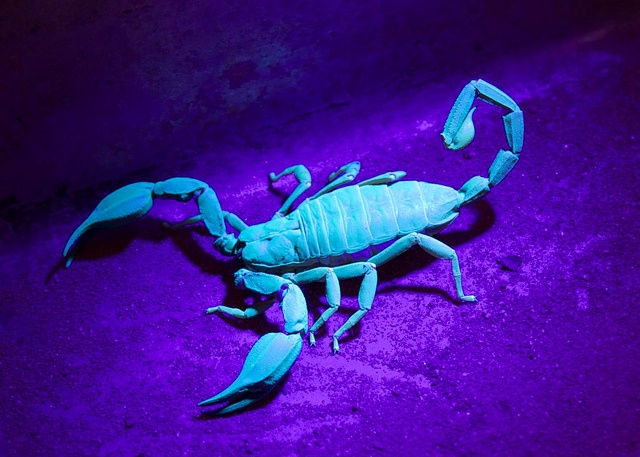
Flip on a porch light and catch the eerie glow of a scorpion under UV light, and you already know these creatures inspire equal parts fascination and fear. This guide covers what scorpions actually are, where they live, how dangerous their venom really is, and what to do if they're showing up around your home.
What Is a Scorpion?
Fascinating, ancient, and often misunderstood — here's what a scorpion actually is before we get into how dangerous it really is.
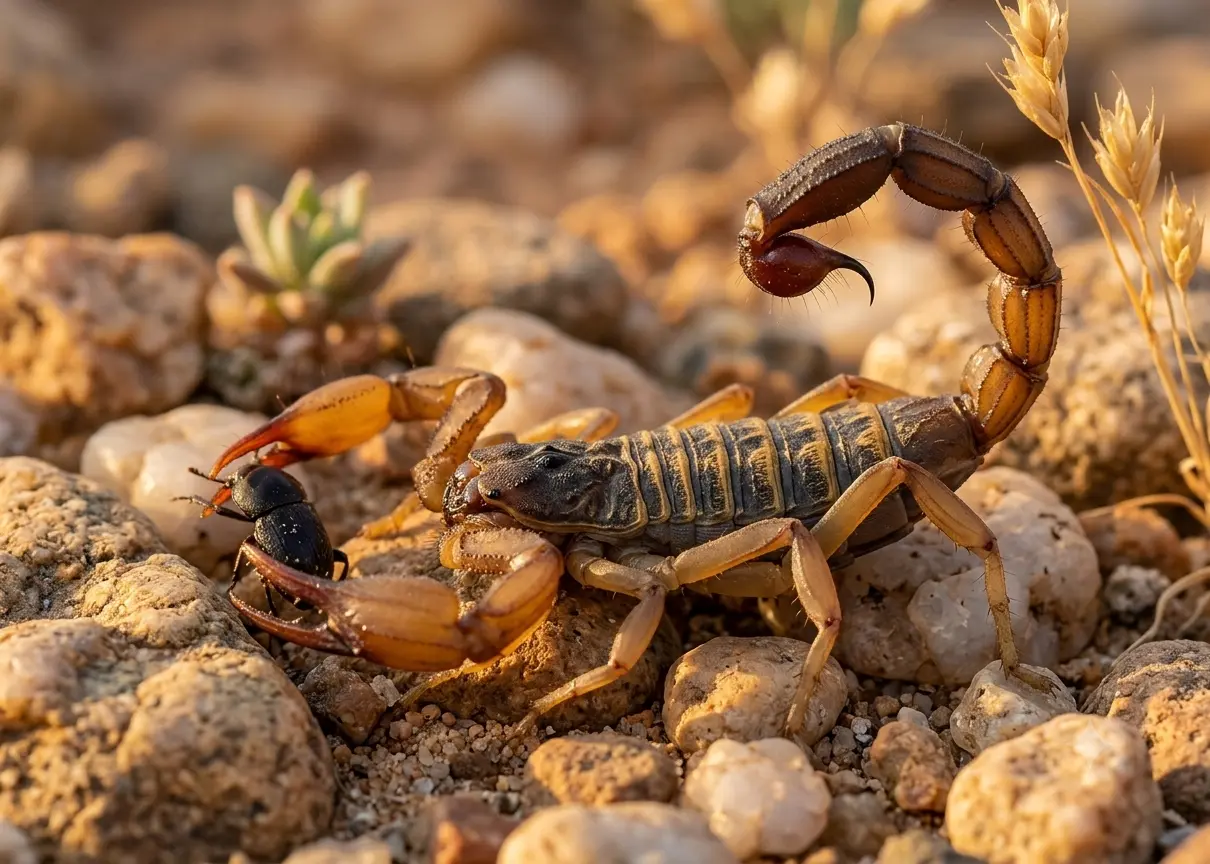
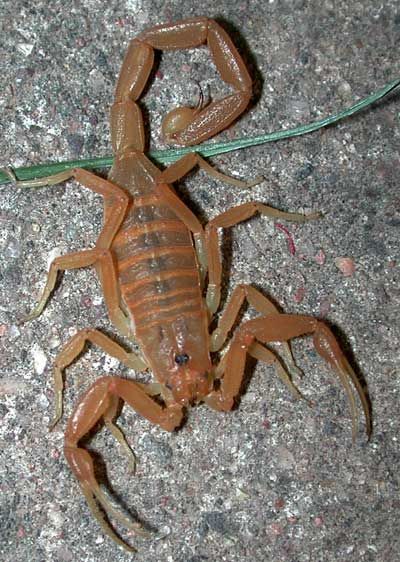
A scorpion is an arachnid — not an insect — closely related to spiders, ticks, and mites. Scorpions belong to the order Scorpiones and are instantly recognizable by two features: a pair of pincer-like claws (pedipalps) at the front, and a long, segmented tail that curves up and over the body, ending in a venomous stinger.
There are roughly 1,500 to 2,500 identified scorpion species, and scientists believe many more remain undiscovered, especially in remote tropical regions.
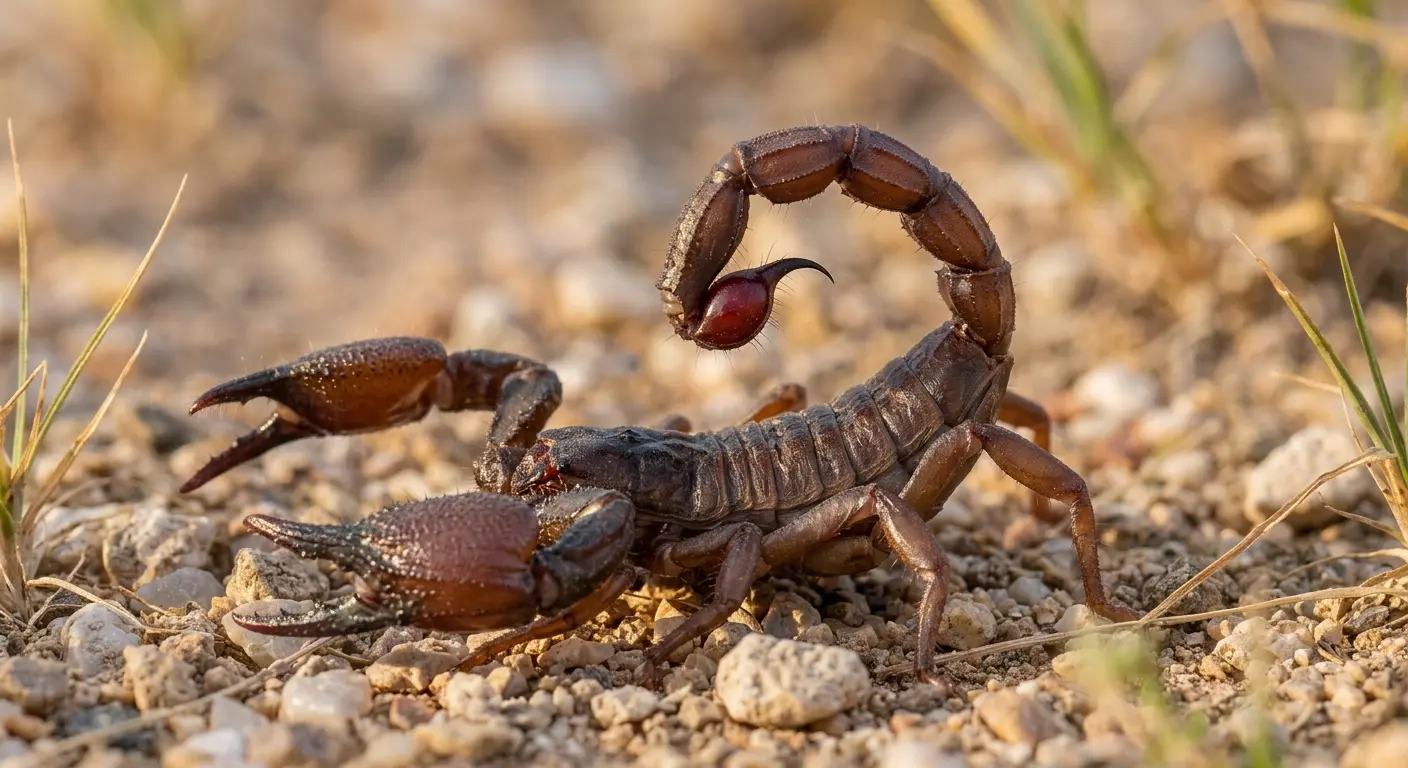
A scorpion is a venomous arachnid of the order Scorpiones. It has eight legs, two huge pincers (pedipalps) and a segmented tail with a deadly stinger used for hunting and self-defense. Scorpions live on all continents except Antarctica and are usually found in deserts, woods, grasslands, and rocky environments.
How Big Do Scorpions Get?
Most scorpions are surprisingly modest in size — but the range across species is wider than you'd expect.
Most scorpions average around 6 cm (2.5 inches) long. But size varies dramatically across species:
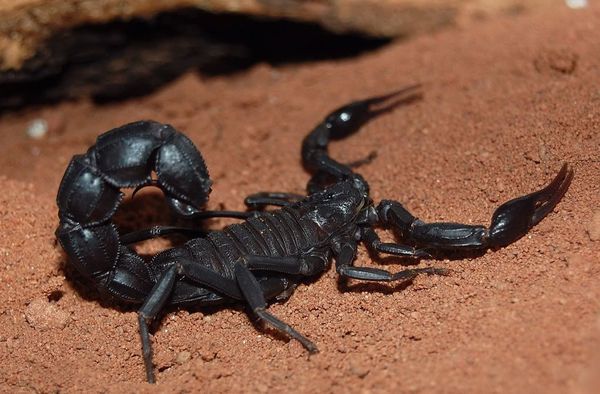
🦂 Giant Forest Scorpion
Native to India, one of the largest living species — can reach 20–23 cm (about 9 inches) in length.
📏 Largest Living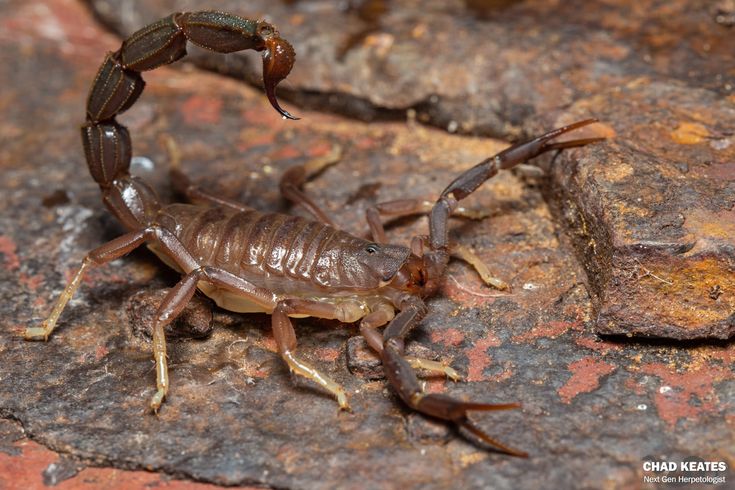
🦂 Rock Scorpion
Found in South Africa, also among the largest living species, rivalling the giant forest scorpion in size.
📏 Largest Living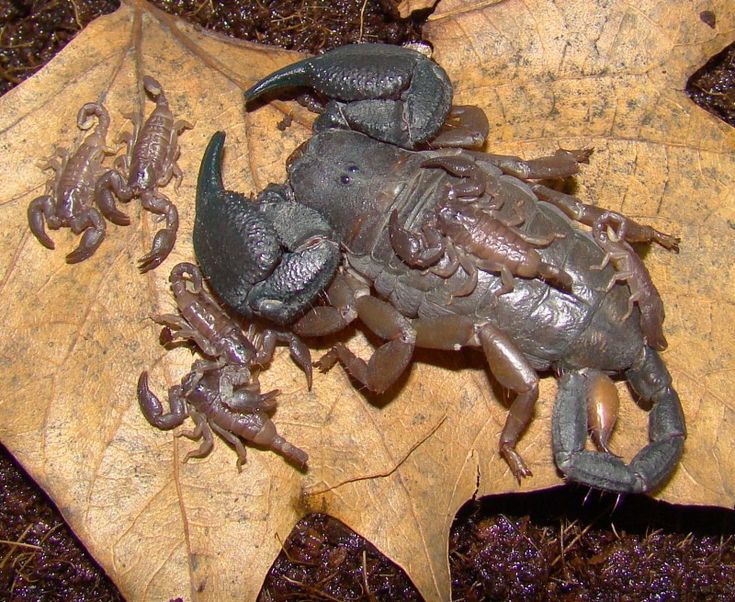
🦕 Brontoscorpio (Extinct)
A prehistoric species estimated to have exceeded a metre in length — the largest scorpion ever known.
🦴 Prehistoric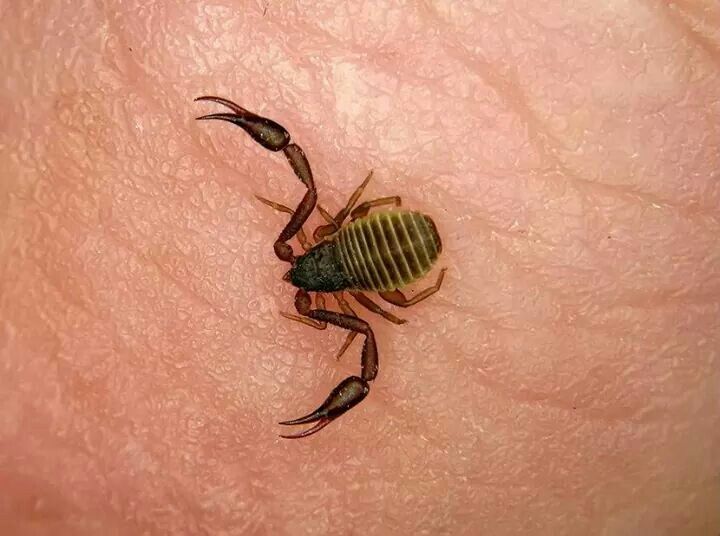
🦂 Caribbean Dwarf Scorpions
Among the smallest known scorpions, measuring barely over a centimetre as adults.
🔎 Smallest SpeciesWhere Do Scorpions Live?
Deserts get all the credit — but scorpions have quietly adapted to almost every land habitat on Earth.
Scorpions are one of the most widely distributed creatures on Earth. They're commonly linked with deserts, and it's true that arid regions host the greatest diversity of species — but scorpions have adapted to nearly every land habitat imaginable, including:
- Deserts and semi-deserts
- Grasslands and savannas
- Tropical and temperate forests
- Mountain slopes above 5,000 metres
- Caves (some over 800 metres deep)
- Coastal intertidal zones
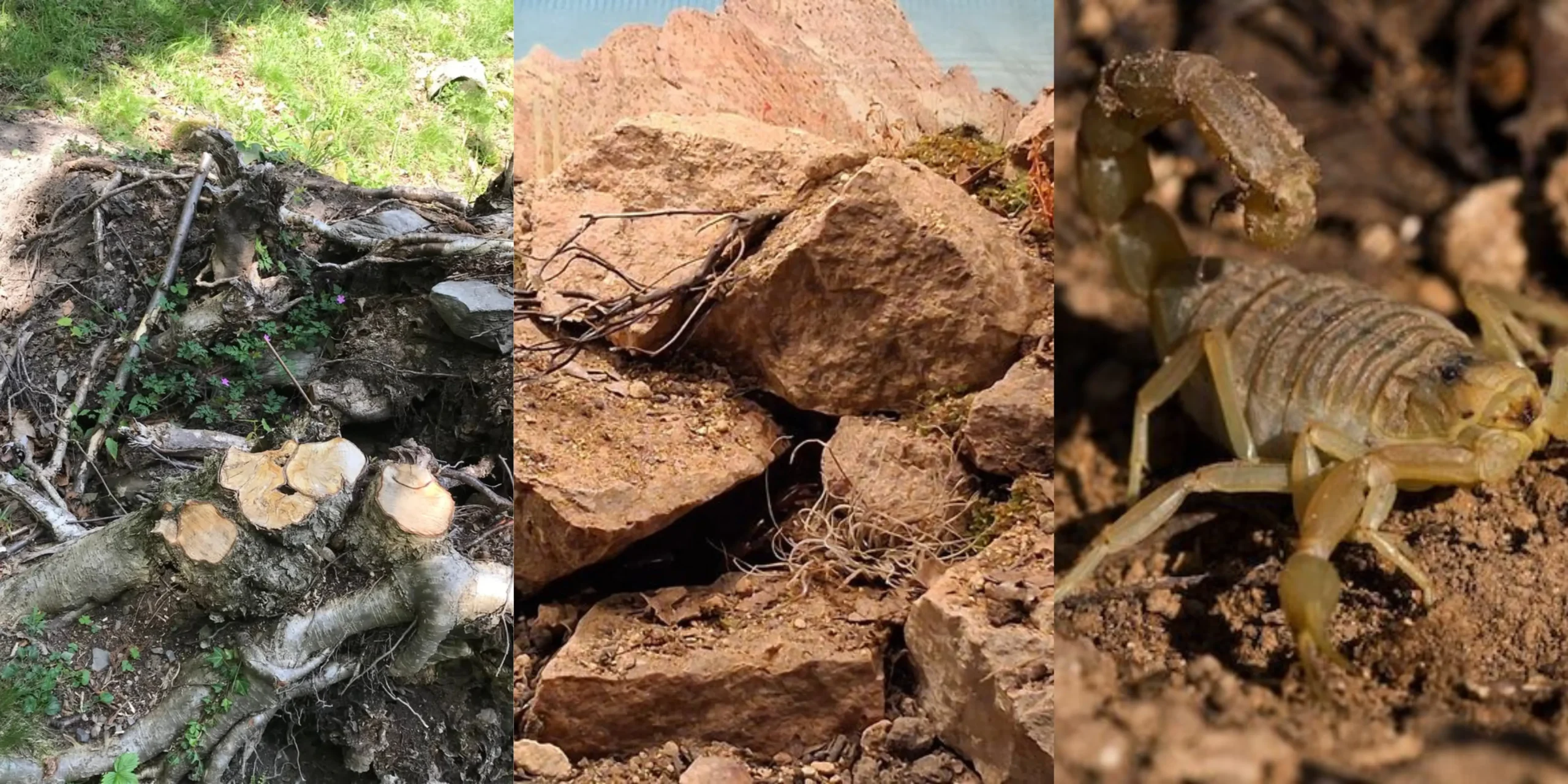
This adaptability explains why scorpions can turn up almost anywhere — including basements, garages, woodpiles, and cracks in home foundations, even in areas people don't associate with them.
Are Scorpion Stings Deadly?
This is the question most people actually want answered — and the honest answer is: rarely.
Out of the thousands of scorpion species worldwide, only around 25 to 40 have venom potent enough to be life-threatening to a healthy adult human. Most stings cause intense pain, swelling, and localized discomfort — similar to a severe bee or wasp sting — rather than systemic danger. That said, children, the elderly, and people with allergies face higher risk, and any sting accompanied by difficulty breathing, blurred vision, or muscle spasms needs immediate medical attention.
| Factor | Typical Scorpion Sting | Dangerous Species Sting |
|---|---|---|
| Pain Level | Intense, localized — similar to a severe bee/wasp sting | Intense, may spread beyond sting site |
| Swelling | Localized swelling and redness | Swelling plus possible numbness or tingling |
| Systemic Risk | ✓ Rare | ✗ Possible — breathing issues, muscle spasms |
| Species Count | Majority of the 1,500–2,500 known species | Roughly 25–40 species worldwide |
Most scorpion stings are painful but not fatal. Only a small fraction of species (roughly 25–40) produce venom dangerous enough to kill a healthy adult.
How Do Scorpions Hunt and Survive?
Nocturnal, patient, and built to survive almost anything — here's how scorpions actually operate.
Scorpions are nocturnal ambush predators that prey largely at night. They hide in burrows, under rocks, under logs and in dark cracks during the day to avoid heat, dehydration and predators. They feed mainly on insects, spiders, centipedes and other small invertebrates. Scorpions capture prey with their strong pincers (pedipalps) and then use their venomous stinger to paralyze or kill them before feeding. This hunting approach enables scorpions to live in deserts, woodlands, grasslands and other ecosystems around the world.
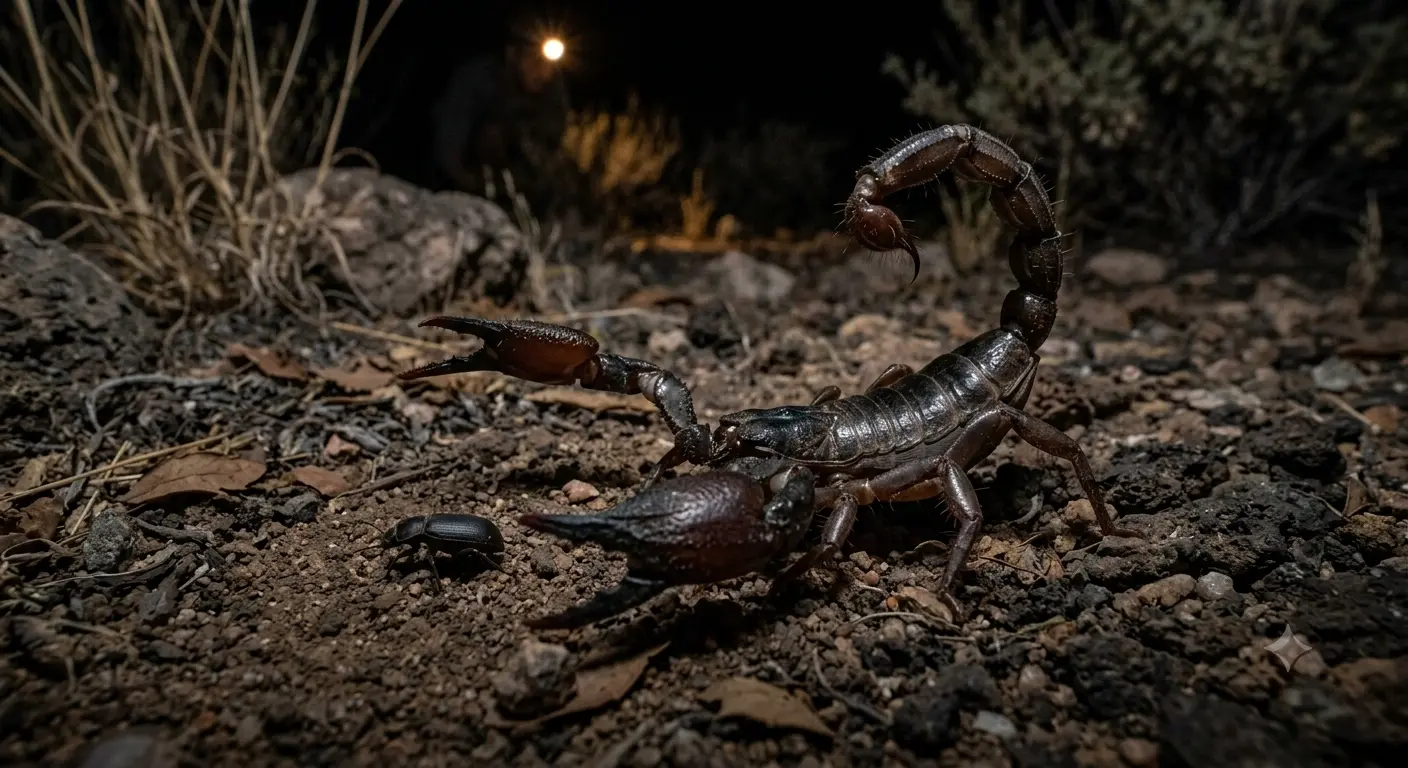
Scorpions have a very slow and efficient metabolism and can live for weeks or even months without food. They considerably slow their metabolic rate when prey is not available, saving energy for when food is present. This amazing adaptation enables scorpions to survive in difficult situations like deserts where food and water are scarce.
How Do Scorpions Reproduce?
Unlike most arachnids, scorpions don't lay eggs — they give birth to live young that ride on the mother's back.
Scorpions reproduce through a fascinating courtship known as the promenade à deux, where the male gently guides the female over a sperm packet (spermatophore) deposited on the ground.
After mating, the female undergoes a gestation period that may last from several months to about a year, depending on the species and environmental conditions. Unlike many arachnids, scorpions give birth to live young called scorplings.
Newborn scorplings immediately climb onto their mother's back, where they remain protected until their first molt. During this time, they rely on their mother for safety before becoming independent hunters.Depending on the species and habitat, scorpions typically live between 2 and 20 years, while some species can survive for more than 20 years in captivity or under ideal environmental conditions.
Why Do Scorpions Glow Under UV Light?
One of the most commonly asked scorpion questions — and it has a genuinely interesting answer.
Scorpions glow under ultraviolet light because they have fluorescent compounds in their exoskeleton that absorb UV radiation and re-emit it as a bright blue-green glow. This natural process is called fluorescence and occurs in nearly all scorpion species and is only visible under UV or blacklight.
Scientists havenot yet determined precisely what this glow is for. However, the most frequently accepted theories claim that fluorescence helps scorpions detect ultraviolet radiation, prevent excessive sun exposure, or has a function in navigation and communication. Some researchers also believe it may provide an evolutionary advantage by helping scorpions respond to predators or environmental changes, although no single explanation has been proven.
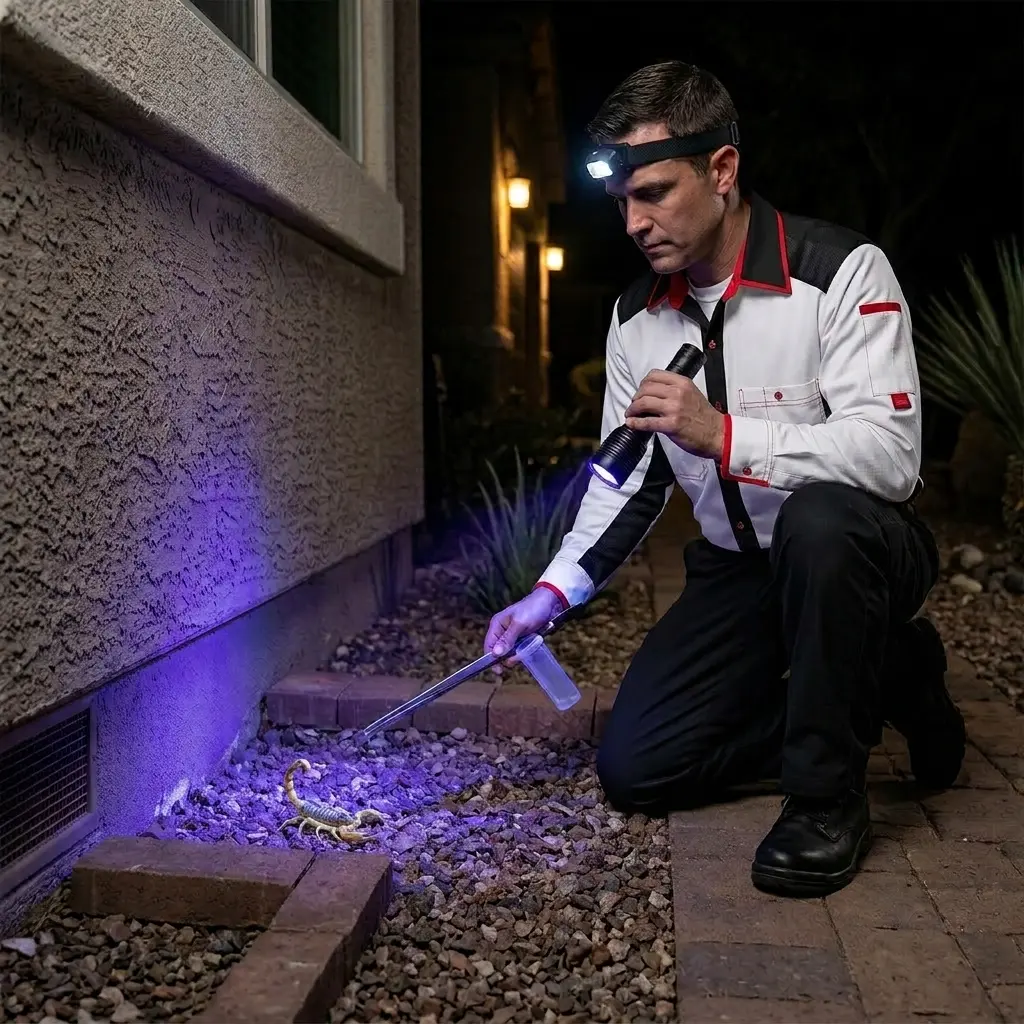
Scorpion fluorescence is especially valuable for pest control professionals and researchers. Since scorpions are nocturnal and spend the day hiding under rocks, in cracks, or around building foundations, they can be difficult to detect with the naked eye. A UV flashlight makes them glow brightly, allowing professionals to quickly locate scorpions, identify hiding places, and inspect properties more effectively.
For homeowners, finding glowing scorpions around a property may indicate a scorpion problem. Multiple scorpions in and around your home may require a professional inspection and targeted treatment to get rid of the infestation and reduce the risk of painful stings.
How to Keep Scorpions Out of Your Home
Because scorpions are secretive and nocturnal, an infestation can go unnoticed for a long time. Here's how to stay ahead of it.
Scorpion proofing your home comes down to removing the conditions they need to survive — shelter, moisture, and food. Here's how to keep scorpions out of your house for good:
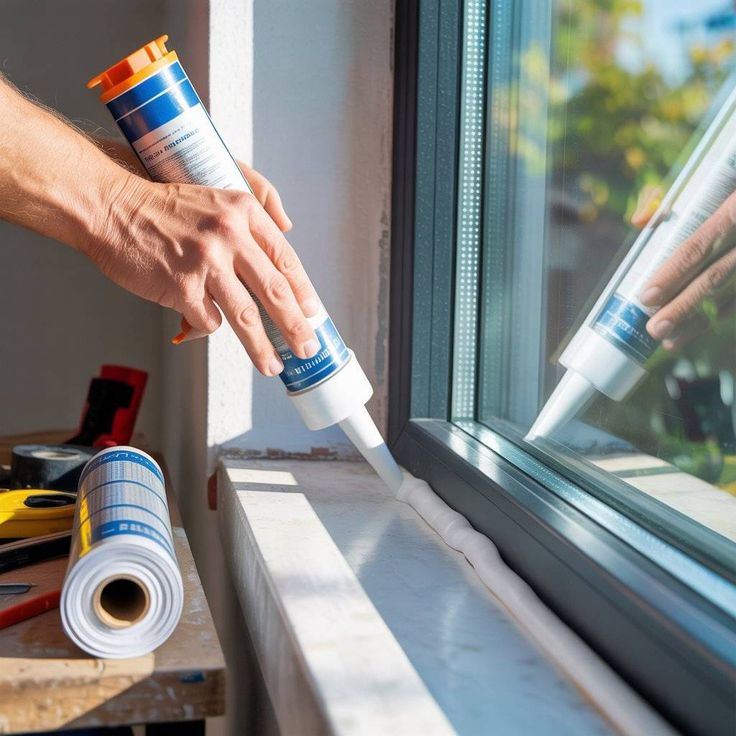
- Seal entry points: Caulk gaps around doors, windows, utility lines, and foundation cracks; scorpions can flatten their bodies to squeeze through openings as thin as a credit card
- Clear debris and clutter: Remove woodpiles, rock piles, leaf litter, and stacked garden materials near your home's foundation, since these are prime daytime hiding spots
- Reduce moisture around the property: Fix leaking taps, AC condensation lines, and standing water; damp areas attract the crickets, roaches, and other insects scorpions hunt
- Install door sweeps and weatherstripping: Add sweeps to exterior doors and garage entries to close off ground-level gaps scorpions commonly use to get inside
- Trim vegetation away from the house: Keep bushes, trees, and vines cut back from walls and rooflines, since overgrown greenery acts as a bridge onto your property
- Turn off unnecessary outdoor lighting: Bright lights attract the insects scorpions feed on, so switching to motion-activated or yellow "bug" lighting reduces the food source near entry points
- Inspect shoes, linens, and stored boxes: Shake out shoes and check bedding before use, and avoid storing cardboard boxes directly on garage or shed floors, especially in regions where scorpions are common
- Use a UV flashlight for a quick home check: Scorpions fluoresce under black light, making a five-minute nighttime sweep of the yard and garage one of the easiest ways to catch activity early
DIY scorpion control can reduce activity but rarely eliminates an established infestation. Scorpions hide in hard-to-reach places, making them difficult to remove. Professional scorpion control is the most effective way to eliminate scorpions and prevent them from returning.
When to Call a Professional
Seeing scorpions indoors regularly? That's usually a sign of a larger nesting site nearby — not an isolated encounter.
If you're regularly spotting scorpions indoors, it's usually a sign of a larger nesting site nearby rather than an isolated encounter. This is where Total Defence comes in. Our pest control specialists identify exactly how scorpions are entering your property, treat active nesting areas, and put long-term preventive barriers in place — so you're not just removing the scorpion you saw, but addressing the reason it got in.
- 1
Free Inspection with UV Detection
A licensed technician walks the property with a UV flashlight after dark, since this is when scorpions are actually active and easiest to spot. We check the usual suspects — foundation cracks, woodpiles, garage corners, garden beds — and map out exactly where activity is coming from before recommending anything.
- 2
Targeted Treatment
Once we know where the activity is concentrated, we apply commercial grade treatment directly to entry points, foundation cracks and likely nesting areas. We also treat for the crickets, roaches and other insects scorpions hunt, since cutting off their food supply is just as important as treating the scorpions themselves.
- 3
Entry Point Sealing
Treatment only solves half the problem if scorpions can keep walking back in. We physically seal gaps around doors, windows, utility lines and foundation cracks with weather-rated material built to hold up against Dubai's heat so the same access points don't reopen a few months later.
- 4
Report & Prevention Advice
Before we leave, you get a written report covering what we found, what was treated and simple habits that make your property less inviting to scorpions going forward. And if anything comes back within 90 days, we return and retreat at no extra cost.
Every Total Defence scorpion treatment comes with a 90-day guarantee. If scorpion activity returns within 90 days, we return and re-treat at zero cost. No questions asked.
Scorpion Control & Related Pest Services
A property that suits scorpion activity often has the same gaps that suit other pests. Here's what we handle alongside scorpion control.
Areas We Serve Across Dubai & Sharjah
From Dubai Marina to Sharjah's Al Majaz — we're already near you. Same-day assessment available across both emirates.
Total Defence provides professional scorpion inspection and control across all Dubai and Sharjah districts. Same-day assessment available in most areas — from Dubai Marina, Downtown, and Arabian Ranches to Sharjah's Al Nahda, Al Majaz, and Al Qasimia.
We cover all of Dubai and Sharjah — including Dubai Marina, JBR, Downtown, Business Bay, DIFC, Jumeirah, Al Barsha, Mirdif, Arabian Ranches, The Springs, Dubailand, Al Quoz, JAFZA, Dubai South, Silicon Oasis, Discovery Gardens, International City, Deira & Bur Dubai, plus Sharjah's Al Nahda, Al Majaz, Al Qasimia, Muweilah, and Al Taawun.
Frequently Asked Questions — Scorpions in Dubai
The short answers our Dubai customers ask for most before booking.
Are scorpions insects?
No. Scorpions are arachnids, in the same class as spiders and ticks, not insects.
Can a scorpion sting through clothing or shoes?
Yes, thin fabric doesn't fully block a scorpion's stinger, which is why checking shoes and bedding is recommended in scorpion-prone areas.
Do all scorpions glow under black light?
Yes, virtually all scorpion species fluoresce under UV light due to compounds in their exoskeleton.
How can I tell if scorpions are nesting near my home?
Frequent indoor sightings, especially at night, along with visible cracks, woodpiles, or debris near the foundation, are common signs. A professional inspection is the most reliable way to confirm a nesting site.
What should I do immediately after a scorpion sting?
Clean the area, apply a cold compress, and monitor for severe symptoms like difficulty breathing or muscle spasms, which require emergency medical care.
How much does professional scorpion control cost in Dubai?
Cost depends on the size of the property, the extent of activity found, and accessibility of entry points. Total Defence offers a free, no-obligation on-site quote before any work begins.
Seeing Scorpions Around Your Property? Get It Handled Safely.
Dubai Municipality approved · Licensed & insured technicians · 90-day guarantee · Free inspection & quote