Introduction
You spot a single ant on your kitchen counter. You think nothing of it. Twenty-four hours later, there are hundreds marching in a long, determined line across your pantry shelf, through your sugar jar, and into every crack in your wall. This is the reality of ant infestations in the UAE — they escalate fast, and they are far harder to eliminate than most homeowners expect.
Whether you are dealing with tiny sugar ants in your apartment in Jumeirah, aggressive fire ants on your villa terrace in Sharjah, or carpenter ants silently hollowing out the wooden frames of your office, this guide answers every question you have ever had about professional ant control service in Dubai and Sharjah. We cover species identification, the real dangers, why DIY rarely works, and how Total Defence’s certified experts eliminate ant colonies at the source — permanently.
Key Statistics
- 20,000+ ant species worldwide; 50+ found in UAE
- 2× activity increase in Dubai summers (40°C+)
- 3-month warranty on every ant treatment
What Are the Most Common Ant Species Found in the UAE?
The UAE’s warm desert climate, rapid urban construction, and abundance of food sources in residential and commercial buildings make it an ideal habitat for numerous ant species. Before any ant control service in Dubai or Sharjah can be effective, correct identification is essential — different species require different treatment approaches, different bait chemistries, and different entry-point strategies.
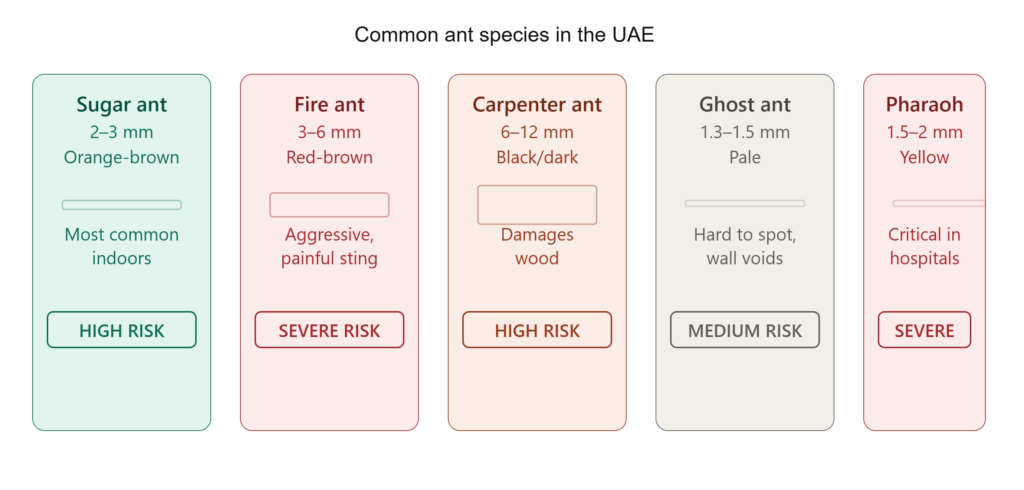
Species Comparison Chart
Sugar Ants (Camponotus consobrinus)
By far the most common complaint we receive from homeowners. Sugar ants are drawn to any sweet residue — spilled juice, open fruit, jam jars, sticky worktops. Their colonies can reach 300,000 workers and establish satellite nests inside walls, making a full colony elimination surprisingly complex without professional-grade bait systems.
Fire Ants (Solenopsis invicta)
If you have a garden, outdoor walkway, or sandy driveway, fire ants are a serious concern. Their sting is genuinely painful and can trigger anaphylactic reactions in sensitive individuals. Children playing outdoors are particularly vulnerable. Fire ant mounds are often hidden beneath paving stones or in planters.
Carpenter Ants (Camponotus spp.)
While carpenter ants do not eat wood like termites, they excavate it to build galleries for their nests — causing significant structural damage over time. If you find coarse sawdust-like material (frass) near wooden doors, window frames, or furniture, carpenter ants may be the culprit. Our residential pest control service in Dubai and Sharjah regularly handles carpenter ant infestations in older villas and wooden-framed apartments.
Ghost Ants (Tapinoma melanocephalum)
Ghost ants are notoriously difficult to detect due to their near-transparent abdomens. They thrive in humid environments — kitchens, bathrooms, and utility rooms — and are often misidentified or missed entirely until the colony is enormous. They emit a distinctive coconut-like odour when crushed.
Pharaoh Ants (Monomorium pharaonis)
Particularly concerning in commercial and healthcare settings, pharaoh ants are associated with the transmission of Salmonella, Staphylococcus, and other pathogens. Their polydomous (multi-queen) colony structure means that standard spray treatments can actually cause the colony to “bud” — splitting into multiple new colonies. Only professionally deployed slow-acting baits reliably eliminate pharaoh ant infestations.
Why Are Ant Infestations So Common in Dubai and the UAE?
Dubai is one of the fastest-growing cities in the world. That construction boom — combined with the desert climate and the way buildings are designed — creates near-perfect conditions for ants to thrive. Understanding why infestations happen so readily helps you defend your property proactively.
Climate Pressure
During the brutal UAE summers (June–September), outdoor temperatures regularly exceed 45°C. Ants cannot survive those surface temperatures, so they migrate indoors en masse. Air-conditioned kitchens and bathrooms become their oasis. This is why peak ant control service demand in Dubai occurs between May and September every year.
The combination of factors driving infestations in Dubai and Sharjah includes:
- Urban heat pressure — extreme temperatures push ant colonies to seek cool, air-conditioned interiors with reliable moisture sources (kitchens, bathrooms, utility rooms).
- Construction activity — ongoing excavation constantly disturbs underground ant colonies, causing them to relocate into nearby structures.
- Condensation from AC units — the moisture produced by air conditioning systems creates ideal humidity pockets within walls, attractive to ants year-round.
- High-rise and villa building designs — shared walls, communal pipe runs, and utility shafts provide highway networks for ants to move between units without ever going outside.
- Organic food waste concentration — dense residential communities generate concentrated food waste. Even responsible disposal does not eliminate the scent trails ants use to locate food sources.
- Garden and landscape irrigation — drip-irrigation systems in garden beds create consistently moist soil — ideal nesting ground for fire ants and other ground-dwelling species.
How Do I Know If I Have an Ant Infestation? Signs to Look For
Recognising an ant infestation early dramatically reduces the cost and complexity of treatment. Most homeowners only call a pest control professional once they see large numbers of ants — but by that point, the colony is usually mature and well-established. Here are the warning signs to act on immediately.
Six Key Warning Signs
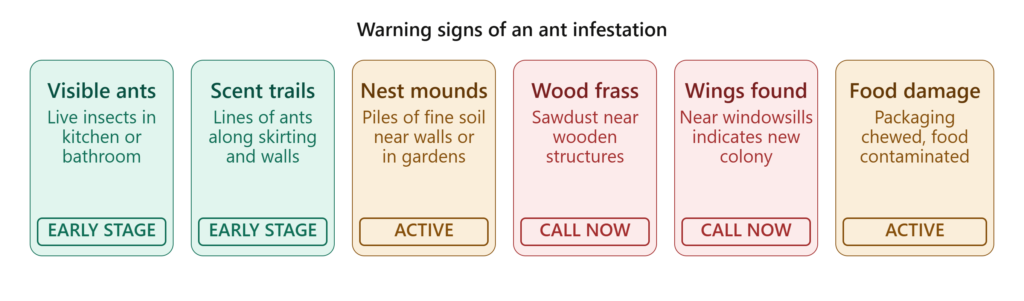
The most important single piece of advice: do not wait. A colony spotted early — say, a line of ants along a single kitchen wall — can be treated in one visit with gel baits and targeted spray treatment. The same colony left for six weeks may have spread into wall cavities, under flooring, and into adjacent rooms, requiring multiple visits and more intensive chemical treatment.
What Are the Real Dangers of an Ant Infestation?
Ants are often dismissed as a minor nuisance — a few insects hardly seem threatening. This is a costly misconception. A mature ant colony can number in the hundreds of thousands and pose genuine health, structural, and financial risks that should never be minimised.
Six Major Risk Categories
Food Contamination — Ants travel through sewers, rubbish areas, and other filth before crossing your kitchen counter. They deposit bacteria — including Salmonella and E. coli — on food preparation surfaces and open food items. This is a particular risk for families with young children and elderly residents.
Electrical Hazards — Certain ant species (notably fire ants and ghost ants) are attracted to electrical fields and warmth emitted by wiring and control boxes. They nest inside fuse boxes, AC units, and distribution boards — causing short circuits, equipment failure, and in rare cases, electrical fires.
Structural Damage — Carpenter ants hollow out wooden beams, door frames, furniture, and skirting boards to construct their galleries. Over months, this can compromise the structural integrity of wooden elements. Combined with moisture infiltration, the damage becomes progressively more expensive to repair.
Stings & Allergic Reactions — Fire ant stings are genuinely painful and cause raised, itching welts. In individuals with insect venom allergies, even a small number of stings can trigger anaphylaxis — a life-threatening emergency requiring immediate medical treatment. Children are disproportionately at risk due to outdoor play.
Pathogen Transmission — Pharaoh ants are of serious concern in commercial kitchens, hospitals, and care facilities. They are documented vectors of Salmonella typhimurium, Staphylococcus, Clostridium, and other dangerous pathogens. Our commercial pest control service is specifically designed for these high-risk environments.
Colony Expansion — Untreated ant colonies reproduce and fragment. A single mature colony may produce multiple satellite nests within your building or in neighbouring properties. What began as one manageable infestation can become a building-wide problem within a single season — dramatically increasing remediation costs.
Can I Get Rid of Ants Myself? DIY vs Professional Ant Control
Supermarket shelves and online marketplaces are full of ant sprays, powders, chalk barriers, and bait traps. So why do most homeowners in Dubai find themselves repeating the same DIY treatments week after week without ever fully resolving an infestation? The answer lies in how ant colonies are structured.
The Colony Problem
A worker ant you see foraging in your kitchen represents, at most, 5–10% of the colony. The queen, secondary queens, brood, and the majority of workers remain deep within a protected nest — often inside walls, under concrete, or in soil several feet below the surface. Most DIY products kill visible workers but leave the reproductive core entirely intact. The colony replenishes itself within days.
Comparison: DIY vs Professional Treatment
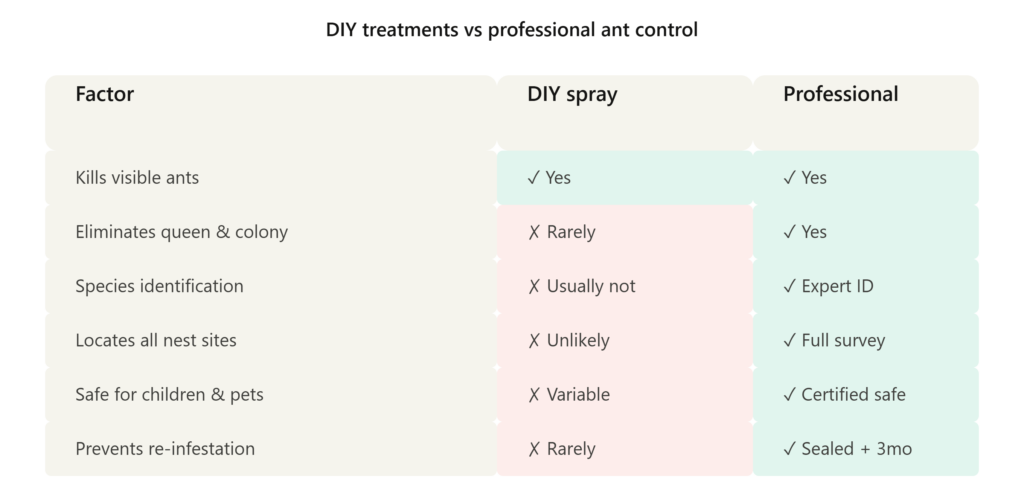
Over-the-counter ant sprays contain fast-acting pyrethroids that kill on contact — but they also alert the colony. The surviving ants learn to avoid treated surfaces, and the colony may bud into new satellite nests to protect against the threat. This phenomenon, called “colony budding,” is particularly problematic with pharaoh ants and ghost ants, and it is specifically triggered by broad-spectrum sprays — the very products most homeowners reach for first.
Professional ant control does the opposite: slow-acting bait gel is fed to foraging workers, who carry it back to the colony and share it with nestmates — including the queen. The entire colony collapses from within over 48–72 hours, leaving no survivors to repopulate. This is why professional treatment is not just more effective — it is the only method that actually resolves an established infestation.
How Does Professional Ant Control Service Actually Work?
When you book an ant control service with Total Defence, the process is structured around permanently eliminating the colony — not just the visible insects. Here is exactly what to expect from our certified technicians.
Five-Stage Total Defence Process
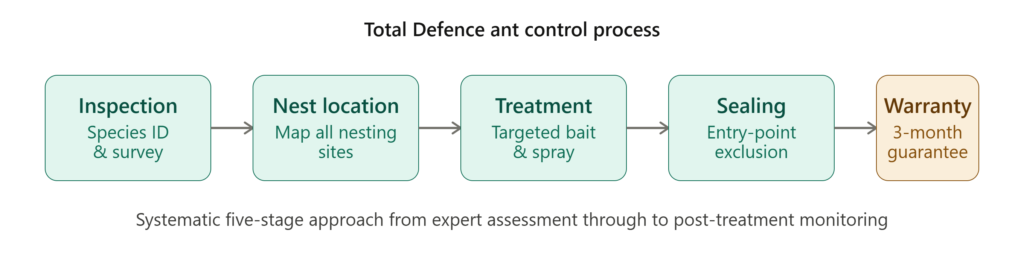
Step 1: Full Property Inspection & Species Identification
Our certified technician conducts a systematic inspection of your entire property — including wall cavities, under-sink areas, loft spaces, garden beds, and any external structures. Correct species identification at this stage is non-negotiable; it determines every subsequent decision about treatment chemistry, bait selection, and application method.
Step 2: Nest Location and Colony Mapping
Using trail-following techniques, borescope inspection, and thermal moisture detection where necessary, the technician traces foraging trails back to their source and identifies all active nesting sites. A single property may have three to five satellite nests linked to one main colony — all of which must be targeted for treatment to be permanent.
Step 3: Targeted Treatment Application
Depending on species and colony location, treatment may combine slow-acting bait gel (placed precisely along foraging trails and near nest entrances), micro-encapsulated residual spray (applied to harborage areas, wall voids, and external perimeter), and dust insecticide injected into inaccessible cavities. All products are Dubai Municipality-approved and applied in measured doses that are effective yet pose minimal risk to occupants.
Step 4: Entry-Point Exclusion & Sealing
Once treatment is applied, the technician identifies and recommends sealing of the entry points used by the colony — pipe penetrations, gaps around utility conduits, cracks in foundations, and poorly sealed window/door frames. This exclusion step is critical for preventing re-infestation from external colonies.
Step 5: Follow-Up Review & 3-Month Warranty
Every ant control treatment by Total Defence is backed by a three-month warranty. If ant activity is observed again within this period, our team returns for a complimentary re-treatment. For severe or recurring infestations, we also offer quarterly preventive contracts that include scheduled inspections and proactive treatment before infestations can establish.
What Treatment Methods Does Total Defence Use for Ant Control?
Our technicians select the treatment method — or combination of methods — based on species, colony size, location, and whether the property is residential or commercial. Here is a breakdown of our primary ant control tools:
Gel Bait Systems — The gold standard for most ant species. Attractive bait matrices containing slow-acting active ingredients (indoxacarb, fipronil, or hydramethylnon depending on species) are applied in small dots along foraging trails. Workers carry the bait back to the nest and feed it to nestmates, brood, and the queen. Colony elimination typically occurs within 3–7 days. Gel baits are odourless, invisible to residents, and safe for use around children and pets when placed correctly.
Residual Perimeter Spray — Micro-encapsulated or emulsifiable concentrate insecticides are applied to the external perimeter of the building, under-floor areas, and wall bases to form a barrier against entry. This method is particularly effective for fire ant prevention and for properties near construction sites or green spaces where external ant pressure is high.
Dust Application — For ants nesting deep within wall voids, electrical conduits, or inaccessible cavities, insecticidal dust (silica gel or diatomaceous earth-based products with residual actives) is injected using a hand bellows or electric applicator. Dust products remain active for months and are ideal for long-term suppression of carpenter ants and ghost ants in wall structures.
Crack and Crevice Treatment — Precision application of concentrated formulations directly into cracks around skirting boards, under kitchen units, and around pipe entries. This targeted approach minimises the total volume of chemical used while maximising contact with the colony’s infrastructure.
Is Ant Treatment Safe for My Children and Pets?
This is the single most frequently asked question we receive from families in Dubai — and understandably so. The short answer is: yes, when applied by a certified professional using Dubai Municipality-approved products.
Our Safety Commitment
All products used by Total Defence are registered with the Dubai Municipality and compliant with UAE Federal Law on pesticide regulation. Our technicians are trained and licensed by the relevant regulatory authorities and apply all treatments in accordance with product label instructions and safety data sheets. We do not use banned or restricted substances under any circumstances.
For most standard ant gel bait treatments, occupants are asked to stay clear of treated surfaces for a short re-entry period of 30 to 60 minutes. Gel placements are made in areas inaccessible to children and pets — behind appliances, inside cabinet hinges, under flooring edges — so direct contact is not possible during normal use. For spray treatments in enclosed spaces, a re-entry period of 1–2 hours is typically recommended with ventilation before re-entering.
We always brief residents before treatment begins: we explain which products will be used, where they will be applied, and precisely when it is safe to return to the treated area. If a resident has specific allergies, respiratory conditions, or if a pet has known sensitivities, we adjust our product selection accordingly. Your family’s safety is not a footnote — it is the foundation of how we design every treatment protocol.
How Long Does Ant Treatment Take and How Long Do the Results Last?
Treatment duration depends on the size of the property and the severity of the infestation. For a typical Dubai apartment or townhouse with a standard kitchen ant problem, a complete inspection and gel bait treatment takes between 45 minutes and 90 minutes. Larger villas or properties with multiple nest sites may take 2–3 hours including thorough inspection.
How quickly will the ants disappear?
With gel bait treatment, you should expect to see increased ant activity in the first 24–48 hours as workers are attracted to the bait and carry it back to the nest. This is normal and expected — it is a sign the bait is working. Visible ant numbers typically drop sharply by days 3–5 and are usually eliminated by day 7–10. For severe infestations, a second visit at the 2-week mark may be recommended.
How long do results last?
With correct colony elimination and entry-point exclusion, results are long-lasting. Most properties remain ant-free for 6–12 months following a single professional treatment. However, Dubai’s continuous external ant pressure — from neighbouring properties, construction sites, and the natural environment — means that annual or bi-annual preventive treatments are strongly recommended, particularly for ground-floor properties and garden villas. Our 3-month warranty means that if ants return within that window, we treat again at no charge.
How Can I Prevent Ants from Coming Back?
Professional ant control eliminates the current colony. Prevention is the ongoing practice that keeps new colonies from establishing. These are the most effective measures our expert team recommends following treatment:
Secure All Food Sources — Store sugar, honey, cereals, dried fruits, and all sweet foods in sealed glass or hard plastic containers. Even a thin film of sugar syrup on a jar exterior is enough to trigger a foraging trail.
Eliminate Moisture Sources — Fix leaking taps, seal condensation from AC drainage lines, and ensure there is no standing water under sinks or in kitchen/bathroom cabinets. Moisture is as attractive to ants as food.
Deep Clean Regularly — Wipe down kitchen surfaces after cooking, sweep floors to eliminate crumbs, and clean behind appliances where food debris accumulates undetected. Pay particular attention to the space under the refrigerator and washing machine.
Seal Entry Points — Use silicone sealant to close gaps around pipes, cable conduits, and skirting boards. Ensure window and door frames seal cleanly without gaps. Ants can enter through a gap as narrow as 0.5 mm.
Manage Garden & Exterior — Keep garden beds clear of organic debris, raise plant pots off the ground, and ensure tree branches do not contact the building exterior — ants use these as bridges. Check irrigation drip points for pooling water.
Schedule Preventive Treatments — Book a professional preventive inspection before summer (April) and after the cooler season (October) to catch any nascent colonies before they establish. Our annual preventive contracts include priority scheduling and discounted re-treatment rates.
How Much Does Ant Control Service Cost in Dubai?
The cost of ant control service in Dubai varies depending on property size, ant species, severity of infestation, and whether additional services such as nest excavation or building-wide treatment are required. While we are unable to publish a fixed price list without assessing your specific situation, the following provides a realistic guide.
Free Inspection Policy
Total Defence offers a free initial inspection and quotation on all pest control services. Our technician visits your property, identifies the species and extent of the infestation, and provides a detailed, no-obligation quote before any work begins. You are never committed to a service until you approve the quotation.
For a standard Dubai apartment with a kitchen or bathroom ant problem, professional treatment is typically a highly cost-effective single expenditure compared to months of ongoing DIY product purchases — which, as discussed, rarely resolve the underlying colony. For commercial properties requiring larger-scale or multi-area treatment, we provide customised contracts with volume pricing.
Factors that affect pricing include: property size (studio vs villa), number of identified nest sites, species type (pharaoh ant infestations requiring specialist slow-acting baits are more complex than sugar ant treatments), and whether follow-up visits are required within the warranty period.
Frequently Asked Questions About Ant Control Service in Dubai
What is the difference between an ant and a termite — how do I tell them apart?
The key visual differences are: ants have a distinctly pinched waist (two segments between thorax and abdomen), elbowed antennae, and front wings longer than rear wings when present. Termites have a broad, straight waist, straight antennae, and wings of equal length. If you are unsure, photograph the insect and send it to our team — misidentification can lead to ineffective treatment and ongoing structural damage.
I’ve been using ant spray from the supermarket for weeks but they keep coming back. Why?
Contact sprays kill the foraging workers you can see, but they do not penetrate to the colony. The queen continues to produce new workers — typically 800–1,500 eggs per day in a mature colony. Some species also exhibit colony budding when threatened by spray products, causing the colony to split and spread to new locations in the building. Professional bait-based treatment addresses the colony at source.
Do I need to leave my home during ant treatment?
For gel bait-only treatments, there is typically no need to vacate. The bait is odourless and applied in contained areas. For spray treatments in enclosed spaces such as kitchen cabinets or under-floor areas, a 1–2 hour re-entry period is standard, with windows opened for ventilation before return. Our technician will brief you specifically based on the products being used on the day.
Can ants in my apartment be coming from a neighbour’s unit?
Yes — very commonly. In apartment buildings, ants travel freely through shared wall cavities, pipe chases, and ceiling voids. A colony established in a neighbouring unit, communal area, or even a floor above or below can forage extensively across multiple apartments. This is why building-wide or at least floor-wide treatment is often recommended for persistent infestations in apartment settings.
How often should I have my property treated for ants preventively?
For most Dubai properties, a preventive ant inspection twice per year — once in April before summer temperatures peak and once in October — is sufficient to catch early-stage activity before it becomes a full infestation. Ground-floor properties, garden villas, and commercial food-handling premises benefit from quarterly visits. Our annual preventive contracts provide scheduled visits at a reduced rate compared to reactive call-out treatments.
Do you offer ant control service for restaurants and commercial kitchens?
Absolutely. We provide comprehensive pest management programmes for restaurants, hotel kitchens, food manufacturing facilities, schools, offices, and healthcare settings across Dubai and Sharjah. Commercial ant control programmes include full documentation for Dubai Municipality compliance, HACCP-compatible treatment protocols, and rapid-response callouts outside of scheduled visit windows.
What makes Total Defence different from other pest control companies in Dubai?
Several things set us apart: we always begin with species identification rather than generic spray-and-go treatments; we use a structured five-stage process from inspection through to warranty follow-up; all our technicians are certified and licensed by Dubai Municipality; we back every treatment with a 3-month warranty; and we offer free initial inspections so you only commit to a service once you have a clear picture of the problem and the solution. We operate seven days a week across Dubai, Sharjah, and Ajman.
Conclusion: Don’t Let Ants Win
Ant infestations in Dubai are not a cosmetic problem or a minor inconvenience to be managed with weekly supermarket sprays. They are a genuine health risk, a structural threat, and a self-amplifying problem that grows harder and more expensive to resolve the longer it is left untreated. The tropical climate, high-density residential living, and continuous construction activity across the UAE make ants one of the most persistent pest challenges that homeowners and businesses face year-round.
Professional ant control service — delivered by certified technicians who correctly identify the species, locate all nest sites, apply the right treatment chemistry, and seal entry points — is the only approach that provides reliable, lasting results. Total Defence’s five-stage process, backed by a three-month warranty and free initial inspection, is specifically designed for the unique pest pressure of the UAE environment.
If you are currently seeing ants in your property — whether a single foraging line or an active infestation — do not wait. The earlier we treat, the simpler, faster, and more cost-effective the resolution. Call our team today on +971 52 161 2380, or fill in our online form to book your free inspection at a time that suits you.
Final Warning
If you discover a large fire ant mound in your garden, a suspected carpenter ant gallery in wooden structures, or Pharaoh ants in a food-handling area — these situations require urgent professional attention. Do not attempt to disturb the nest, apply DIY products, or seal entry points without professional assessment first. Improper intervention can trigger colony fragmentation and significantly worsen the infestation. Contact Total Defence for a same-day urgent response callout.
About This Guide
Written by Total Defence’s team of certified pest control technicians and public health specialists, serving Dubai, Sharjah and Ajman since 2018. All content is reviewed for accuracy and compliance with Dubai Municipality pest control guidelines.
Contact Total Defence
- Phone: +971 52 161 2380
- Service areas: Dubai, Sharjah
- Hours: 7 days a week
- Free inspection and no-obligation quotation available