A grease trap does one job: stop fats, oils, and grease from entering the municipal drainage network. It does that job silently, underground, and without complaint — until it is full, blocked, and actively working against you. When a grease trap fails in a UAE restaurant, hotel kitchen, or food facility, the consequences are immediate: blocked drains, a smell that customers can detect before they open the door, and a municipality inspection that nobody wants. This guide covers everything — how to know your trap is overdue before it becomes a crisis, what the cleaning process actually involves, what the law requires of you, and how to keep your operation compliant year-round.
Why grease trap problems in UAE commercial kitchens are more common than most operators realise
Every commercial kitchen in Dubai and Sharjah that connects to the municipal drainage network is required by law to have a functioning grease trap — also called a grease interceptor. This is not optional. It is a condition of your trade licence, your food establishment permit, and your drainage connection approval from the relevant municipality.
The purpose of the grease trap is to intercept fats, oils, and grease (FOG) before they reach the municipal sewer. FOG is the single largest cause of sewer blockages in any urban drainage network. At the temperature of wastewater leaving a commercial kitchen, grease is liquid and flows freely. As it cools in the pipe, it congeals, accumulates on pipe walls, combines with other waste, and eventually creates a fatberg — a dense, concrete-hard blockage that can take a section of the sewer system out of service entirely. Dubai Municipality and Sharjah Municipality both require grease traps precisely to prevent this.
The problem is that grease traps fill up. They are designed to accumulate the grease that they intercept. If they are never cleaned, they eventually reach capacity — and at that point, grease flows through the full trap unchecked, directly into the drainage network. The trap stops doing its job. Your drains block. The smell becomes intolerable. And you are now non-compliant with the same regulations that required the trap in the first place.
In the UAE, the combination of high-volume kitchen operations, extremely hot ambient temperatures (which affect the behaviour of grease in drainage systems), and the pace of hospitality operations creates conditions where grease traps fill faster than operators in cooler climates would expect. A grease trap that might last six months in a moderate-volume restaurant in Europe may need cleaning every four to six weeks in a busy Dubai restaurant running at full capacity.
Total Defence provides professional grease trap cleaning services across Dubai and Sharjah for restaurants, hotels, school canteens, supermarkets, catering facilities, and any commercial kitchen operation. Our tank cleaning services cover grease traps of all sizes, from compact under-sink units to large external interceptors serving multi-kitchen facilities. This guide tells you everything you need to know.
What is a grease trap and how does it actually work?
A grease trap is a plumbing device — underground or under-sink — that sits between your kitchen drainage and the main sewer connection. Its design exploits a basic principle: fats and oils are less dense than water and naturally float.
Wastewater from your sinks, dishwashers, floor drains, and cooking equipment flows into the grease trap. Inside the trap, the flow slows down significantly. Because the water is moving slowly, the physics of separation have time to work: grease, fats, and oils float to the surface and collect in a layer at the top of the trap. Solid food particles and other dense waste sink to the bottom as sludge. The cleaner wastewater in the middle layer — called the effluent — exits through the outlet pipe into the municipal drainage network.
Over time, the floating grease layer at the top and the sludge layer at the bottom both accumulate. The functional capacity of the trap reduces. Eventually, the grease layer is thick enough that wastewater entering the trap disturbs it — grease is carried out through the outlet with the effluent. At this point, the trap has failed functionally. Grease is now entering the sewer.
There are two main types of grease traps found in UAE commercial properties. Passive grease traps are the most common — a simple chamber design without any mechanical components. They rely entirely on the flow-slowing and density-separation principle described above. They are installed under sinks in smaller operations or as external underground units outside kitchen buildings. Hydromechanical grease interceptors are larger, more sophisticated units that use additional baffles and chambers to improve separation efficiency. These are common in hotel kitchens, large restaurant groups, and institutional catering operations.
A third category — automatic grease removal units (AGRUs) — use a motorised skimmer to remove the floating grease layer continuously. These are installed in very high-volume operations and reduce but do not eliminate the need for professional cleaning.
The signs that your grease trap needs cleaning — before it costs you
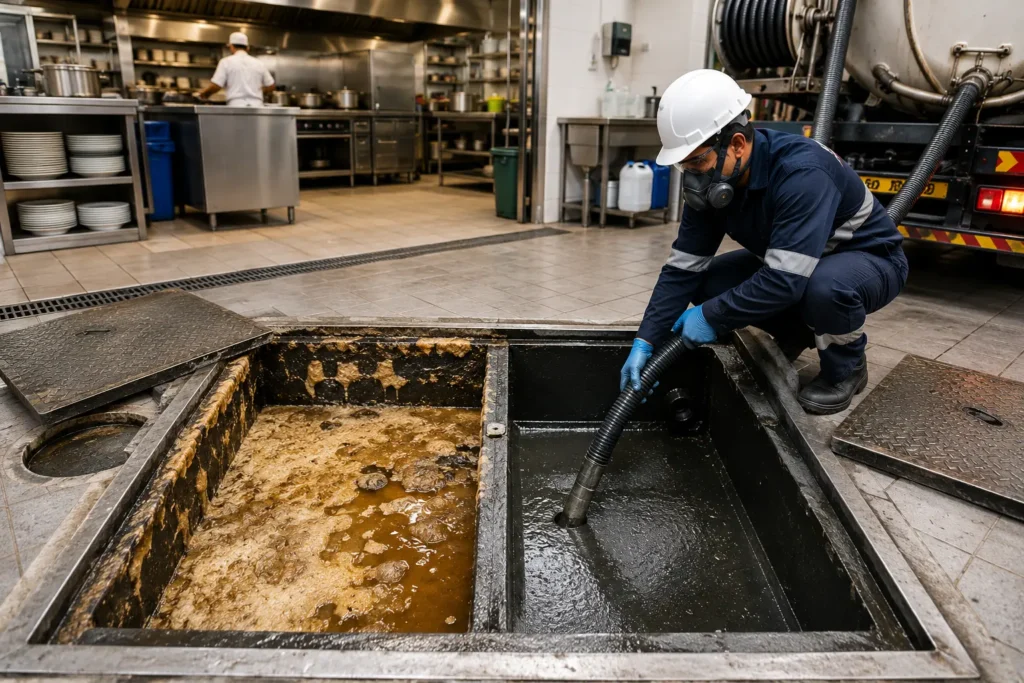
By the time a grease trap causes visible problems, it has already been overdue for cleaning for some time. The process of a grease trap declining toward failure is gradual, but the signs are readable if you know what to look for.
Kitchen drains that are slower than normal are the earliest and most consistent indicator. When a grease trap is approaching capacity, wastewater backs up into the trap faster than it exits through the outlet. The drain in your floor or sink appears to work, but takes longer to clear. Staff typically adapt to this over days and weeks without reporting it, because the change is gradual. By the time a drain is fully blocked, the trap has been failing for some time.
A persistent foul smell inside the kitchen — distinct from cooking smells — indicates that the grease and organic matter in an overfull trap is producing hydrogen sulphide and other decomposition gases. These gases travel back up through the drainage pipes into the kitchen. In a working kitchen, this smell is difficult to trace at first. As the trap gets worse, the smell intensifies and eventually becomes obvious in the customer-facing areas of the restaurant. A customer who can smell your drains will not return.
Grease surfacing around floor drain covers is a later-stage sign. When the trap is full and grease is flowing straight through into the outlet, some of it also migrates back up through the floor drain under the hydraulic pressure of kitchen wastewater flow. You will see a film or puddle of grey-brown grease around drain covers on the kitchen floor.
Fruit flies and drain flies appearing around kitchen drains indicate a biological accumulation in the drainage system. An overfull grease trap is ideal breeding habitat for drain flies — moisture, warmth, and abundant organic matter. If you have a persistent drain fly problem in your kitchen that does not resolve with standard drain treatments, the grease trap is usually the source. Total Defence addresses both the grease trap cause and the resulting pest problem — our commercial pest control services and tank cleaning teams work together on combined infestations.
Sewage or drainage smell in the dining area is a critical-stage sign. If kitchen drain smells are reaching the front of house through air handling systems or open kitchen layouts, your grease trap is at capacity and you are at immediate risk of a municipality inspection finding.
If you are experiencing any of these signs, contact Total Defence for an urgent grease trap inspection across Dubai and Sharjah. Do not wait.
What happens if a grease trap is never cleaned in the UAE?
The consequences of neglecting grease trap maintenance escalate through clear stages. Understanding them is useful for any operator making a decision about whether to invest in regular maintenance or wait until there is a visible problem.
The first stage is functional failure of the trap itself. When the trap is full, it stops intercepting grease. Fats and oils enter the sewer connection. In the pipe between your kitchen and the main sewer — which may be shared with other businesses in your building — grease accumulates on the pipe walls. Over weeks and months, this builds into a complete blockage. The first sign is usually a single drain that stops clearing. The second is multiple drains backing up simultaneously.
The second stage is sewage backflow. When the connecting pipe between your kitchen and the sewer is blocked by accumulated grease, wastewater has nowhere to go. It backs up through your floor drains, under-sink units, and potentially through dishwasher and cooking equipment drainage. Sewage backflow in a food preparation area is an immediate health hazard and an immediate trigger for a mandatory inspection and potential closure by the Food Safety Department or municipality.
The third stage is structural pipe damage. Grease does not sit inert in a pipe — it reacts with water and organic acids in the drainage to form a substance that adheres to pipe walls and hardens over time. Removing this from pipes that have been neglected for a long time requires high-pressure water jetting at a significantly higher cost than regular grease trap maintenance. In some cases, severe grease accumulation in drainage pipes causes the pipe fittings to fail or crack under pressure. Pipe repair in a commercial kitchen — under concrete floor slabs — is expensive and disruptive.
The fourth stage is municipality action. In Dubai and Sharjah, grease trap maintenance is a legal requirement for food establishments. A municipality inspector who finds a non-functioning, full, or absent grease trap at a licensed food establishment can issue a compliance notice, impose a fine, and — in serious cases — suspend the food establishment permit pending remediation. For a restaurant, any period of suspension is a trading loss that far exceeds the cost of the grease trap cleaning that was avoided.
The fifth stage is reputational damage. A restaurant that smells of drains, has grease overflowing from floor drains, or receives a visible municipality compliance notice loses customers. In the UAE market, where review platforms and social media move quickly, the reputational impact of a closure or a bad review mentioning odour problems can be significant and lasting.
What does professional grease trap cleaning actually involve?
When Total Defence carries out a grease trap clean in Dubai or Sharjah, this is the actual process — not a simplified summary.
Step one is assessment.
The technician accesses the grease trap inspection cover and measures the current grease layer depth and sludge depth. For a properly maintained trap, the industry standard is that cleaning is required when the combined depth of the grease and sludge layers reaches 25% of the total trap volume. We record the measurements before and after service.
Step two is pump-out.
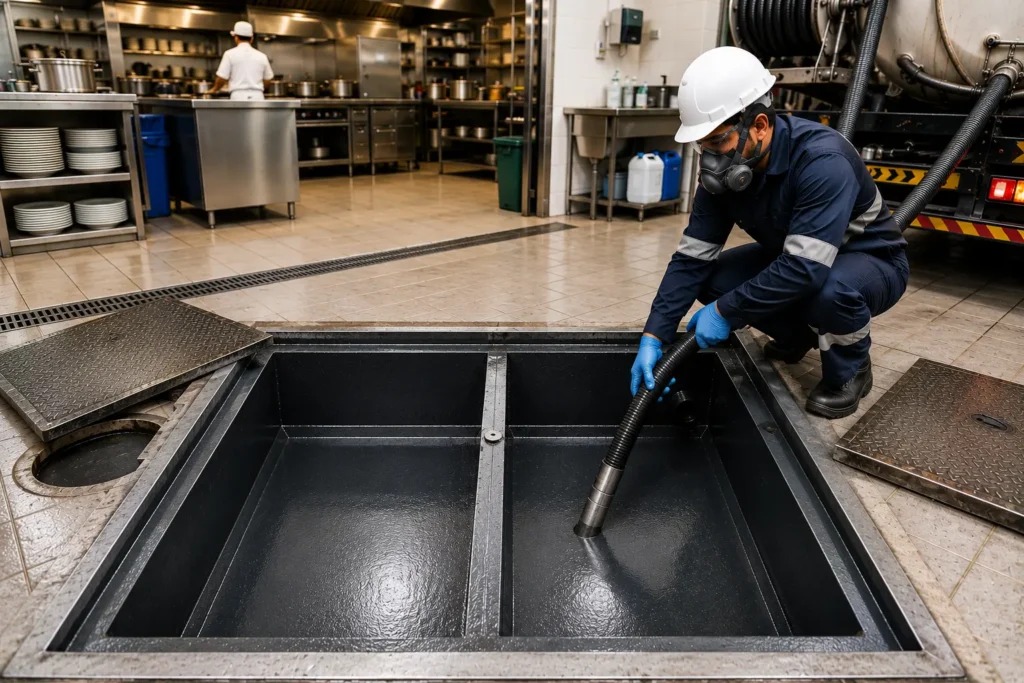
A vacuum tanker removes all waste — the grease layer, the effluent, and the sludge layer — from the trap. Everything is pumped into the sealed tanker. Nothing is discharged into drains, grounds, or public areas. Total Defence uses only licensed operators compliant with UAE environmental regulations. We provide documentation of compliant disposal as part of every service. This documentation is what your file needs for municipality compliance records.
Step three is interior scraping and jetting.
This is what separates a genuine clean from a basic pump-out. After the trap is emptied, the walls, baffles, and base of the trap are scraped to remove the layer of hardened grease that cannot be vacuumed out. This is then followed by high-pressure water jetting — flushing every internal surface and every baffle opening. Grease hardens on trap surfaces and, if left, begins to decompose again immediately after a fresh charge of wastewater enters the trap. A clean trap that has not been properly scraped and jetted will smell and perform like an uncleaned one within days.
Step four is inspection of trap components.
With the trap clean and empty, we inspect the inlet and outlet baffles, the trap lid seal, the outlet screen (if fitted), and the condition of the trap body. Cracked baffles allow grease to bypass the separation chamber and flow directly to the outlet. Deteriorating outlet screens allow solid waste to enter the drainage network. These are findings that need to be addressed, not ignored.
Step five is connecting pipe jetting where required.
If the drainage pipes between the kitchen and the grease trap, or between the trap and the main sewer, have grease accumulation, high-pressure jetting is used to clear them. A clean trap connected to a grease-lined pipe will re-block faster than the cleaning interval is designed for.
On completion, Total Defence provides a signed service report and certificate confirming the date, grease trap location, volumes removed, trap condition, and disposal compliance. This is the document your municipality compliance file requires and the record that a food establishment inspector will ask for.
Our building cleaning services for commercial properties integrate grease trap maintenance into wider facilities management programmes — a single contract, a single record-keeping system, and a schedule that keeps every system compliant.
How often should a grease trap be cleaned in Dubai and Sharjah?
Frequency depends on the size of the trap, the volume of food production, and the type of food being prepared. Here is a realistic guide for UAE commercial kitchen operations.
High-volume restaurants, fast food outlets, and hotel kitchens — operations running multiple services daily with heavy frying, grilling, or cooking-oil use — typically require cleaning every four to six weeks. In UAE conditions, with high ambient temperatures and high-volume kitchen operation, six weeks is the upper limit for traps that are correctly sized. Under-sized traps in these operations may need cleaning every two to three weeks.
Mid-volume restaurants and cafés — operations running one or two services per day with moderate frying — typically require cleaning every six to eight weeks. Monthly cleaning is the safe and recommended schedule for most operations in this category.
Low-volume food operations — corporate canteens, small cafés, school kitchens, and operations with limited cooking-oil use — may manage with cleaning every two to three months. However, “low volume” in the UAE hospitality context is relative, and we recommend a baseline inspection at the three-month mark even for smaller operations.
Supermarket and food retail operations with food preparation areas — deli counters, rotisserie stations, hot food counters — typically require cleaning every four to six weeks depending on throughput.
The practical rule, regardless of operation type: when the combined grease and sludge layers inside the trap reach 25% of the trap’s total capacity, it is time to clean. Waiting for the layers to reach 50% significantly increases the risk of grease breakthrough to the outlet. Do not use the 25% mark as a guideline to clean at the last possible moment — use it as the point at which cleaning becomes urgent.
If you do not know when your grease trap was last cleaned or how full it currently is, Total Defence can carry out a level assessment before establishing a schedule.
For properties with multiple kitchen units or large interceptors, Total Defence offers planned maintenance contracts — scheduled visits at agreed intervals, consistent documentation, and priority response for any urgent callouts between scheduled visits.
What the municipalities in Dubai and Sharjah require from food establishments
Both emirates regulate grease trap installation and maintenance as part of the food establishment licensing framework. Non-compliance is not a minor administrative issue — it is a condition of licence validity.
Dubai Municipality requires that all commercial food establishments connecting to the municipal drainage network install a correctly sized grease interceptor compliant with Dubai Municipality guidelines. Grease trap cleaning must be carried out by licensed operators, and waste must be transported to designated treatment facilities. Dubai Municipality Food Safety inspectors and drainage inspectors both have authority to require evidence of grease trap maintenance. Inspectors typically ask for service records covering the previous twelve months. Establishments found to be non-compliant — with a full, non-functioning, or absent grease trap — may receive a compliance notice, a fine, and a re-inspection requirement before trading can continue.
Sharjah Municipality enforces similar requirements under the Sharjah Food Control Authority framework. Commercial kitchens in Sharjah are required to maintain grease traps in functional condition and retain maintenance records. Trade licence renewal may be conditional on demonstrating compliance with drainage maintenance requirements.
The most important practical requirement for any operator is documentation. Every Total Defence grease trap cleaning service generates a signed service certificate showing the property, date, trap size, volume removed, and confirmation of compliant disposal at an approved facility. This certificate is the document your inspector will ask for. Without it, you have no verifiable proof that the work was carried out by a licensed provider.
Keep every certificate — inspectors in the UAE have requested records going back twelve months or more. A single missing service record in a period when you cannot demonstrate compliance can complicate a renewal or inspection outcome.
Our building cleaning services include grease trap maintenance as part of broader commercial facility management packages for operators who want a single service relationship covering multiple compliance requirements.
FAQ
What is a grease trap and do I need one in Dubai?
A grease trap is a plumbing chamber that intercepts fats, oils, and grease from kitchen wastewater before they enter the municipal sewer. Any commercial food establishment in Dubai or Sharjah connected to the municipal drainage network is legally required to have one. It is a condition of your food establishment permit and trade licence.
How much does grease trap cleaning cost in Dubai?
Pricing varies depending on trap size, location, fill level, and whether pipe jetting is included. Contact Total Defence for a fixed site-specific quotation based on your trap type and location across Dubai or Sharjah.
How often should a restaurant grease trap be cleaned in the UAE?
High-volume restaurants and hotel kitchens: every four to six weeks. Mid-volume cafés and restaurants: every six to eight weeks. Low-volume food operations: every two to three months. Frequency increases in the UAE summer when high temperatures accelerate grease decomposition. Clean before the combined grease and sludge layer reaches 25% of the trap’s capacity.
Is grease trap cleaning required by law in Dubai?
Yes. Dubai Municipality requires all commercial food establishments to maintain a functioning grease trap and to have it cleaned by licensed operators with compliant waste disposal. Non-compliance during an inspection can result in fines, a compliance notice, and licence renewal complications. Sharjah Municipality has equivalent requirements.
What happens if I don’t clean my grease trap?
The trap fills, stops intercepting grease, and your drainage pipes begin to accumulate FOG. This leads to blocked drains, sewage backflow into the kitchen, drain flies and pest infestation, municipality compliance failure, and in serious cases, trade licence suspension. The cost of emergency remediation is always higher than the cost of regular maintenance.
How do I know if my grease trap is full?
The main signs are: slow kitchen drains that take longer than usual to clear, a persistent foul smell in the kitchen not related to cooking, grease surfacing around floor drain covers, drain flies appearing around sinks and floor drains, and sewage smell reaching the dining area. Any of these signs means the trap needs immediate inspection.
Can I clean a grease trap myself?
No. Grease trap cleaning requires a vacuum tanker to remove accumulated waste, specialist scraping and jetting equipment for interior cleaning, and licensed disposal at an approved facility. It cannot be done by kitchen staff with standard tools. Attempting to clean a grease trap without proper equipment is also a health and safety risk due to hydrogen sulphide gas.
Does Total Defence provide grease trap cleaning certificates for municipality compliance?
Yes. Every Total Defence grease trap service generates a signed service certificate showing the date, property, trap size, volume removed, and confirmation of compliant disposal. This is the document Dubai and Sharjah municipality inspectors will ask for. Book your service here.
What is the difference between a grease trap and a grease interceptor?
These terms are often used interchangeably. Technically, a grease interceptor is a larger external unit typically installed underground outside a building, while a grease trap refers more often to smaller under-sink units inside the kitchen. Both perform the same function — intercepting FOG from kitchen wastewater — but differ in size, placement, and cleaning frequency requirements.
Can a blocked grease trap cause cockroaches or flies in my restaurant?
Yes. An overfull or blocked grease trap creates ideal breeding conditions for drain flies and American cockroaches — warmth, moisture, and abundant organic matter. Drain fly infestations appearing around kitchen drains are almost always connected to a grease trap that needs cleaning. Our commercial pest control and tank cleaning teams address both issues together. Contact us.
How long does a grease trap clean take?
An under-sink unit clean takes 30–60 minutes. A standard external restaurant trap takes 1.5–2.5 hours including pump-out, scraping, and interior jetting. Large commercial interceptors take 3–4 hours or more depending on volume.
Does grease trap cleaning include pipe jetting?
Not automatically. Standard service covers the trap itself — pump-out, scraping, and interior jetting. Connecting pipe jetting is an additional service quoted separately. If your drains are slow or you have had a blockage in the pipes between the kitchen and the trap, pipe jetting should be included. Total Defence offers combined packages. Get a quotation here.
Does Total Defence cover grease trap cleaning in Sharjah?
Yes. We provide full grease trap cleaning across Sharjah with Sharjah Municipality-compliant documentation and scheduled maintenance contracts. Contact us.
What is the 25% rule for grease traps?
The 25% rule — used by drainage professionals and recognised by municipality standards — states that a grease trap should be cleaned when the combined depth of the floating grease layer and the settled sludge layer reaches 25% of the total trap volume. At this point, the functional liquid zone in the middle of the trap has been reduced enough to risk grease breakthrough to the outlet.
Why does my restaurant smell like drains even after a grease trap clean?
If the smell persists after cleaning, possible causes include: connecting drainage pipes that were not jetted and still contain grease deposits; a cracked or missing inspection cover seal allowing gas to escape; a failed baffle inside the trap; or a secondary grease trap serving another kitchen area that was not included in the service. Request a follow-up inspection from Total Defence.
What documentation do I need to show a Dubai Municipality food inspector?
A signed service certificate from the cleaning company showing the property address, date of service, trap details, volumes removed, and confirmation of compliant disposal. Total Defence issues this certificate with every service. Keep all certificates — inspectors may request records covering the previous twelve months.
Can a grease trap be too small for my kitchen?
Yes — this is common in UAE food operations where a premises has expanded output but the original trap was sized for lower volumes. An undersized trap fills faster than the recommended cleaning schedule allows and may need replacement with a larger unit. Total Defence can advise on sizing during an inspection. Contact us here.
What is high-pressure jetting inside a grease trap?
After the trap is pumped out and scraped, a high-pressure water lance is used to blast hardened grease from every internal surface — the walls, baffles, base, and outlet screen. This step is essential because vacuuming out the liquid leaves a thick layer of compacted, hardened grease on every surface. Without jetting, this residue begins decomposing within hours and the trap performs as if it were never properly cleaned.
Does grease trap cleaning affect my restaurant operations?
Minimal disruption with a professional service. The cleaning is carried out at the access point external to or at the edge of the kitchen, and the tanker is a sealed, odour-controlled system. We recommend scheduling service during off-peak hours — early morning before service begins or between lunch and dinner. A well-managed clean does not require kitchen shutdown.
The bottom line
Grease trap maintenance is one of the most straightforward compliance requirements in UAE food operations — straightforward because the consequences of neglect are entirely predictable, and the cost of regular cleaning is a fraction of the cost of emergency drain clearance, municipality fines, structural pipe repair, or a forced closure. The trap exists to protect your drainage, your licence, your kitchen, and your customers. It works invisibly when it is maintained. It fails very visibly when it is not.
In the UAE climate and at UAE operational volumes, regular cleaning intervals are shorter than most operators initially expect. Establishing a scheduled maintenance contract is the approach that removes the decision from your operational workload entirely — the service happens, the certificate is issued, the record is complete, and your compliance is maintained without a reactive crisis driving it.
Book your grease trap inspection or cleaning with Total Defence today. We serve Dubai and Sharjah with same-week appointments, licensed compliant disposal, and full municipality compliance documentation.
Total Defence provides grease trap cleaning, commercial pest control, and building cleaning services across Dubai and Sharjah. Contact: (+971) 52 161 2380