Professional disinfection is not the same as cleaning — and in Dubai, Sharjah, and Ajman, the difference matters more than most property owners and business operators realise. Total Defence provides Dubai Municipality-approved disinfection and sterilisation services for residential, commercial, and industrial properties across all three emirates.
Book your free assessment today.
Cleaning removes visible dirt and debris. Disinfection eliminates the pathogens — bacteria, viruses, fungi, and other microorganisms — that cleaning products leave behind. A surface can look spotless and still carry active viral particles, drug-resistant bacteria, or fungal spores at densities that pose a genuine health risk to everyone who comes into contact with it.
In the UAE, the combination of high-density occupancy, year-round warmth, shared building infrastructure, and the specific post-pandemic awareness of surface and airborne transmission has made professional disinfection a standard requirement — not just for hospitals and food businesses, but for offices, schools, gyms, residential properties, and any space where people gather regularly.
This guide answers every real question that residents, facility managers, business operators, and property owners in Dubai, Sharjah, and Ajman ask about professional disinfection — from what the service actually involves, to when you need it, to how to choose a licensed provider.
1. What is the difference between cleaning, sanitising, and disinfecting?
These three terms are frequently used interchangeably — and that confusion leads to genuine gaps in hygiene protection. Understanding the distinction helps you specify the right service for your situation.
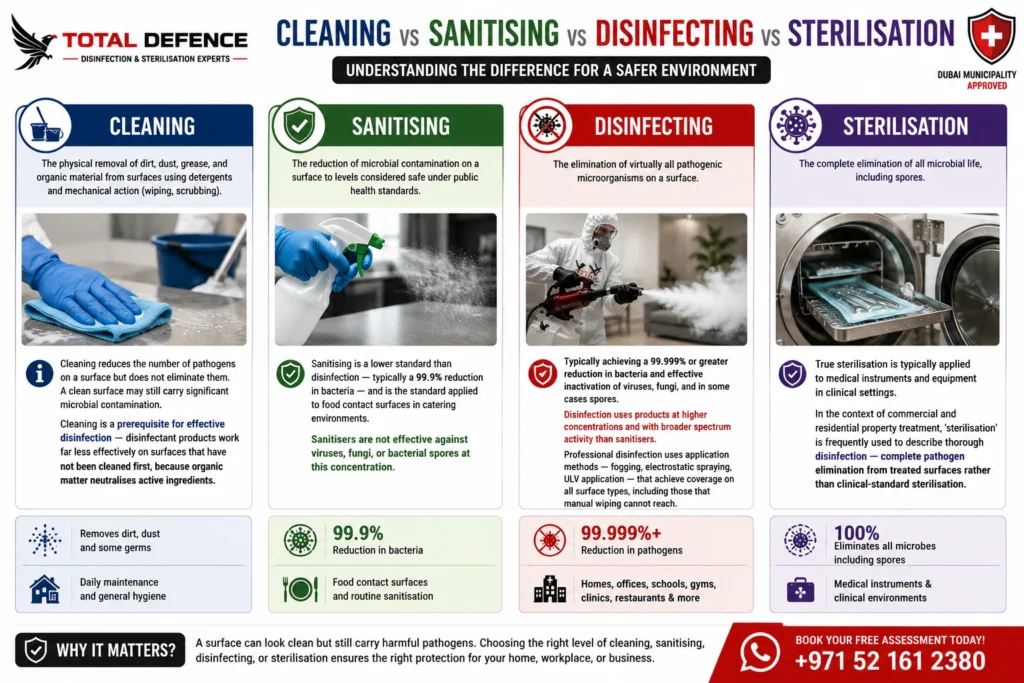
- Cleaning — the physical removal of dirt, dust, grease, and organic material from surfaces using detergents and mechanical action (wiping, scrubbing). Cleaning reduces the number of pathogens on a surface but does not eliminate them. A clean surface may still carry significant microbial contamination. Cleaning is a prerequisite for effective disinfection — disinfectant products work far less effectively on surfaces that have not been cleaned first, because organic matter neutralises active ingredients.
- Sanitising — the reduction of microbial contamination on a surface to levels considered safe under public health standards. Sanitising is a lower standard than disinfection — typically a 99.9% reduction in bacteria — and is the standard applied to food contact surfaces in catering environments. Sanitisers are not effective against viruses, fungi, or bacterial spores at this concentration.
- Disinfecting — the elimination of virtually all pathogenic microorganisms on a surface, typically achieving a 99.999% or greater reduction in bacteria and effective inactivation of viruses, fungi, and in some cases spores. Disinfection uses products at higher concentrations and with broader spectrum activity than sanitisers. Professional disinfection uses application methods — fogging, electrostatic spraying, ULV application — that achieve coverage on all surface types, including those that manual wiping cannot reach.
- Sterilisation — the complete elimination of all microbial life, including spores. True sterilisation is typically applied to medical instruments and equipment in clinical settings. In the context of commercial and residential property treatment, ‘sterilisation’ is frequently used to describe thorough disinfection — complete pathogen elimination from treated surfaces rather than clinical-standard sterilisation.
When Total Defence refers to disinfection and sterilisation services, we mean professional-grade disinfection achieving the highest practical pathogen elimination for occupied property environments — not clinical sterilisation, and not the sanitising standard applied to routine surface cleaning.
2. When do I need professional disinfection in Dubai, Sharjah, or Ajman?
Professional disinfection is appropriate — and in some cases essential — in the following situations:
After a confirmed illness or disease exposure
- A confirmed case of COVID-19, influenza, gastroenteritis, or other infectious illness in your home, office, or commercial premises
- A confirmed case of food poisoning affecting multiple people who shared a food preparation or service area
- Any confirmed outbreak of a communicable disease in a shared space — school classroom, gym, office floor, hotel room
After pest infestation treatment
- Following rodent infestation — rodent droppings, urine, and carcasses carry Leptospirosis, Hantavirus, Salmonella, and other pathogens that remain active in the environment after the rodents themselves have been eliminated
- Following cockroach infestation — cockroaches carry and deposit E. coli, Salmonella, and Staphylococcus on food preparation surfaces and utensils
- Following any pest infestation in food storage, food preparation, or food service areas
Routine and preventive disinfection
- Regular scheduled disinfection for high-occupancy or high-contact environments: gyms, nurseries, schools, clinics, offices, and food service areas
- Pre-opening disinfection for new businesses, renovated premises, or properties returning to use after a period of vacancy
- Post-construction or post-renovation disinfection before occupation
Specific events and circumstances
- After flooding or water damage — standing water in buildings creates conditions for rapid bacterial and fungal growth
- After a death or serious injury in a property requiring biological material remediation
- Before a major event, opening, or inspection where hygiene compliance must be demonstrated
- Seasonal deep disinfection at the start of school terms, before Ramadan, or at the beginning of the summer season for hospitality businesses
If you are unsure whether your situation requires professional disinfection, contact Total Defence for a free assessment. We will give you a straightforward recommendation based on your specific circumstances — not a generic sales response.
3. What pathogens does professional disinfection eliminate?
Professional disinfection using approved products and correct application methods is effective against the full spectrum of pathogens of concern in residential and commercial environments in Dubai, Sharjah, and Ajman:
Bacteria
- Staphylococcus aureus and MRSA — one of the most common causes of skin, wound, and respiratory infections. MRSA (methicillin-resistant Staphylococcus aureus) is a drug-resistant variant of particular concern in healthcare-adjacent settings and gyms. Survives on surfaces for weeks.
- Salmonella — a major cause of food poisoning. Deposited on food preparation surfaces by cockroaches, rodents, and contaminated food. Eliminated by professional-grade disinfection.
- E. coli — including pathogenic strains associated with severe gastroenteritis. Common in food handling environments and after rodent or cockroach infestation.
- Listeria monocytogenes — a food pathogen of particular concern in commercial food environments, able to survive and grow at refrigeration temperatures. Eliminated by professional disinfection.
- Leptospira — the bacterium responsible for Leptospirosis, deposited in environments contaminated by rodent urine. Eliminated by disinfection after rodent control treatment.
Viruses
- SARS-CoV-2 (COVID-19) — eliminated by professional-grade disinfectants at correct concentrations. Remains active on hard surfaces for up to 72 hours without treatment.
- Influenza viruses — active on surfaces for 24 hours or more. Eliminated by professional disinfection.
- Norovirus — a highly contagious cause of gastroenteritis. One of the more resistant viruses to standard sanitisers; requires professional-grade disinfection for reliable elimination.
- Rotavirus — a leading cause of severe diarrhoea in children. Survives on surfaces for days to weeks.
Fungi and moulds
- Aspergillus species — a common environmental mould that causes respiratory disease in immunocompromised individuals. Found in damp building materials, AC systems, and areas with water damage.
- Candida species — opportunistic fungal pathogens associated with healthcare environments and food handling areas.
- Trichophyton (ringworm/athlete’s foot) — a dermatophyte fungus commonly found in gyms, changing rooms, and swimming pool areas.
The specific products and methods used in your disinfection programme are selected based on the pathogens of concern for your environment. A disinfection service for a gym has different product requirements from a disinfection service following a rodent infestation — and a professional operator calibrates accordingly.
4. What disinfection methods does Total Defence use?
Total Defence uses a combination of professional application methods matched to the environment, the pathogen of concern, and the areas requiring treatment:
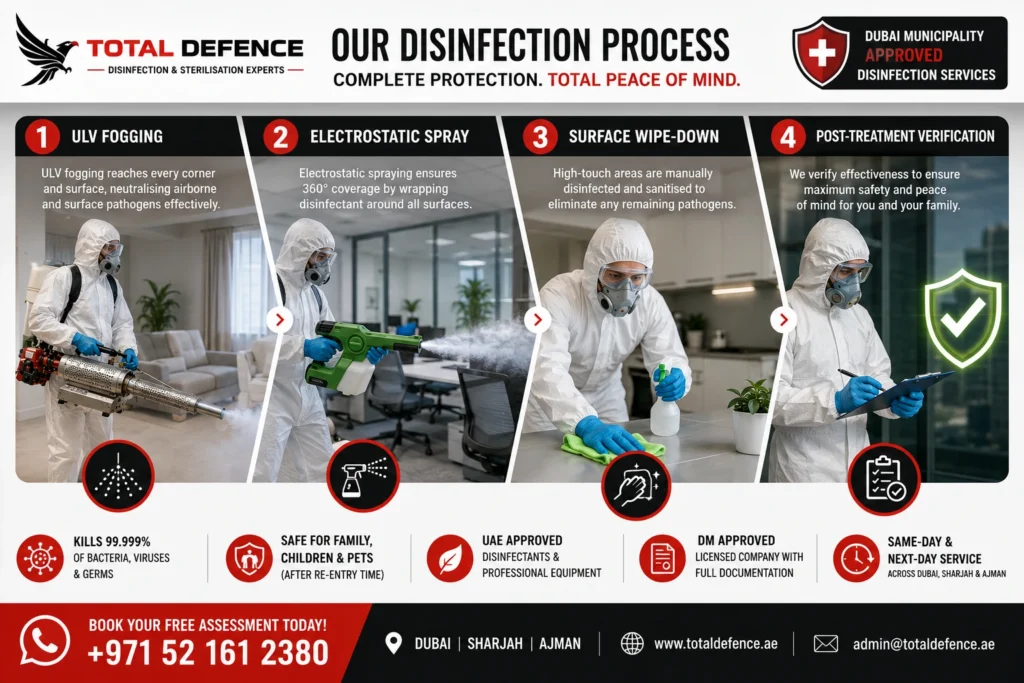
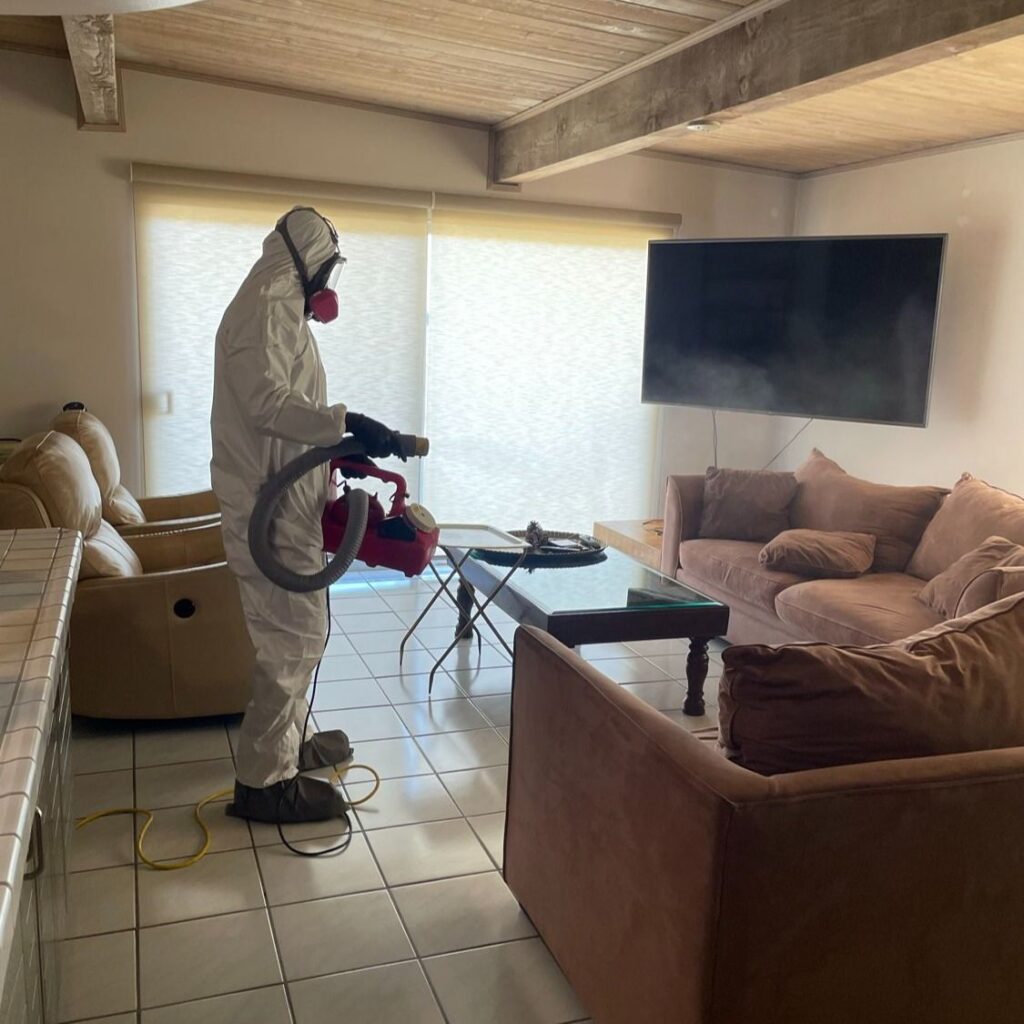
- ULV cold fogging — Ultra Low Volume fogging generates a fine mist of disinfectant that penetrates all areas of a room, including surfaces that manual application cannot reach: under furniture, inside cupboards (with doors open), ceiling corners, air conditioning return vents, and the backs of shelving units. ULV fogging is the most comprehensive method for whole-room disinfection and is the primary method used for post-illness treatment, post-pest infestation treatment, and large-area commercial disinfection. The disinfectant droplets remain airborne for several minutes, providing both surface deposition and airborne pathogen inactivation.
- Electrostatic spraying — electrostatic sprayers charge disinfectant particles as they leave the nozzle, causing them to be electrostatically attracted to surfaces — including the undersides and backs of objects. This provides wraparound coverage that neither manual wiping nor standard spraying achieves, and is particularly effective for complex surfaces such as gym equipment, vehicle interiors, school furniture, and food preparation equipment.
- Surface disinfection (manual application) — targeted manual application of disinfectant to high-contact surfaces: door handles, light switches, lift buttons, countertops, taps, toilet flush handles, and communal touch points. Manual application allows precise product selection and dwell time control for specific surface types and is used in combination with fogging for comprehensive coverage.
- Thermal fogging — thermal fogging generates a dense visible fog by heating the disinfectant carrier. Particularly effective for large spaces, outdoor areas, and heavily contaminated environments. Used in combination with other methods for severe contamination situations.
- Drain and waste system treatment — targeted disinfection of drain channels, waste pipes, and drainage infrastructure using appropriate products. Essential for food businesses and any property where drainage systems may be contributing to pathogen spread.
Every Total Defence disinfection programme begins with a pre-treatment assessment to determine which combination of methods is appropriate for the specific environment and situation. We do not apply a generic fogging service to every job — the treatment is designed for the specific pathogen risk and coverage requirement.
5. What products does Total Defence use for disinfection? Are they safe?
All disinfection products used by Total Defence are registered with the UAE Ministry of Environment and Climate Change and approved by Dubai Municipality for use in occupied residential and commercial properties. Safety is the first consideration in product selection — not just efficacy.
- Quaternary ammonium compounds (QACs) — broad-spectrum disinfectants effective against bacteria, enveloped viruses (including COVID-19 and influenza), and fungi. Low toxicity to humans and animals when applied correctly; safe for use on most surface types. The primary product class used for routine disinfection in occupied environments.
- Hydrogen peroxide-based products — broad-spectrum disinfectants with excellent activity against bacteria, viruses, and fungi. Break down to water and oxygen after application, leaving no harmful residue. Particularly appropriate for food handling environments and areas with sensitive occupants.
- Chlorine dioxide — a highly effective disinfectant used for severe contamination, post-flood treatment, and situations requiring sporicidal activity. Applied at calibrated concentrations to balance efficacy against surface compatibility.
- Hypochlorous acid (HOCL) — an electrolysed water-based disinfectant that is effective against a broad spectrum of pathogens and is non-toxic, non-irritant, and safe for use around children, pets, and food contact surfaces. Increasingly used in childcare, school, and healthcare-adjacent settings.
Before any treatment begins, our technician will tell you exactly which products are being used, their active ingredients, the relevant safety data, and any specific precautions for your property. You will never be left uninformed about what is being applied in your space.
Re-entry periods vary by product and application method. For ULV fogging in a standard residential space, re-entry is typically 30 to 60 minutes after ventilation. Our technician provides specific guidance for your property and application.
6. Is professional disinfection safe for children, babies, pets, and food contact surfaces?
Yes — when conducted by a licensed professional using UAE-approved products at correct concentrations and application rates, professional disinfection is safe for all occupants when the re-entry guidance is followed.
- Children and babies — for homes with very young children or infants, we use hydrogen peroxide or hypochlorous acid-based products which break down to non-toxic compounds after application. Our technician will advise on re-entry timing and any specific precautions for nurseries or areas used by young children.
- Pets — most disinfection products used are safe for cats and dogs after the re-entry period. Fish should be removed or tanks covered during and shortly after fogging as some products are toxic to aquatic life at very low concentrations. Birds are sensitive to airborne compounds and should be removed from the treatment area and returned only after full ventilation. Our technician will advise specifically for your pets.
- Food contact surfaces — all products used on food preparation surfaces are food-safe at the concentrations applied. In commercial food environments, product selection specifically accounts for food contact surface requirements and HACCP compliance.
- People with respiratory conditions — for households or workplaces with individuals with asthma or other respiratory sensitivities, our technician will discuss product selection and ventilation requirements before treatment. We can accommodate most sensitivities with appropriate product choices.
Raise any specific concerns at the time of booking. We adapt the treatment approach to your occupants — not the other way around.
7. How long does a disinfection service take in Dubai, Sharjah, or Ajman?
Treatment time depends on the size of the property, the method used, and the scope of the programme:
- Standard apartment (1–2 bedroom) — 45 to 60 minutes for ULV fogging plus high-contact surface treatment.
- Larger apartment or small villa (3–4 bedroom) — 60 to 90 minutes.
- Large villa or townhouse — 90 minutes to 2.5 hours depending on floor area and number of treatment areas.
- Small commercial property (retail unit, small office, small restaurant) — 60 to 90 minutes.
- Large commercial property (school, gym, large restaurant, warehouse, hotel floor) — 2 to 4 hours or more; quoted individually after site assessment.
The re-entry period after treatment (the time before occupants return to the treated space) is typically 30 to 60 minutes for standard residential properties after ULV fogging, plus ventilation time. Our technician will give you the specific re-entry guidance for your property and treatment.
For businesses, we schedule disinfection outside operational hours — before opening, after closing, or overnight — to eliminate disruption entirely.
8. Do I need to leave my home or business during disinfection?
For ULV fogging — the primary disinfection method — all occupants need to vacate the treated areas during the application and for the re-entry period afterwards (typically 30 to 60 minutes plus ventilation). This is not because the products are dangerous to humans at low exposure, but because the fogging mist is not comfortable to breathe at application concentrations and the treatment is more effective with the space unoccupied.
For surface disinfection only (manual application to high-contact surfaces without fogging), occupants can typically remain in adjacent areas of the property while treatment is conducted, provided the treated areas themselves are unoccupied during application.
For businesses, total evacuation of the treatment area is standard practice. Staff return after the re-entry period — which in most cases means overnight treatment allows normal operations to resume the following morning with zero downtime.
Our technician will give you specific guidance on evacuation requirements and re-entry timing for your specific treatment before the visit begins.
9. What should I do to prepare before a Total Defence disinfection visit?
A small amount of preparation before our visit improves treatment coverage and effectiveness:
- Remove food, drinks, and open food containers from kitchen countertops and dining tables, or store them in sealed containers inside cupboards
- Remove or cover fish tanks and aquariums — advise our technician of their location
- Remove pet birds from the treatment area
- Open all internal doors, wardrobe doors, and cupboard doors to allow the fog to reach all interior surfaces
- Clear surfaces of clutter where possible to maximise surface contact with the disinfectant
- Turn off air conditioning units in the treatment area — fogging with AC running disperses the product too rapidly and reduces contact time on surfaces
- Ensure our technician has access to all areas requiring treatment including storage rooms, utility areas, and any rooms currently in use
- Inform our technician of any surface types that require specific care: natural stone, certain metals, antique furniture, or sensitive electronics
No deep cleaning is required before our visit — our technician will advise on any pre-cleaning requirements specific to your situation. For post-pest infestation disinfection, we will advise on the safe removal of pest debris before the disinfection treatment begins.
10. How does disinfection relate to pest control? Why are they often done together?
Disinfection and pest control address two different but connected problems — and in many situations, both are required to fully resolve a contamination issue.
Pest control eliminates the pest population. Disinfection eliminates the pathogens that the pest population has deposited in the environment during the infestation. Without disinfection, a successfully treated rodent infestation can still leave active Leptospira, Hantavirus particles, Salmonella, and other pathogens in the areas the rodents occupied — in droppings, urine residue, and contaminated surfaces — for weeks or months after the last rodent has been eliminated.
The same principle applies to cockroach infestations (E. coli, Salmonella deposited on food preparation surfaces), bird infestations (fungal spores from droppings, particularly Histoplasma capsulatum and Cryptococcus neoformans), and any pest that deposits biological material in the environment.
Total Defence offers combined pest control and disinfection programmes specifically designed for post-infestation situations. Both services can be completed in a single visit where appropriate — pest control first, followed by disinfection of the treated areas once the pest activity has been confirmed eliminated.
See our Rodent Control Service
See our full Pest Control Service
11. What areas and property types does Total Defence disinfect in Dubai, Sharjah, and Ajman?
Our disinfection and sterilisation services cover all property types across Dubai, Sharjah, and Ajman:
Residential
- Apartments and flats — all sizes, from studios to large multi-bedroom units
- Villas and townhouses — including all rooms, utility areas, and external spaces where required
- Maids’ rooms, driver’s quarters, and staff accommodation
- Storage rooms, basements, and car parking areas
Commercial and hospitality
- Offices and co-working spaces — single floors, full buildings, and individual suites
- Restaurants, cafes, and food courts — including kitchens, service areas, and dining spaces
- Hotels and hotel apartments — guest rooms, common areas, kitchens, and back-of-house
- Gyms, fitness centres, and sports facilities
- Retail shops and shopping mall units
- Beauty salons, barbershops, and spas
Healthcare-adjacent and education
- Medical clinics and dental practices
- Nurseries, schools, and training centres
- Pharmacies and health food retail
Industrial and logistics
- Warehouses and cold storage facilities
- Food processing and packaging facilities
- Vehicle fleets — cars, vans, trucks, and buses
- Construction site offices and welfare facilities
If your property type is not listed here, contact us — we cover all commercial and residential environments across Dubai, Sharjah, and Ajman.
12. Is disinfection service in Dubai regulated? Do I need a licensed company?
Yes — and this is particularly important for commercial operators in Dubai, Sharjah, and Ajman.
Under Dubai Municipality regulations, disinfection services in commercial premises — including restaurants, food businesses, healthcare facilities, and hospitality properties — must be conducted by licensed operators. Treatment records, including the products used, areas treated, and the operator’s licence number, must be available for inspection.
For food businesses specifically, Dubai Municipality food establishment inspections evaluate disinfection records as part of food safety compliance. A disinfection service conducted by an unlicensed operator has no standing as a compliance record — and in the event of a food safety incident, the absence of properly documented, licensed disinfection services is a significant liability.
Total Defence holds a valid Dubai Municipality pest control and disinfection licence covering all services across Dubai, Sharjah, and Ajman. Every treatment produces a signed service report with our DM licence number, the products used, the areas treated, and the technician’s details — suitable for Dubai Municipality inspection records, food safety audits, and corporate compliance requirements.
See our Commercial Services page.
13. How does disinfection connect to water tank hygiene in Dubai buildings?
Water tanks are one of the most important and most overlooked hygiene risks in Dubai, Sharjah, and Ajman buildings — and disinfection is a core component of any professional water tank cleaning and maintenance programme.
In UAE buildings, water is typically stored in rooftop or underground tanks before distribution to individual units. Without regular cleaning and disinfection, these tanks accumulate sediment, biofilm, and microbial contamination — including Legionella pneumophila (the bacterium responsible for Legionnaires’ disease), E. coli, and other pathogens — that is then distributed through the building’s water supply.
A water tank cleaning and disinfection programme involves physical cleaning to remove sediment and biofilm, followed by disinfection of the tank interior and the distribution pipework. This is a distinct service from general property disinfection — it requires different equipment, different products (typically chlorine-based at specific concentrations), and specific post-treatment flushing and testing protocols.
Total Defence offers a combined water tank cleaning and disinfection service across Dubai, Sharjah, and Ajman. If your building requires both water tank treatment and property disinfection, both can be coordinated in a single programme visit.
Learn more: Water Tank Cleaning Dubai — Complete Guide
14. How often should disinfection be carried out in Dubai, Sharjah, and Ajman?
The appropriate frequency of professional disinfection depends on the property type, occupancy level, and the specific hygiene risks present:
- Food businesses (restaurants, cafes, food courts, catering) — monthly disinfection as a minimum for compliance and food safety. High-volume operations benefit from fortnightly treatment. Required more frequently after any pest activity or food safety incident.
- Healthcare-adjacent settings (clinics, dental practices, physiotherapy) — monthly or quarterly disinfection as part of a documented infection control programme. Immediately after any confirmed pathogen exposure.
- Schools and nurseries — at the start of each term and immediately following any confirmed illness outbreak. Regular scheduled treatment during term time for high-contact areas.
- Gyms and fitness facilities — monthly disinfection for equipment and changing areas. Immediately following any confirmed skin infection (ringworm, MRSA) among members.
- Offices and commercial spaces — quarterly scheduled disinfection as part of workplace hygiene. Immediately following any confirmed COVID-19 or influenza case. Pre-return disinfection after periods of vacancy.
- Residential properties — as required following illness, pest infestation, flooding, or property handover. Annual preventive disinfection is appropriate for high-occupancy properties or those with vulnerable occupants.
For clients who require regular scheduled disinfection, Total Defence offers annual maintenance contracts covering Dubai, Sharjah, and Ajman — with fixed pricing, priority scheduling, and full compliance documentation.
15. What guarantee does Total Defence offer for disinfection services?
Every Total Defence disinfection treatment is conducted to the standard required for the specific pathogen risk and environment. We provide a signed service report confirming the treatment conducted, products used, and areas covered — suitable for regulatory compliance, corporate records, and insurance purposes.
For post-illness or post-pest infestation disinfection, where the goal is pathogen elimination from a contaminated environment, we stand behind the thoroughness of our treatment. If you have concerns about the coverage or effectiveness of a completed treatment, contact us immediately and we will return to address the concern.
For ongoing contract clients in Dubai, Sharjah, and Ajman, our service agreement includes defined treatment standards, response times for emergency call-outs, and documentation structured to meet all relevant regulatory requirements.
16. How much does professional disinfection cost in Dubai, Sharjah, and Ajman?
We are transparent about pricing — and an accurate quote requires a free assessment, because cost varies with property size, the treatment methods required, and the specific pathogen risks involved.
Every quote comes after a free assessment. You will always know the full cost before any work begins — no surprises, no hidden fees.
For clients combining disinfection with pest control, water tank cleaning, or building cleaning in a single programme, package pricing applies — typically producing significant savings against booking each service separately.
See our Water Tank Cleaning Service
See our Building Cleaning Service
Book your free assessment and quote.
17. How do I book disinfection services in Dubai, Sharjah, or Ajman?
Booking is straightforward — call, WhatsApp, or use the contact form on our website:
- Phone/WhatsApp: (+971) 52 161 2380
- Email: admin@totaldefence.ae
Online: totaldefence.ae/contact
We offer same-day and next-day appointments across Dubai, Sharjah, and Ajman. For urgent situations — a confirmed illness case, a scheduled inspection within 24 hours, or an immediate post-pest infestation requirement — same-day response is available in most areas.
Areas covered include all of Dubai (Deira, Bur Dubai, Al Barsha, Jumeirah, JBR, Al Quoz, Mirdif, Arabian Ranches, and all surrounding areas), all of Sharjah (Al Nahda, Muwaileh, Al Khan, Al Majaz, and all surrounding areas), and Ajman.
Final word: cleaning is not disinfection — and the difference matters
The visible cleanliness of a space tells you nothing about its microbial contamination level. Pathogens survive on surfaces for hours, days, and in some cases weeks — and they cannot be seen, smelled, or detected by any means other than laboratory testing. Professional disinfection provides the only reliable means of eliminating them from your environment.
Total Defence is a Dubai Municipality-approved company providing professional disinfection and sterilisation services across Dubai, Sharjah, and Ajman. We serve all property types — homes, offices, restaurants, schools, gyms, warehouses, clinics, hotels, and all other commercial and residential environments. We offer:
- Free assessment and no-obligation quote
- Same-day and next-day appointments across Dubai, Sharjah, and Ajman
- Dubai Municipality-compliant treatment and full documentation
- UAE Ministry of Environment-approved products only
- Disinfection combined with pest control, tank cleaning, and building cleaning
- Annual maintenance contracts for businesses and residential clients
Ready to book? Contact Total Defence today or call (+971) 52 161 2380 for your free assessment.
Frequently Asked Questions
Q: How quickly can Total Defence respond to a disinfection emergency in Dubai, Sharjah, or Ajman?
A: We offer same-day and next-day appointments across all three emirates. Call or WhatsApp (+971) 52 161 2380 for urgent bookings.
Q: Is your disinfection service effective against COVID-19?
A: Yes. The disinfectant products used by Total Defence are effective against SARS-CoV-2 (COVID-19) and all other enveloped viruses. Our ULV fogging method ensures comprehensive surface coverage — including areas that manual wiping cannot reach — providing reliable virus inactivation across the entire treated space.
Q: Do I need to clean before you disinfect, or does your service include cleaning?
A: Disinfection is most effective on pre-cleaned surfaces — organic matter reduces the efficacy of disinfectant products. For most residential and commercial disinfection, your normal cleaning standard is sufficient preparation. For post-pest infestation situations involving heavy contamination (rodent droppings, cockroach debris), our technician will advise on safe debris removal before the disinfection treatment begins. Combined cleaning and disinfection services are available — ask at the time of booking.
Q: Can you disinfect a car or vehicle fleet?
A: Yes. Electrostatic spraying and ULV fogging are both effective for vehicle interiors — seats, carpets, door panels, steering wheels, and air vents. Vehicle fleet disinfection for corporate clients across Dubai, Sharjah, and Ajman is available on scheduled contract or as a one-off service.
Q: How do I know the disinfection has worked?
A: Total Defence provides a signed service report after every treatment confirming the products used, the areas treated, and the application method. For clients requiring verified pathogen elimination (healthcare, food business compliance), surface swab testing before and after treatment can be arranged through a certified laboratory — ask about this at the time of booking.
Q: Does Total Defence provide documentation for Dubai Municipality compliance?
A: Yes. Every completed treatment produces a signed service report with our DM licence number, technician details, products used with their registration numbers, and areas covered — suitable for Dubai Municipality inspection compliance records and food safety audits.
Q: Can I combine disinfection with a pest control service?
A: Absolutely — and we recommend combining both for any property that has experienced a pest infestation. Combined packages are available at package pricing. The pest control treatment is completed first; disinfection follows once the treated areas have been confirmed clear.
Q: Do you offer disinfection services in Ajman as well as Dubai and Sharjah?
A: Yes. Total Defence operates full disinfection and sterilisation services across Dubai, Sharjah, and Ajman. Call us to confirm scheduling and availability for your specific location.
Q: What is the difference between disinfection fogging and sanitiser spraying?
A: Sanitiser spraying — applying a consumer-grade sanitiser product with a hand sprayer — achieves surface coverage only on directly sprayed surfaces at a sanitising (99.9% bacterial reduction) standard. Disinfection fogging uses a professional ULV machine to generate a mist of professional-grade disinfectant at calibrated concentration that penetrates all areas of a room including surfaces that cannot be directly sprayed, achieving 99.999%+ pathogen reduction. Fogging also provides airborne pathogen inactivation that manual spraying does not. The two are not equivalent.